From Hybrid to Electric: Understanding Battery Longevity in 2026
If you've been searching for information on the battery 2011 Toyota Sienna hybrid system, you're likely weighing repair costs against upgrading to a modern electric or plug-in hybrid vehicle. The 2011 Sienna didn't come with a full hybrid powertrain in the US market — it was offered exclusively as a 3.5L V6 gasoline minivan. However, the broader conversation about battery replacement costs, longevity, and chemistry is more relevant than ever in 2026, whether you're maintaining an older hybrid or evaluating a new battery-electric vehicle (BEV).
This guide breaks down everything modern EV owners and prospective buyers need to know about traction battery technology: chemistry trade-offs, real degradation data, warranty coverage, replacement costs, and how to maximize the lifespan of a high-voltage pack. We'll also address what the 2011 Sienna's era of battery tech tells us about how far the industry has come.
Battery Chemistry Explained: LFP vs. NMC/NCA
The two dominant lithium-ion chemistries in 2026 EV battery packs are Lithium Iron Phosphate (LFP) and Nickel Manganese Cobalt (NMC) or Nickel Cobalt Aluminum (NCA). Each has distinct engineering trade-offs that affect range, longevity, cost, and cold-weather performance.
| Attribute | LFP (Lithium Iron Phosphate) | NMC / NCA |
|---|---|---|
| Energy Density | ~160–180 Wh/kg (lower) | ~250–300 Wh/kg (higher) |
| Typical Cycle Life | 3,000–5,000+ cycles | 1,000–2,500 cycles |
| Cold-Weather Performance | More range loss below 32°F | Better low-temp conductivity |
| Cost per kWh (pack-level) | ~$90–$110 | ~$120–$145 |
| Thermal Stability | Excellent — less prone to thermal runaway | Good — requires more active cooling |
| Recommended SoC Range | Can charge to 100% regularly | Best kept 20–80% for daily use |
| Common Applications (2026) | Tesla Model 3/Y RWD, Ford Mustang Mach-E Select, BYD models | Tesla Long Range, Hyundai Ioniq 5/6, Rivian, most premium EVs |
Which is better? It depends on your use case. LFP packs sacrifice some energy density (meaning slightly less range for the same battery weight) but deliver dramatically longer cycle life and tolerate daily 100% charging. If you commute daily and charge at home every night, LFP is often the superior choice. NMC/NCA packs offer more range per kilogram, making them ideal for long-range and performance trims where maximizing EPA-rated miles matters — but they degrade faster if routinely charged to 100% or exposed to extreme heat without adequate thermal management.
How Long Do EV Batteries Last? Real Degradation Data
Modern EV traction batteries are engineered to outlast the vehicles they power. Data aggregated from fleet studies, manufacturer reports, and owner tracking platforms like Recurrent and Geotab consistently show that most 2020–2026 model-year EVs lose between 5% and 15% of total capacity over 100,000 miles, depending on chemistry, climate, and charging habits.
Typical Capacity Retention by Milestone
| Mileage | LFP Pack (avg. retention) | NMC Pack (avg. retention) |
|---|---|---|
| 30,000 miles | ~97% | ~95% |
| 60,000 miles | ~95% | ~92% |
| 100,000 miles | ~92% | ~88% |
| 150,000 miles | ~89% | ~84% |
| 200,000 miles | ~85% | ~80% |
Sources: Recurrent fleet data (2025), Geotab EV Battery Degradation Study. Figures represent averages; individual results vary by climate and usage.
The key insight: degradation is not linear. Most packs lose 2–5% in the first year (the "break-in" drop), then settle into a slow, roughly linear decline of ~0.5–1.5% per year afterward. A 2024 Tesla Model 3 RWD with a 60 kWh LFP pack, for example, might show 58.5 kWh usable after 30,000 miles — still delivering over 250 real-world miles on a charge versus its EPA-rated 272 miles.
What Does the Battery Warranty Actually Cover?
Federal law mandates that EV battery warranties cover a minimum of 8 years / 100,000 miles (10 years / 150,000 miles in California Air Resources Board states). Most manufacturers match or exceed this baseline, and the warranty guarantees a specific capacity retention threshold — typically 70% of original capacity.
| Vehicle | Warranty Term | Capacity Threshold | Chemistry |
|---|---|---|---|
| Tesla Model 3 RWD | 8 yr / 100,000 mi | 70% | LFP |
| Tesla Model 3 Long Range | 8 yr / 120,000 mi | 70% | NMC |
| Hyundai Ioniq 5 | 10 yr / 100,000 mi | 70% | NMC |
| Ford Mustang Mach-E | 8 yr / 100,000 mi | 70% | NMC |
| Chevrolet Equinox EV | 8 yr / 100,000 mi | 60% | NMC (Ultium) |
| Rivian R1T / R1S | 8 yr / 175,000 mi | 70% | NMC |
Important nuance: Warranty coverage applies to defects and abnormal degradation — not gradual wear that stays above the threshold. If your 8-year-old pack retains 72% capacity, you won't qualify for a replacement even though range has noticeably dropped. This is why monitoring State of Health (SoH) proactively matters.
EV Battery Replacement Cost: What to Expect in 2026
Out-of-warranty battery replacement remains one of the most anxiety-inducing aspects of EV ownership — but the reality is that the vast majority of packs never need replacement during the vehicle's useful life. When they do, costs have declined substantially.
| Battery Size / Vehicle Class | Parts Cost | Labor | Total Estimate |
|---|---|---|---|
| ~60 kWh (Tesla Model 3 RWD, LFP) | $5,500–$7,500 | $1,000–$1,800 | $6,500–$9,300 |
| ~75–82 kWh (Model 3 LR, Ioniq 5) | $8,000–$12,000 | $1,200–$2,000 | $9,200–$14,000 |
| ~100+ kWh (Rivian R1T, F-150 Lightning Ext.) | $12,000–$18,000 | $1,500–$2,500 | $13,500–$20,500 |
| Refurbished / remanufactured pack | $3,500–$7,000 | $1,000–$1,800 | $4,500–$8,800 |
Costs based on 2025–2026 dealer and independent shop estimates. Refurbished packs are increasingly available through programs like OEM and third-party remanufacturers.
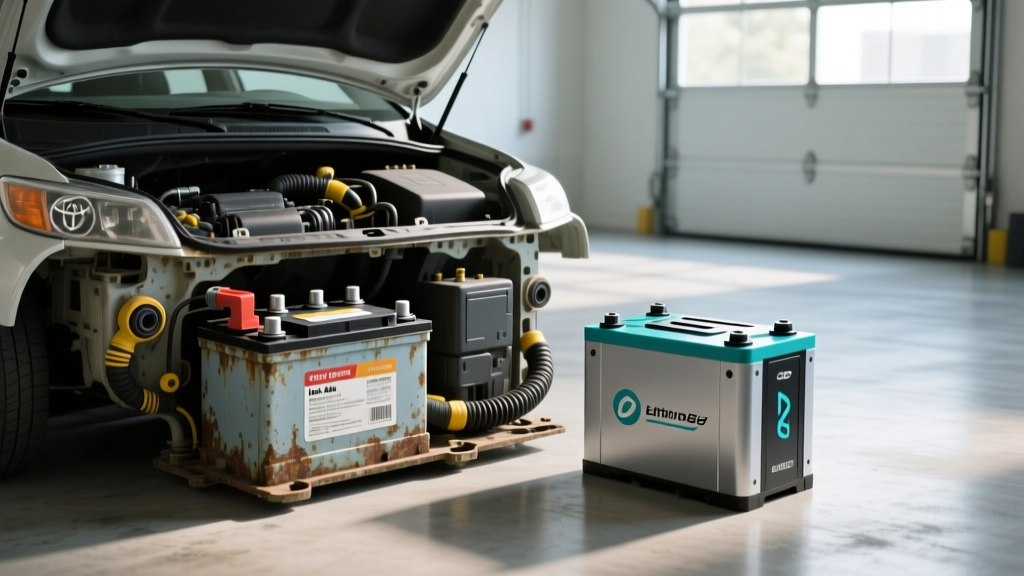
For context on the battery 2011 Toyota Sienna comparison: the 2011 Sienna's conventional 12V lead-acid battery costs roughly $150–$250 to replace, and since the US-market 2011 Sienna was not a hybrid, there is no high-voltage traction battery to service. By contrast, a 2026 Toyota Sienna Hybrid (which uses a 1.9 kWh NiMH hybrid battery) might see that hybrid battery replaced for $2,000–$3,500 after 150,000+ miles — a much smaller pack serving a very different function than a full EV's 60–100+ kWh traction battery.
Factors That Affect EV Battery Lifespan
Battery degradation is influenced by how you charge, drive, and store the vehicle. The following factors have the most measurable impact:
Battery Care Best Practices
- Avoid routine DC fast charging: Occasional road-trip fast charging is fine, but daily use of 150+ kW DC chargers accelerates degradation by generating sustained high temperatures inside cells. Studies from Geotab show vehicles that fast-charge more than 3x per week degrade roughly 1–2% faster over 4 years than those that primarily use Level 2.
- Manage State of Charge (SoC): For NMC/NCA packs, keep daily charging between 20–80%. LFP packs tolerate (and benefit from) regular 100% charges — in fact, Tesla recommends periodic 100% charges for LFP to recalibrate the BMS.
- Minimize extreme-temperature exposure: Parking in shade during summer and using preconditioning (plugging in and warming/cooling the battery before departure) reduces thermal stress. Most 2024+ EVs include active liquid thermal management that runs even when parked.
- Don't store at 100% or 0%: If leaving the vehicle for more than a week, aim for ~50% SoC. Extended storage at full charge or near-empty accelerates calendar aging.
- Use scheduled charging: Set your charger to finish just before you leave rather than completing hours early. This minimizes time spent at high SoC.
How to Check and Monitor Battery Health (SoH)
State of Health (SoH) represents your battery's current maximum capacity as a percentage of its original capacity. A new pack starts at 100% SoH; at 70%, you've hit most manufacturers' warranty-replacement threshold.
Built-in tools: Most 2024–2026 EVs display SoH or estimated range degradation through the vehicle's settings menu or companion app. Tesla's service mode (accessible in the car) shows detailed battery health metrics. Hyundai/Kia's Bluelink/UVO apps include battery-condition reports. Ford's Pass app provides SoC and health status.
OBD-II diagnostics: Third-party tools like OBDLink SX/MX+ paired with apps such as EV Battery Health or LeafSpy (for Nissan) can read cell-level voltage data and calculate SoH. This is especially useful for out-of-warranty vehicles or used-EV purchases where you want independent verification.
Third-party services: Companies like Recurrent offer free battery health reports that compare your pack's degradation to their fleet database of tens of thousands of EVs. Some dealerships will run a full battery diagnostic for $50–$150 — worth requesting before purchasing a used EV.
Emerging Battery Technology: What's Next (and When)
Several next-generation battery technologies are in advanced development, but none are yet available in production vehicles sold in the US market as of 2026:
Solid-state batteries: Toyota, Samsung SDI, and QuantumScape are targeting 2027–2029 production timelines for solid-state cells, which promise 30–50% higher energy density, faster charging (potentially 10–80% in under 10 minutes), and improved safety. However, manufacturing scale-up and cost reduction remain significant hurdles. Expect initial deployment in limited, premium models first.
Silicon-dominant anodes: Companies like Sila Nanotechnologies and Group14 are replacing graphite anodes with silicon-based materials to boost energy density by 15–25%. Some early implementations appeared in 2024–2025 model-year vehicles in limited form. Wider adoption is expected by 2027–2028.
Sodium-ion batteries: CATL and BYD have begun producing sodium-ion packs for budget EVs in China. While less energy-dense than LFP, sodium-ion cells are cheaper and perform well in cold weather. US-market availability is not expected before 2028 at the earliest, and likely in entry-level or fleet vehicles.
These technologies are worth tracking but should not delay a purchase decision. Today's LFP and NMC packs already deliver 200,000+ miles of useful life with proper care — more than enough for the vast majority of owners.
Frequently Asked Questions
How long do EV batteries last in years and miles?
Based on 2025–2026 fleet data, most modern EV batteries retain 80–90% of original capacity after 150,000 miles and 10–12 years. With proper care, reaching 200,000+ miles before dropping below the 70% warranty threshold is common, especially for LFP packs. Complete battery failure before 100,000 miles is rare and typically covered under warranty.
How much does an EV battery cost to replace in 2026?
Out-of-warranty replacement costs range from approximately $6,500 for a ~60 kWh LFP pack to $20,500 for a 100+ kWh pack in a large truck or SUV. Refurbished or remanufactured packs can reduce costs to $4,500–$8,800. Most owners never need a replacement — degradation data shows the majority of packs outlive the vehicle's economic life.
What does the federal EV battery warranty cover?
Federal law requires a minimum 8-year/100,000-mile warranty (10 years/150,000 miles in CARB states) covering defects and capacity loss below a specified threshold — usually 70% of original capacity. This covers the high-voltage traction battery only, not the 12V auxiliary battery. Check your specific manufacturer's terms, as some (like Hyundai and Rivian) exceed the federal minimum.
How do I check my EV's battery State of Health?
Use the vehicle's built-in diagnostics menu or companion app for a basic SoH reading. For more detailed cell-level data, an OBD-II scanner with EV-specific software (OBDLink MX+ with apps like EV Battery Health) provides granular insights. Third-party services like Recurrent offer free comparative battery health reports based on fleet-wide data.
LFP vs NMC — which battery chemistry is better for me?
Choose LFP if you charge at home daily, want maximum cycle life (3,000–5,000+ cycles), don't mind slightly less range, and prefer the convenience of regular 100% charging. Choose NMC/NCA if you need maximum EPA-rated range, frequently drive long highway distances, live in a cold climate where NMC performs better at low temperatures, or are buying a performance/long-range trim. Both chemistries will reliably last 150,000+ miles with proper care.
Did the 2011 Toyota Sienna have a hybrid battery?
No. The US-market 2011 Toyota Sienna was sold exclusively with a 3.5L V6 gasoline engine and a conventional 12V lead-acid battery. Toyota introduced the Sienna Hybrid in the 2021 model year. If you're researching battery replacement for a 2011 Sienna, you're dealing with a standard 12V battery (~$150–$250) — not a high-voltage traction pack.