If you've ever searched for a 2011 Jeep Liberty battery, you were probably dealing with a dead 12-volt lead-acid unit — a $150-$220 Group 34 or Group 75 battery that cranks a 3.7L V6 and typically lasts 3-5 years before sulfation kills it. That's a completely different animal from the high-voltage lithium-ion traction batteries powering today's electric vehicles. But the comparison is actually illuminating: it shows just how far battery technology has come, and what modern EV owners can realistically expect from their packs in terms of longevity, cost, and maintenance.
This guide breaks down everything you need to know about EV battery technology in 2026 — chemistry, degradation data, warranties, replacement economics, and care strategies — while keeping that old Liberty battery as a reference point for how much the automotive world has shifted.
The 2011 Jeep Liberty Battery: A Baseline for Comparison
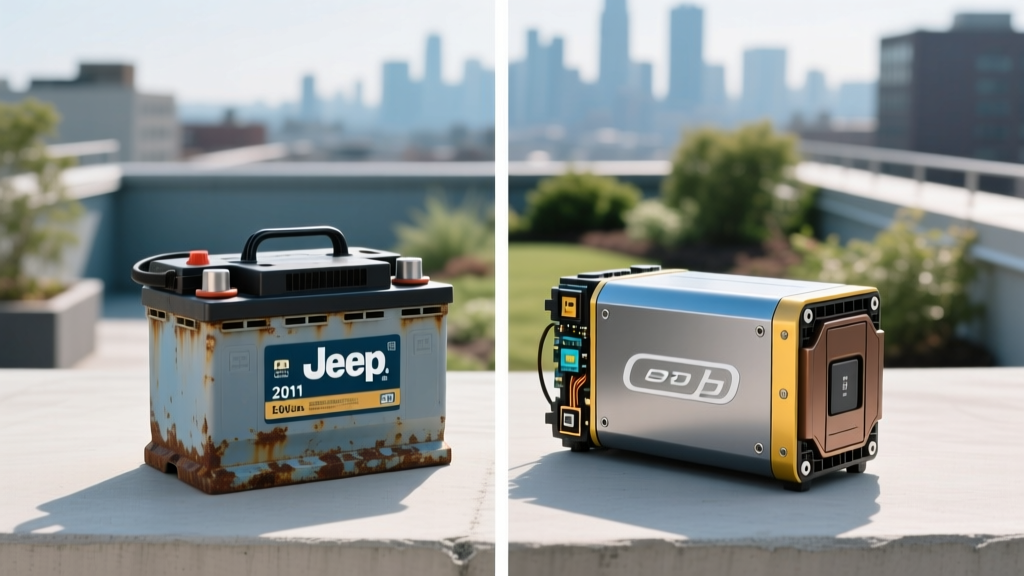
The 2011 Jeep Liberty used a conventional 12V flooded lead-acid or AGM (absorbed glass mat) battery, typically rated at around 600-700 cold cranking amps (CCA). Its job was simple: turn over an internal combustion engine. Here's what ownership looked like:
- Cost: $130-$220 for a replacement at any auto parts store
- Lifespan: 3-5 years in moderate climates; 2-3 years in extreme heat
- Failure mode: Sulfation, plate corrosion, electrolyte loss
- Warranty: Typically 2-3 years free replacement, then prorated
- DIY replacement: 10 minutes with a wrench
That 12V battery is still present in modern EVs — it runs the lights, infotainment, and computers — but the real story is the high-voltage traction battery underneath the floor. That's where the engineering leap happened.
EV Battery Chemistry in 2026: LFP vs. NMC vs. NCA
Modern EV batteries aren't one technology — they're a family of lithium-ion chemistries, each with distinct trade-offs. The two dominant types in 2026 are LFP (lithium iron phosphate) and NMC/NCA (nickel manganese cobalt / nickel cobalt aluminum). Understanding which is in your EV matters for range, longevity, and how you should charge it.
| Attribute | LFP (Lithium Iron Phosphate) | NMC / NCA (Nickel-based) |
|---|---|---|
| Energy Density | ~160-180 Wh/kg (lower) | ~230-280 Wh/kg (higher) |
| Cycle Life | 3,000-5,000+ cycles to 80% SoH | 1,000-2,000 cycles to 80% SoH |
| Cold-Weather Performance | Weaker below 32°F; slower charging | Better cold performance; heat pump helps |
| Thermal Stability | Excellent; very low thermal runaway risk | Good but requires robust BMS management |
| Cost per kWh (2026) | ~$80-$100/kWh at cell level | ~$110-$140/kWh at cell level |
| Charging to 100% | Recommended periodically for cell balancing | Best kept at 80% daily; 100% for trips only |
| Common Applications (2026) | Tesla Model 3 RWD, Model Y RWD, Ford Mustang Mach-E Select, BYD models | Tesla Long Range/Performance, Hyundai Ioniq 5/6, Rivian, GM Ultium vehicles |
| Cobalt Content | Zero cobalt | Contains cobalt (sourcing concerns) |
The short version: LFP wins on longevity and cost but sacrifices some range per pound and cold-weather performance. NMC/NCA wins on energy density (more range in a lighter pack) but degrades faster and costs more. Neither is universally "better" — it depends on your driving pattern.
If you commute 40 miles a day and can charge at home, LFP is arguably the superior daily-driver chemistry: you can charge it to 100% without guilt, and it'll outlast the car. If you regularly road-trip 300+ miles or live in Minnesota, NMC's energy density and cold-weather edge matter more.
How Long Do EV Batteries Actually Last? Degradation Data
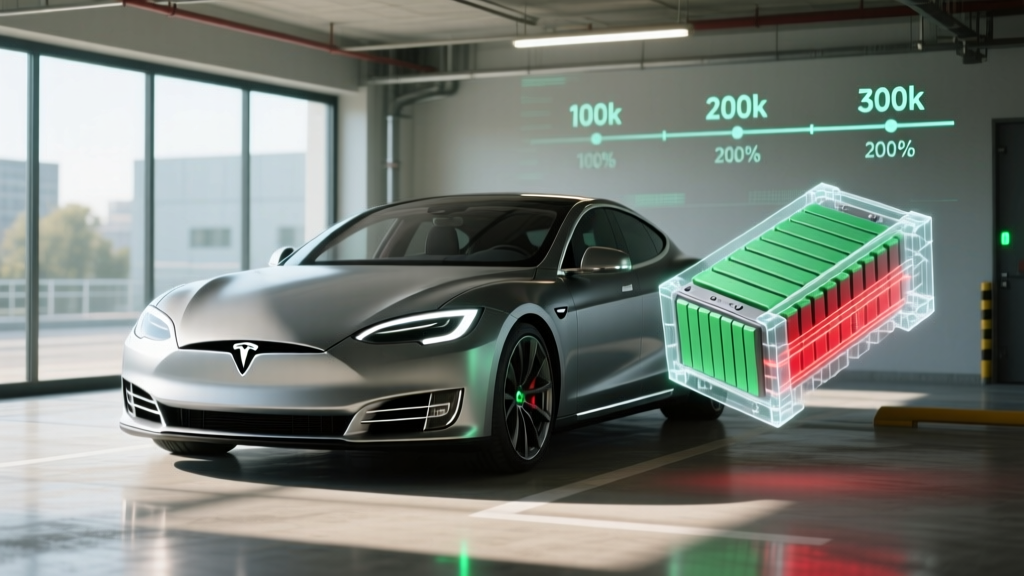
This is the number-one anxiety for EV shoppers, and the data in 2026 is reassuring. Unlike the 2011 Jeep Liberty's 12V battery that you'd swap every few years, modern EV traction batteries are engineered to outlast the vehicle itself in most cases.
Real-World Degradation Benchmarks (aggregated fleet data, 2024-2026):
- Year 1 / 15,000 miles: 1-3% capacity loss (initial formation loss)
- Year 3 / 45,000 miles: 4-7% total loss
- Year 5 / 75,000 miles: 6-10% total loss
- Year 8 / 120,000 miles: 8-14% total loss (most packs still above 85% SoH)
- Year 10 / 150,000 miles: 10-18% total loss (many NMC packs near 80-85% SoH; LFP packs often above 90%)
Sources: Geotab fleet battery health study, Recurrent Auto battery degradation reports, manufacturer warranty data.
To put that in perspective: a Tesla Model 3 Long Range with an EPA-rated 341 miles that loses 12% over 8 years still delivers roughly 300 miles of range. That's more range than most 2026 EVs deliver when new. The degradation curve is also non-linear — the steepest loss happens in year one, then it flattens significantly.
Cold-weather caveat: Range loss in freezing temperatures is temporary, not degradation. An NMC pack might lose 20-30% of its range at 10°F, and LFP can lose 30-40%. This recovers when temperatures rise. A heat pump (standard on most 2026 EVs) reduces this penalty to 10-20%.
Battery Warranties: What's Actually Covered
Federal law mandates a minimum 8-year / 100,000-mile warranty on EV battery packs (emissions-related component rules apply to all 50 states; California and CARB-adopting states extend this to 10 years / 150,000 miles). But the details matter.
| Manufacturer / Model | Warranty Term | Capacity Retention Threshold | Notes |
|---|---|---|---|
| Tesla Model 3/Y (LFP RWD) | 8 yr / 100,000 mi | 70% minimum | LFP degradation rarely triggers this |
| Tesla Model 3/Y (Long Range NMC) | 8 yr / 120,000 mi | 70% minimum | Higher mileage threshold |
| Hyundai Ioniq 5 / Ioniq 6 | 10 yr / 100,000 mi | 70% minimum | Among the longest terms |
| Ford Mustang Mach-E | 8 yr / 100,000 mi | 70% minimum | LFP and NMC variants |
| GM Ultium (Blazer EV, Equinox EV) | 8 yr / 100,000 mi | 70% minimum | Modular pack design aids repairability |
| Rivian R1T / R1S | 8 yr / 175,000 mi | 70% minimum | Best mileage coverage in the segment |
| BMW i4 / iX | 8 yr / 100,000 mi | 70% minimum | Includes battery management diagnostics |
What triggers a warranty claim: The battery must fall below the stated capacity threshold (usually 70% of original capacity) within the term. So a 75 kWh pack would need to drop below ~52.5 kWh of usable capacity. In practice, very few packs hit this — Geotab's data shows less than 1.5% of EVs required warranty battery replacements through year 8.
What's NOT covered: Damage from accidents, improper modifications, or using non-approved charging equipment. Gradual capacity loss above the threshold (say, dropping to 75% over 8 years) is considered normal wear and isn't warrantable.
EV Battery Replacement Cost: The Numbers
This is where the fear-mongering lives, so let's anchor it in real 2026 data. Yes, an out-of-warranty EV battery replacement is expensive — but context matters enormously.
| Vehicle / Pack Size | Full Pack Replacement | Module-Level Repair | Typical Need Timeline |
|---|---|---|---|
| Tesla Model 3 RWD (60 kWh LFP) | $10,000-$13,000 | $2,500-$4,500 per module | Rarely needed before 200,000+ mi |
| Tesla Model Y LR (82 kWh NMC) | $14,000-$18,000 | $3,000-$5,500 per module | Rarely needed before 150,000+ mi |
| Hyundai Ioniq 5 (77.4 kWh NMC) | $13,000-$16,000 | $2,800-$5,000 per module | Rarely needed before 150,000+ mi |
| Ford F-150 Lightning Ext. Range (131 kWh NMC) | $22,000-$30,000 | $4,000-$7,000 per module | Rarely needed before 150,000+ mi |
| Chevrolet Equinox EV (85 kWh NMC) | $12,000-$15,000 | $3,000-$5,000 per module | Rarely needed before 150,000+ mi |
| Rivian R1T (149 kWh Max Pack) | $25,000-$35,000 | $4,500-$8,000 per module | Rarely needed before 175,000+ mi |
Key context that changes the calculus:
- Most EVs never need a full battery replacement. The vast majority of packs outlive the vehicle's useful economic life. The average age of a scrapped car in the US is ~12 years with ~150,000 miles — most EV packs are still above 80% SoH at that point.
- Module-level repair is increasingly standard. GM's Ultium platform, Hyundai's E-GMP, and newer Tesla packs allow technicians to replace individual modules rather than the entire pack. A single failed module might cost $3,000-$5,000 instead of $15,000+.
- Cell prices continue falling. BloombergNEF reports lithium-ion cell prices dropped from ~$1,200/kWh in 2010 to roughly $95-$110/kWh in 2026. A replacement pack in 2032 will cost substantially less than today.
- Compare it to ICE maintenance: A 2011 Jeep Liberty's transmission replacement ran $3,000-$5,000. An engine rebuild could hit $4,000-$7,000. Over 150,000 miles, a gas vehicle's cumulative powertrain maintenance often approaches or exceeds EV battery replacement cost — and you're paying it in smaller chunks.
What Kills an EV Battery Early? Factors That Accelerate Degradation
Your driving and charging habits directly impact how quickly your battery loses capacity. Here's what the data shows, ranked by impact:
Habits That Preserve Battery Health
- ✅ Daily charge limit: 80% for NMC/NCA packs (LFP can be charged to 100% regularly — this actually helps cell balancing)
- ✅ Home Level 2 charging (7-11 kW) as your primary method — slower charging generates less heat
- ✅ Precondition the battery before DC fast charging (most EVs do this automatically when you navigate to a charger)
- ✅ Park in shade or a garage during summer — sustained high ambient heat accelerates calendar aging
- ✅ Keep SoC between 20-80% for daily NMC use; avoid leaving the car at 100% for days
- ✅ Use regenerative braking on moderate settings — extreme regen in cold weather can stress the pack
Habits That Accelerate Degradation
- ❌ Exclusive DC fast charging: Daily 150+ kW charging adds ~2-4% more degradation over 5 years vs. primarily Level 2 charging. It's not catastrophic, but it accumulates.
- ❌ Regularly draining to 0%: Deep discharge cycles stress lithium-ion chemistry. Try not to drop below 10%.
- ❌ Storing at 100% SoC in heat: A full battery at 100°F is the worst-case scenario for calendar aging. If storing for weeks, leave it at 50-60%.
- ❌ Ignoring thermal management: EVs with active liquid cooling (most 2026 models) handle heat far better than older air-cooled packs (early Nissan Leaf). This is why modern degradation is so much lower.
The DC fast charging nuance: Occasional road-trip fast charging is perfectly fine. The concern is using 350 kW chargers as your daily charging method. If you can charge at home on Level 2 overnight, do that — and save the Superchargers and Electrify America stops for road trips. Your battery will thank you with an extra 2-3% of capacity over a decade.
How to Check Your EV's Battery Health (State of Health)
State of Health (SoH) is the metric that tells you how much capacity your battery retains compared to when it was new. A brand-new pack is 100% SoH; a pack that holds 90% of its original energy is at 90% SoH. Here's how to monitor it in 2026:
Built-In Vehicle Tools
- Tesla: The service menu (hold the model badge on the About screen for 3 seconds) shows battery health percentage. The Tesla app also logs estimated range at full charge, which you can track over time.
- Hyundai/Kia: The EV settings menu includes a battery health indicator. The Bluelink/Uvo connected app provides SoH estimates.
- GM Ultium vehicles: The myChevrolet/myCadillac app includes a battery health status. OnStar diagnostics can pull detailed SoH data.
- Ford: The FordPass app shows battery health status, and the in-car diagnostics menu provides capacity estimates.
Third-Party and OBD-II Tools
- OBD-II dongles + apps: Tools like OBDeleven, Leaf Spy (for Nissan), or Scan My Tesla can read detailed battery management system (BMS) data including individual cell voltages, pack SoH, and cycle counts.
- Recurrent Auto: A free service that connects to your EV's telematics and provides battery health reports, range tracking, and comparisons to similar vehicles in their fleet.
- Dealer diagnostics: Any authorized service center can pull a full BMS report. Ask for a "battery health report" during routine service visits.
When to be concerned: If your SoH drops below 85% in the first 5 years or 60,000 miles, that's faster than typical degradation curves and worth a dealer visit. If it's approaching 70% within the warranty period, you likely qualify for a warranty replacement or module repair.
Beyond Lithium-Ion: Solid-State and Silicon Anode Batteries
The next frontier in EV battery technology is real — but it's not here yet. Here's an honest timeline based on 2026 industry status:
Silicon Anode Batteries (near-term, 2026-2028):
- Replacing graphite anodes with silicon increases energy density by 20-40%
- Sila Nanotechnologies and Group14 Technologies are supplying early production cells
- Expected in limited 2027-2028 model-year vehicles; Porsche has announced silicon-anode cells for future Taycan variants
- Trade-off: silicon expands significantly during charging, requiring new binder materials — this is largely solved in lab settings but manufacturing scale-up is ongoing
Solid-State Batteries (medium-term, 2028-2032):
- Replace liquid electrolyte with a solid ceramic, polymer, or sulfide conductor
- Promised benefits: 2x energy density, 10-minute fast charging, improved safety (no flammable electrolyte), 5,000+ cycle life
- Toyota has announced solid-state prototypes targeting 2027-2028 production, but in very limited volumes
- Samsung SDI, QuantumScape, and Solid Power are in pilot production phases
- Mass-market availability at competitive pricing is realistically a 2030+ proposition
- Bottom line: If you're buying an EV in 2026-2028, you'll be buying lithium-ion. Solid-state is promising but not a reason to delay a purchase — today's batteries are already good enough for most owners.
Sources: US Department of Energy vehicle lifespan data, BloombergNEF battery price survey, IRS §30D clean vehicle credit rules.
Frequently Asked Questions
How long do EV batteries last in years and miles?
Based on 2026 fleet data, most modern liquid-cooled EV batteries retain 80-90% of their original capacity at 150,000 miles and 10 years. LFP chemistry packs often exceed 90% SoH at that point. Many packs will outlast the vehicle's body and interior. The 2011 Jeep Liberty's 12V battery lasted 3-5 years — an EV traction battery is engineered for 15-20 years of service.
How much does it cost to replace an EV battery?
Full pack replacement ranges from roughly $10,000 for a 60 kWh LFP pack (Tesla Model 3 RWD) to $30,000+ for a 149 kWh pack (Rivian Max Pack). However, module-level repairs cost $2,500-$8,000, and the vast majority of EVs never need a replacement because the pack outlives the car. Cell prices are also falling ~10-15% annually, so future replacements will cost less.
What does the EV battery warranty actually cover?
Federal law requires a minimum 8-year / 100,000-mile warranty (10 years / 150,000 miles in CARB states). The warranty covers capacity loss below a threshold — typically 70% of original capacity. If your 75 kWh pack drops below ~52.5 kWh within the warranty term, the manufacturer must repair or replace it. Normal gradual degradation above 70% is not covered.
How do I check my EV battery's health?
Most 2026 EVs include battery health indicators in their infotainment system or companion app. For more detailed data, OBD-II tools like Scan My Tesla or OBDeleven can read BMS data including SoH percentage, cell voltages, and cycle counts. Services like Recurrent Auto offer free battery health tracking via connected-car telematics.
Is LFP or NMC better for daily driving?
For daily commuting with home charging, LFP is generally superior: it tolerates 100% daily charging, lasts 3,000-5,000+ cycles (vs. 1,000-2,000 for NMC), costs less, and contains no cobalt. NMC is better if you need maximum range for frequent long trips or live in very cold climates where its energy density and cold-weather performance matter more. Neither is "better" universally — it depends on your use case.
Does the 2011 Jeep Liberty have anything in common with modern EV batteries?
Only the 12V auxiliary battery, which is still a lead-acid or AGM unit in most 2026 EVs. It runs the 12V electronics (lights, computers, door locks) and is separate from the 400V-800V traction battery that powers the wheels. The Liberty's 12V Group 34/75 battery is the same technology you'd find in a Tesla's 12V system — but the traction battery underneath an EV is a fundamentally different, far more advanced piece of engineering.