Why a 2011 Chevy Traverse Battery Search Lands on an EV Tech Site
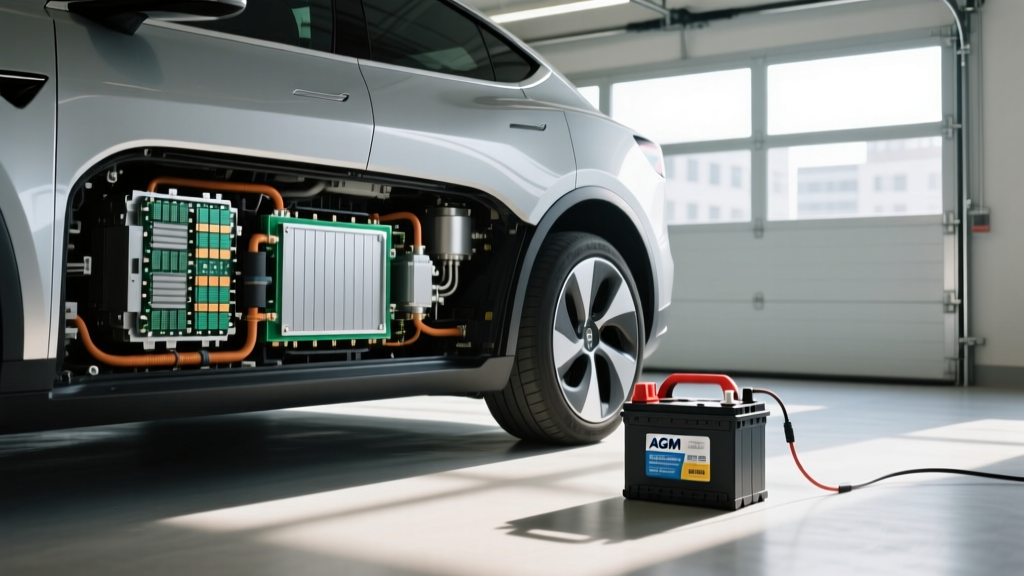
If you've been searching for a battery for a 2011 Chevy Traverse, you're almost certainly dealing with a conventional 12V lead-acid or AGM starter battery — a $150–$280 part you swap every 3–5 years at an auto parts store. The Traverse is a gasoline-only midsize SUV with no high-voltage traction pack. But that search query surfaces a question every electrified-vehicle shopper eventually asks: how different is an EV's main battery, and what happens when it ages?
The gap is enormous. A 2011 Traverse's 12V battery delivers a few seconds of cranking amps to start a 3.6L V6. An electric vehicle's traction battery stores 60–120+ kWh of energy, powers a 200–600+ hp drivetrain, and is engineered to last the life of the vehicle. Understanding that difference — and the chemistry, degradation curves, warranties, and replacement economics behind modern EV packs — is essential before you commit $35,000–$90,000 to an electrified purchase in 2026.
This guide covers the real numbers: how long EV batteries actually last, what warranties protect, how much replacements cost if you ever need one, and whether LFP or NMC chemistry is the better fit for your driving pattern.
12V Auxiliary vs. High-Voltage Traction Battery: Know the Difference
Before we get into EV-specific battery tech, let's clear up the most common confusion — the same one that sends Traverse owners down the wrong search path.
| Attribute | 12V Auxiliary Battery (Gas or EV) | High-Voltage Traction Battery (EV Only) |
|---|---|---|
| Voltage | 12V nominal | 350V–800V nominal |
| Capacity | ~0.5–1.0 kWh | 60–120+ kWh usable |
| Chemistry | Lead-acid or AGM (some EVs use 12V LFP) | NMC, NCA, or LFP lithium-ion |
| Purpose | Starts engine (gas) / runs accessories & ECU (EV) | Powers the electric drivetrain |
| Typical lifespan | 3–6 years | 15–20+ years / 150,000–300,000+ mi |
| Replacement cost (2026) | $150–$400 | $5,000–$22,000+ depending on pack size |
| Warranty | 1–3 years prorated | 8 years / 100,000 mi minimum (federal mandate) |
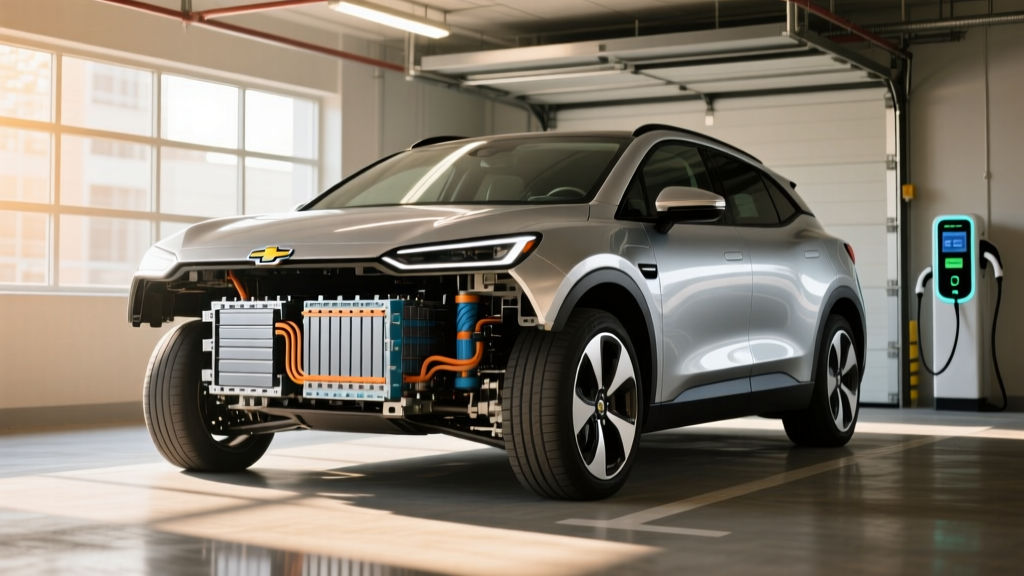
Every EV on the road in 2026 — from the Chevrolet Equinox EV to the Tesla Model Y to the Hyundai Ioniq 5 — still carries a 12V auxiliary battery (or increasingly, a small 12V lithium module) to run lights, infotainment, door locks, and control computers. If your EV won't "start" or the screens stay dark, the 12V battery is usually the culprit, not the main pack. But the traction battery is the component that defines the car's range, performance, and long-term value.
EV Battery Chemistry in 2026: LFP vs. NMC vs. NCA
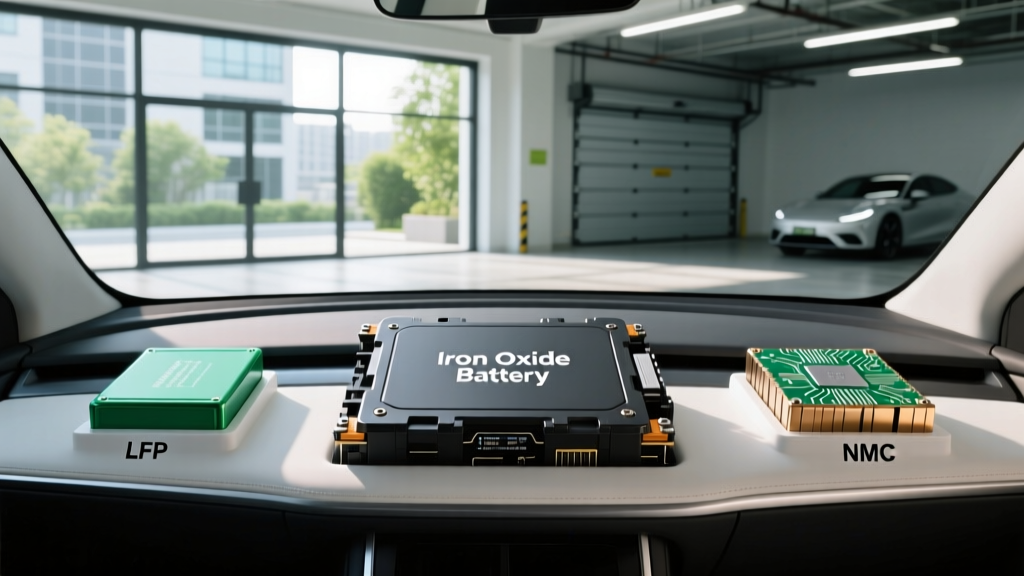
Not all lithium-ion batteries are the same. The cathode chemistry determines energy density, lifespan, cold-weather behavior, and cost. In 2026, three chemistries dominate the US EV market:
- NMC (Nickel Manganese Cobalt) — Used in most Hyundai/Kia, GM Ultium, BMW, Mercedes, and many Tesla Model 3/Y Long Range packs. High energy density, good cold performance.
- NCA (Nickel Cobalt Aluminum) — Primarily Tesla and Panasonic cells. Similar profile to NMC with slightly higher energy density.
- LFP (Lithium Iron Phosphate) — Standard-range Tesla Model 3/Y, Ford Mustang Mach-E Select, many Chinese-market vehicles entering global fleets. Lower energy density but significantly longer cycle life and no cobalt.
| Factor | LFP (Lithium Iron Phosphate) | NMC / NCA |
|---|---|---|
| Energy density | ~160–180 Wh/kg (lower) | ~220–300 Wh/kg (higher) |
| Cycle life (to 80% capacity) | 3,000–6,000+ cycles | 1,000–2,500 cycles |
| Cold-weather range loss | Greater (~35–45% at 20°F) | Moderate (~25–35% at 20°F) |
| Cost per kWh (2026) | ~$80–$100 | ~$110–$140 |
| Charging to 100% regularly | Recommended (helps BMS calibration) | Not recommended (80% daily preferred) |
| Cobalt / ethical sourcing | Cobalt-free | Contains cobalt & nickel |
| Typical use case | Daily commuters, standard-range models, fleet/ride-share | Long-range, performance, cold-climate drivers |
Which is better? Neither is universally superior. If you drive 40–80 miles daily in a temperate climate and want maximum battery longevity with lower upfront cost, LFP is the pragmatic pick. If you need 300+ miles of range, regularly drive in sub-freezing temperatures, or tow, NMC/NCA's energy density advantage matters. According to fueleconomy.gov, a 2026 Tesla Model 3 RWD (LFP, ~60 kWh) delivers 272 miles EPA, while the Long Range AWD (NMC, ~75 kWh) reaches 341 miles — a gap driven largely by chemistry-enabled energy density.
How Long Do EV Batteries Actually Last? Real Degradation Data
The short answer: far longer than most buyers fear. Most modern EV traction batteries will outlast the vehicle's body, interior, and suspension components.
Typical Degradation Curve (Based on Fleet Data, 2018–2025 Model Years):
- Year 1 / ~12,000 mi: 1–3% capacity loss (initial settling)
- Year 3 / ~36,000 mi: 4–7% total loss
- Year 5 / ~60,000 mi: 6–10% total loss
- Year 8 / ~100,000 mi: 8–14% total loss (still above warranty threshold)
- Year 12 / ~150,000 mi: 12–20% total loss (varies heavily by chemistry & usage)
- Year 15+ / ~200,000+ mi: 15–25% total loss — many packs still functional at 75–85% capacity
These figures align with large-scale fleet data. Geotab's longitudinal study of over 10,000 EVs found an average annual degradation rate of roughly 1.8% across all chemistries, with LFP packs degrading more slowly in later years. Tesla's 2025 Impact Report noted that Model 3/Y batteries retained approximately 85% of original capacity at 150,000 miles. A 2026 Hyundai Ioniq 5 with its 77.4 kWh NMC pack, driven 12,000 miles annually, can reasonably expect to retain ~88–92% capacity at the 5-year mark based on current fleet telemetry.
What kills batteries early? The data points to three accelerants: sustained operation at 100% state of charge in hot climates, exclusive reliance on DC fast charging (350 kW sessions generate significant thermal stress), and repeated deep discharges below 10%. Avoid those patterns and degradation stays on the gentle end of the curve.
EV Battery Warranty Terms: What's Actually Covered
Federal law mandates a minimum warranty of 8 years / 100,000 miles on EV traction batteries (10 years / 150,000 miles in California and states that follow CARB standards). But the details matter — particularly the capacity-retention threshold.
| Manufacturer (2026 Models) | Warranty Period | Capacity Threshold | Notes |
|---|---|---|---|
| Tesla (Model 3/Y RWD — LFP) | 8 yr / 100,000 mi | 70% retention | Covers defects + capacity below threshold |
| Tesla (Model 3/Y LR — NMC) | 8 yr / 120,000 mi | 70% retention | Higher mileage threshold on LR/AWD |
| Hyundai / Kia (E-GMP) | 10 yr / 100,000 mi | 70% retention | Among the longest periods in the industry |
| GM (Ultium — Equinox EV, Blazer EV, Silverado EV) | 8 yr / 100,000 mi | 70% retention (60% on some commercial) | Varies by model; check specific window sticker |
| Ford (Mach-E, F-150 Lightning) | 8 yr / 100,000 mi | 70% retention | Covers battery components + capacity loss |
| Rivian (R1T, R1S) | 8 yr / 120,000 mi | 70% retention | Transferable to second owner |
| BMW (i4, iX, i7) | 8 yr / 100,000 mi | 70% retention | Includes thermal management system |
Critical nuance: The warranty covers the battery dropping below the threshold (e.g., 70% of original capacity). A pack at 72% capacity at 95,000 miles is not a warranty claim — even though you've lost 28% of your range. In practice, very few packs breach the 70% line within the warranty window under normal use. According to data cited by the National Highway Traffic Safety Administration (NHTSA), battery-related warranty claims remain well below 2% across major manufacturers.
EV Battery Replacement Cost: What It Takes and When You'd Need It
Replacement cost is the number-one fear among EV-curious buyers — and the most frequently exaggerated figure in automotive media. Here's what 2026 pricing actually looks like:
| Battery Size / Vehicle Class | Estimated Replacement Cost (Parts + Labor) | When Typically Needed |
|---|---|---|
| ~60 kWh (Tesla Model 3 RWD, Chevy Equinox EV 2LT) | $8,000–$12,000 | Rarely before 200,000+ mi |
| ~75–85 kWh (Tesla Model Y LR, Hyundai Ioniq 5, Ford Mach-E Extended Range) | $12,000–$16,000 | Rarely before 180,000+ mi |
| ~100 kWh (Tesla Model S/X, BMW iX, Rivian R1T Max Pack) | $16,000–$22,000+ | Rarely before 150,000+ mi |
| ~130+ kWh (GMC Hummer EV, Silverado EV Max Range) | $20,000–$28,000+ | Extremely rare; few packs in service this long |
Context matters enormously here. First, most EV owners never replace the traction battery. The vehicle is typically sold, traded, or retired for other mechanical reasons before the pack reaches end-of-life. Second, prices have declined roughly 8–12% annually over the past five years as cell manufacturing scales and refurbishment networks mature. Third, module-level repair is increasingly available: a single degraded module within a pack can sometimes be replaced for $1,500–$4,000 rather than swapping the entire assembly.
Compare this to the 2011 Chevy Traverse scenario: over 15 years and 180,000 miles, that Traverse will likely consume 4–5 replacement 12V batteries ($600–$1,200 total), plus thousands in transmission, timing-chain, and fuel-system repairs the EV simply doesn't have. The EV battery replacement fear, while not zero, is frequently the wrong risk to optimize around.
Maximizing Battery Health: A Practical Care Checklist
For NMC/NCA Packs:
- Set daily charge limit to 80% — use the vehicle's built-in charge-limit setting
- Charge to 100% only when departing on a road trip; don't let it sit at 100% for days
- Avoid DC fast charging as your primary routine — Level 2 overnight charging at 7–11.5 kW is gentler
- Precondition the battery before fast charging (most EVs do this automatically when you navigate to a charger)
- In extreme heat, avoid repeated wide-open-throttle launches — thermal stress accumulates
- Don't routinely drain below 10–15%; charge when you can
For LFP Packs:
- Charge to 100% at least once per week — LFP's flat voltage curve requires full-charge calibration for accurate range estimation
- Otherwise, same moderate-use principles apply — avoid extreme heat and constant fast charging
- LFP tolerates high SoC better than NMC, so daily 100% is acceptable if your routine demands it
For All EVs — Cold Weather:
- Precondition while plugged in before departure — this warms the battery using grid power, not pack energy
- Expect 25–40% range reduction at 20°F; plan charging stops accordingly
- Garage parking, even unheated, reduces cold-soak degradation over winter months
Monitoring Battery Health: How to Check State of Health (SoH)
State of Health (SoH) is the percentage of original capacity your battery currently retains. A new pack is 100% SoH; a pack that held 75 kWh when new and now holds 67.5 kWh is at 90% SoH.
How to check it in 2026:
- In-vehicle menus: Many 2024+ EVs (Hyundai, Kia, BMW, Rivian, updated Tesla software) display SoH or a battery-health bar directly in the settings or service menu.
- OBD-II diagnostic tools: Devices like the OBDeleven, Carly, or dedicated EV scanners (e.g., from Autel or Foxwell) can read the BMS-reported SoH via the OBD-II port. Cost: $40–$200 for the tool.
- Manufacturer service centers: Any dealer or authorized service center can pull a full battery health report. Some offer this free during routine service visits.
- Third-party apps: Apps like Tessie (Tesla), Leaf Spy (Nissan), and ABRP's battery-health integrations can estimate SoH from driving and charging data logs.
- Manual calculation: Charge to 100%, note the displayed range, and compare to the original EPA figure adjusted for the pack's usable kWh. Less precise, but free and directionally accurate.
For buyers evaluating a used EV, a SoH reading is as critical as a compression test on a gas engine. Insist on seeing it before purchase. A 2022 Model Y at 45,000 miles showing 94% SoH is an excellent sign; one at 84% SoH warrants investigation into prior fast-charging habits or thermal events.
Emerging Battery Tech: Solid-State, Silicon Anodes, and What's Real
Headlines promise revolutionary batteries every year. Here's what's actually on the near-term horizon versus what remains in the lab:
Silicon-dominant anodes (2025–2027 production): Companies like Sila Nanotechnologies and Group14 are shipping silicon-composite anode materials to manufacturers including Mercedes-Benz and Panasonic. These increase energy density by 15–25% over graphite anodes and enable faster charging. You'll see them in select 2026–2028 models. This is real and shipping — but incremental, not transformational.
Semi-solid-state batteries (2026–2028 limited production): NIO (China) has deployed a 150 kWh semi-solid pack in the ET7 sedan with over 600 miles of CLTC range. Toyota has announced a 2027–2028 timeline for a solid-state pilot in limited-production vehicles. These cells offer higher energy density and potentially faster charging but face manufacturing-cost barriers that will keep them in premium/low-volume applications for years.
Full solid-state batteries (2029–2032+ realistic mass production): The technology works in labs and pilot lines. Scaling to millions of cells per year at competitive cost remains the unsolved challenge. Samsung SDI, Toyota, QuantumScape, and Solid Power are all targeting 2028–2030 initial production, but volume availability for mainstream $35,000–$50,000 EVs is realistically a 2030s proposition.
Sodium-ion batteries (2025–2027 entry): CATL and BYD have begun producing sodium-ion cells for low-cost, short-range EVs and energy storage. Lower energy density than LFP but cheaper and cobalt/nickel-free. Likely to appear in US-market budget EVs and PHEVs by 2028.
The honest takeaway: today's NMC and LFP lithium-ion packs are mature, well-understood, and backed by extensive warranty coverage. Waiting for solid-state to buy an EV is like waiting for a 400-MPG gas car to buy a Prius — the improvement will be real, but the current technology already solves the problem for most drivers.
Frequently Asked Questions
How long do EV batteries last in years and miles?
Based on fleet data through 2025, most modern EV traction batteries retain 80–88% of original capacity at 150,000 miles and 10–12 years. With proper care (moderate charging habits, Level 2 primary charging, thermal preconditioning), reaching 200,000+ miles with 75–85% capacity remaining is common. LFP packs often exceed 300,000 miles in fleet and ride-share applications before approaching the 70% warranty threshold.
How much does an EV battery cost to replace in 2026?
Full pack replacement ranges from approximately $8,000 for a ~60 kWh standard-range pack to $22,000+ for a 100+ kWh long-range pack, including labor. Module-level repairs, when available, cost $1,500–$4,000. Prices have been declining 8–12% annually. Most owners never need a replacement — the vehicle is retired for other reasons first.
What does the federal EV battery warranty actually cover?
US federal law requires a minimum of 8 years / 100,000 miles of coverage on EV traction batteries. This covers manufacturing defects and capacity loss below a stated threshold — typically 70% of original capacity. It does not cover damage from accidents, flooding, or unauthorized modifications. California and CARB-adopting states require 10 years / 150,000 miles. Always check your specific vehicle's warranty booklet for exact terms.
How do I check my EV battery's health before buying used?
Request a State of Health (SoH) reading from the seller or a dealer service department. Many 2024+ EVs display this in-vehicle. Third-party OBD-II tools ($40–$200) can also read SoH. Compare the current maximum range at 100% charge to the original EPA rating. A SoH above 90% on a 2–4-year-old EV is normal and healthy.
LFP vs NMC: which battery chemistry should I choose?
Choose LFP if you want maximum cycle life (3,000–6,000+ cycles), lower cost, cobalt-free sourcing, and your daily driving is under 200 miles in moderate climates. Choose NMC/NCA if you need 300+ miles of range, frequently drive in freezing temperatures, tow trailers, or take regular road trips where energy density matters. Neither is "better" — they optimize for different use cases.
Does fast charging really damage the battery?
Exclusive reliance on DC fast charging (150–350 kW) accelerates degradation by generating sustained heat and lithium-plating stress. Occasional fast charging on road trips has minimal impact. The data shows that EVs charged primarily on Level 2 (7–11.5 kW AC) degrade 2–5% less over 100,000 miles compared to those fast-charged daily. Preconditioning the battery before a fast-charge session significantly reduces thermal stress.
Is a 2011 Chevy Traverse battery the same as an EV battery?
No. The 2011 Chevy Traverse uses a conventional Group 48 or Group H7 12V lead-acid/AGM battery for engine starting and accessory power — a $150–$280 part available at any auto parts store. It has no high-voltage traction battery. The comparison is useful context: a $200 battery every 4 years versus a $12,000+ EV pack that likely never needs replacing. Different systems, different economics.