Why the 2011 Cadillac SRX Battery Keyword Keeps Pulling EV Shoppers In
If you've landed here searching for a 2011 Cadillac SRX battery, you likely own or service this mid-size luxury crossover and are facing a replacement decision. The 2011 SRX shipped with a conventional 12-volt lead-acid battery (Group 48/H6, roughly 70 Ah) that powers the starter, infotainment, and accessories — not an electrified traction pack. Cadillac never offered a hybrid or plug-in variant of the first-generation SRX (2010–2016), so there is no high-voltage battery to discuss for that specific vehicle.
But that search query has become an accidental gateway into the electric-vehicle world. Owners researching a replacement battery for an aging SRX often end up comparing the total cost of keeping a 15-year-old gasoline crossover alive versus stepping into a modern EV or PHEV. This guide serves both needs: we'll clarify what the 2011 SRX actually requires, then deliver a full EV traction-battery primer so you can make an informed decision whether you're replacing a $200 lead-acid cell or evaluating a $10,000+ high-voltage pack in a battery-electric vehicle.
What Battery Does a 2011 Cadillac SRX Actually Use?
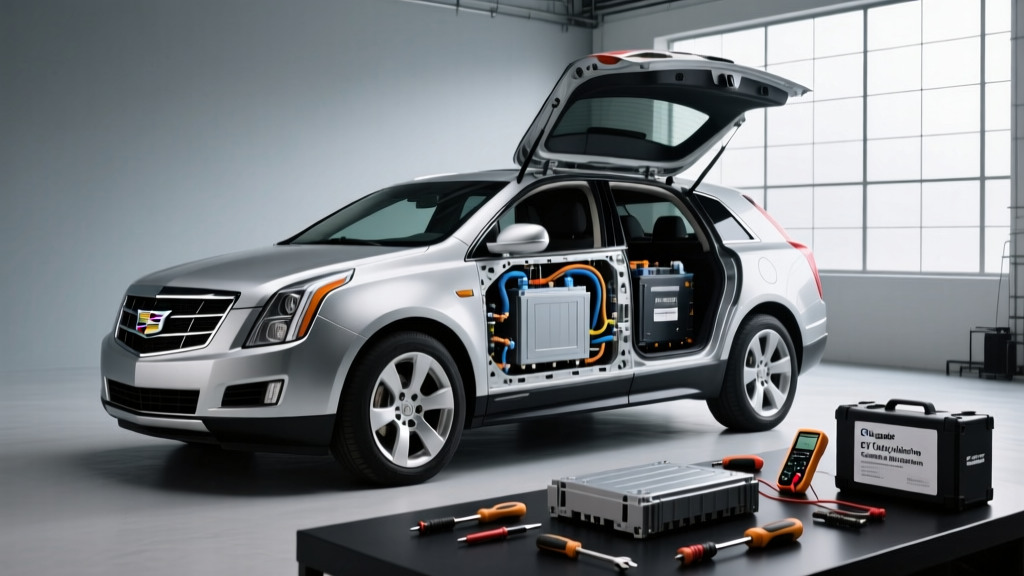
The 2011 SRX, equipped with either the 2.8L turbocharged V6 or the 3.0L direct-injection V6, relies on a single 12V flooded or AGM (absorbent glass mat) battery. Typical replacement cost runs $180–$320 installed at a dealer or parts store. The alternator keeps it charged; there is no regenerative braking, no DC-DC converter feeding a traction system, and no state-of-charge app to monitor. It's a conventional automotive electrical system.
If your SRX is showing slow cranks, dimming headlights, or a "Service Battery" message, the fix is straightforward: load-test the 12V battery, check the alternator output (should be 13.8–14.4V at idle), and replace the battery if it fails. This is entirely separate from the EV traction-battery conversation that follows.
EV Traction Batteries: LFP vs NMC Chemistry Explained
When you move from a 2011 SRX to a modern battery-electric vehicle, the high-voltage traction battery becomes the single most expensive and consequential component. Two dominant lithium-ion chemistries define today's market: LFP (lithium iron phosphate) and NMC/NCA (nickel manganese cobalt / nickel cobalt aluminum). Understanding the trade-offs is essential before you buy.
| Attribute | LFP (LiFePO₄) | NMC / NCA |
|---|---|---|
| Energy Density | ~160–180 Wh/kg (lower) | ~230–300 Wh/kg (higher) |
| Typical Cycle Life | 3,000–5,000+ cycles | 1,000–2,500 cycles |
| Cold-Weather Performance | Moderate loss; slower charging below 32°F | Better low-temp discharge; preconditioned charging |
| Cost per kWh (pack level) | ~$85–$110 | ~$120–$155 |
| Thermal Stability / Safety | Excellent; higher thermal runaway threshold | Good; requires more active thermal management |
| Recommended Daily SoC | 100% is fine (no calendar-degradation penalty) | 80% daily; 100% for trips only |
| Notable 2026 Applications | Tesla Model 3 RWD, Ford Mustang Mach-E Select (LFP trims), BYD Seal, Rivian Standard | Hyundai Ioniq 5 Long Range, Tesla Model S/X, BMW iX, Chevy Silverado EV |
Which is better? Neither is universally superior — it depends on your use case. If you want maximum range per charge, tow frequently, or live in extreme cold, NMC/NCA packs deliver higher energy density and better cold-weather discharge. If you plan to keep the vehicle 10+ years, charge at home nightly to 100%, and want the lowest degradation over time, LFP is the durability champion. Tesla's own data shows LFP packs in Model 3 RWD sedans retaining roughly 92–95% capacity after 100,000 miles, while NMC packs in Long Range variants typically retain 88–92% over the same distance.
How Long Do EV Batteries Actually Last? Real Degradation Data
The most common fear among prospective EV buyers is that the battery will "die" like a smartphone after two years. Real-world fleet data tells a different story. According to analysis published by Recurrent Auto and corroborated by Tesla's 2025 Impact Report, the average EV battery loses roughly 5–10% of its original capacity over the first 100,000 miles, with the steepest drop occurring in the first 20,000–30,000 miles before the curve flattens significantly.
Typical EV Battery Degradation Curve (NMC, liquid-cooled):
- Year 1 / 15,000 mi: ~3–5% loss (initial formation loss)
- Year 3 / 45,000 mi: ~6–8% total loss
- Year 5 / 75,000 mi: ~8–10% total loss
- Year 8 / 120,000 mi: ~10–14% total loss
- Year 10 / 150,000 mi: ~12–18% total loss (most packs still above warranty threshold)
LFP packs tend to run 2–4 percentage points better on this scale due to the chemistry's inherent cycle-life advantage. Catastrophic failure (sudden inability to hold charge) remains rare — well under 1% of packs in major fleets according to Geotab's fleet study of over 10,000 EVs.
So how long do EV batteries last in practical terms? Most modern liquid-cooled packs are engineered to outlast the vehicle's economic life. A 2026 Hyundai Ioniq 5 with its 77.4 kWh NMC pack, for example, should retain roughly 85% of its original 303-mile EPA range at 150,000 miles — still delivering over 250 usable miles per charge. The vehicle will likely be retired for other reasons before the battery becomes unusable.
Battery Warranty Terms: What's Covered and What Isn't
Federal law in the United States mandates that EV batteries carry a minimum warranty of 8 years or 100,000 miles (whichever comes first). In California Air Resources Board (CARB) states — which include California, New York, Massachusetts, Colorado, and several others — the mandate extends to 10 years or 150,000 miles. Most automakers meet or exceed these minimums.
| Vehicle | Warranty Term | Capacity Retention Threshold | Chemistry |
|---|---|---|---|
| Tesla Model 3 RWD | 8 yr / 100,000 mi | 70% of original capacity | LFP |
| Tesla Model Y Long Range | 8 yr / 120,000 mi | 70% of original capacity | NMC |
| Hyundai Ioniq 5 | 10 yr / 100,000 mi | 70% of original capacity | NMC |
| Ford F-150 Lightning | 8 yr / 100,000 mi | 70% of original capacity | NMC (Extended Range) |
| Chevrolet Equinox EV | 8 yr / 100,000 mi | 60% of original capacity (GM Ultium) | NMC |
| BMW iX xDrive50 | 8 yr / 100,000 mi | 70% of original capacity | NMC |
| Rivian R1S (Standard) | 8 yr / 175,000 mi | 70% of original capacity | LFP |
What does the battery warranty cover? These warranties protect against capacity loss below the stated threshold (typically 70%) and defects in materials or workmanship. They do not cover damage from collisions, flooding, improper charging equipment, or modifications. If your pack drops below 70% State of Health within the warranty window, the manufacturer will repair or replace it — often with a refurbished unit of equivalent capacity, not necessarily a brand-new pack.
EV Battery Replacement Cost: When and How Much?
Out-of-warranty battery replacement is the scenario that generates the most anxiety, and it deserves honest numbers. Replacement costs vary enormously by battery size, chemistry, and whether you receive a new, refurbished, or remanufactured unit.
| Vehicle / Pack Size | Chemistry | New Pack Cost | Refurbished / Reman Cost | Typical Replacement Trigger |
|---|---|---|---|---|
| Tesla Model 3 RWD (~60 kWh) | LFP | $10,000–$13,000 | $6,500–$8,500 | 200,000+ mi or physical damage |
| Hyundai Ioniq 5 (77.4 kWh) | NMC | $14,000–$18,000 | $9,000–$12,000 | 180,000+ mi or cell imbalance |
| Ford F-150 Lightning Ext. Range (131 kWh) | NMC | $22,000–$30,000 | $15,000–$20,000 | 200,000+ mi or thermal event damage |
| Chevrolet Bolt EV (65 kWh) | NMC | $9,000–$12,000 | $5,500–$7,500 | Post-recall replacement; high-mileage |
| Nissan LEAF (40 kWh, passive air-cooled) | NMC | $7,000–$9,500 | $4,500–$6,000 | 100,000–130,000 mi (faster degradation due to air cooling) |
Context matters here. The vast majority of EV owners never pay for a battery replacement out of pocket. Data from Consumer Reports and fleet operators shows that fewer than 3% of EVs require a traction battery replacement within the first 12 years of service. Most replacements that do occur are covered under warranty. When you compare this to the $4,000–$7,000 that a 2011 Cadillac SRX owner might spend on engine, transmission, and exhaust repairs over the same period, the EV battery "risk" looks considerably more manageable.
Factors That Accelerate (or Preserve) Battery Life
Battery degradation isn't purely a function of time and mileage — your habits play a measurable role. Here's what the data shows:
Habits That Accelerate Degradation:
- Frequent DC fast charging above 150 kW without preconditioning: Sustained high-C-rate charging raises cell temperatures. Occasional road-trip fast charging is fine; daily reliance on 350 kW chargers without thermal prep adds up.
- Regularly sitting at 100% SoC in hot weather: For NMC packs, storing at full charge above 85°F accelerates calendar degradation. LFP tolerates this better, but extreme heat is still the enemy.
- Deep discharges to 0%: Letting the pack sit fully depleted stresses the chemistry. Most BMS (battery management systems) include a buffer, but habitually running to near-zero isn't ideal.
- Towing or heavy track use: Sustained high-current discharge generates heat. Occasional towing is within design specs; daily heavy-load use shortens lifespan.
Habits That Preserve Battery Health:
- Charge to 80% daily (NMC) or 100% (LFP): Follow the manufacturer's recommended daily limit.
- Use Level 2 home charging as your primary method: Gentle 7–11 kW charging generates minimal heat.
- Precondition before fast charging: Most modern EVs do this automatically when you navigate to a charger.
- Park in shade or a garage during extreme heat: Reducing ambient soak temperature slows calendar aging.
- Keep SoC between 20% and 80% for daily driving (NMC): The "middle 60%" is the chemistry's happy zone.
How to Check and Monitor Your EV's Battery Health (SoH)
State of Health (SoH) is the percentage of original capacity your battery can still hold. A new pack is 100% SoH; a pack that held 77.4 kWh when new but now holds 69 kWh is at roughly 89% SoH. Here's how to check it:
In-vehicle displays: Tesla, Hyundai/Kia, BMW, and Rivian offer varying levels of battery health information through the infotainment or service menus. Tesla's "Battery Health" test (available in service mode or via the app after a full charge cycle) provides a percentage estimate.
OBD-II diagnostic tools: Devices like the OBDLink SX paired with apps such as ABRP (A Better Route Planner) or Leaf Spy (for Nissan LEAF) can read the BMS-reported SoH directly. For $40–$80 in hardware, you gain access to cell-level voltage data, pack temperature, and degradation estimates.
Dealer or service center reports: Most manufacturers can pull a detailed battery health report during a service visit. Hyundai's Bluelink telematics, for example, tracks SoH remotely and flags warranty-eligible degradation.
Third-party services: Companies like Recurrent Auto and Geotab offer fleet and individual battery health reports based on charging data. Some EV subscription platforms now include SoH certificates for resale transparency.
Emerging Battery Technology: Solid-State and Silicon Anodes
The battery landscape is evolving rapidly, but it's critical to separate what's available today from what's on the horizon.
Solid-state batteries replace the liquid electrolyte with a solid material, promising higher energy density (potentially 400–500 Wh/kg at the cell level), faster charging, and improved safety. Toyota has announced a solid-state battery targeting 2027–2028 production in limited volumes, initially in luxury Lexus models. Samsung SDI and QuantumScape are also advancing prototypes. However, manufacturing scalability and cost remain unsolved challenges. Realistic timeline for mainstream availability: 2029–2032.
Silicon-dominant anodes (replacing graphite with silicon to increase lithium-ion storage capacity) are closer to production. Companies like Sila Nanotechnologies and Group14 are supplying silicon-carbon composite anodes to manufacturers including Mercedes-Benz and Panasonic. Expect 10–20% energy-density improvements in packs arriving from 2026–2028, not a wholesale revolution.
Sodium-ion batteries are entering the budget-EV segment, particularly from Chinese manufacturers like BYD and CATL. They offer lower cost and excellent cycle life but significantly lower energy density (~120–150 Wh/kg). These may appear in US-market entry-level EVs by 2027–2028.
None of these technologies are available in production vehicles you can buy today in the United States. If you need an EV now, current LFP and NMC packs are mature, well-understood, and backed by robust warranties.
From the 2011 SRX to an EV: Making the Ownership Transition
If you're currently spending money to keep a 2011 Cadillac SRX on the road — $200 batteries, $1,200 timing-chain services, $800 catalytic-converter replacements — the math for switching to an EV or PHEV deserves a serious look. A 2026 Hyundai Ioniq 5 SE starts around $42,000 before incentives, qualifies for up to $7,500 in federal §30D tax credits (subject to MSRP caps, buyer income limits, and battery-sourcing requirements that change annually), and will cost roughly $550/year in electricity versus $2,100/year in gasoline for an SRX averaging 18 MPG combined at 12,000 miles annually.
The SRX's 12V battery is a $250 annoyance. An EV's traction battery is a $15,000 asset — but one that's warrantied for a decade, degrades slowly, and will almost certainly outlast the car's useful life. The real question isn't whether EV batteries are reliable; the data says they are. The question is whether your next vehicle should be one.
Frequently Asked Questions
Does the 2011 Cadillac SRX have a hybrid or electric battery?
No. The 2011 Cadillac SRX is a conventional gasoline-powered crossover with a 2.8L turbo V6 or 3.0L V6 and a standard 12V lead-acid battery. There is no high-voltage traction battery, hybrid system, or plug-in capability in any SRX model year.
How long do EV batteries last in years and miles?
Most modern liquid-cooled EV batteries retain 85–90% of their original capacity at 150,000 miles and 10 years of service. Catastrophic failure is rare (under 1–3% of packs). Many packs will outlast the vehicle itself.
How much does it cost to replace an EV battery?
Out-of-warranty replacement costs range from roughly $7,000 for a small pack (Nissan LEAF, 40 kWh) to $30,000 for a large pack (Ford F-150 Lightning Extended Range, 131 kWh). However, fewer than 3% of EVs require replacement within 12 years, and most are covered under warranty.
What does an EV battery warranty cover?
Federal minimum is 8 years/100,000 miles; CARB states require 10 years/150,000 miles. Warranties cover capacity loss below a threshold (typically 70% of original capacity) and manufacturing defects. They do not cover collision damage, flooding, or misuse.
LFP vs NMC — which battery chemistry should I choose?
Choose LFP if you want maximum cycle life, can charge to 100% daily, and don't need extreme range or cold-weather performance. Choose NMC if you need the longest possible range per charge, tow frequently, or regularly drive in sub-freezing temperatures. Both are proven and reliable.
How do I check my EV battery's State of Health?
Use your vehicle's built-in battery health display (Tesla, Hyundai, BMW), an OBD-II scanner with an EV-compatible app like Leaf Spy or ABRP, or request a health report from your dealer. Third-party services like Recurrent also analyze charging data to estimate SoH.
Will solid-state batteries make current EVs obsolete?
Not anytime soon. Solid-state batteries are expected in limited production vehicles around 2027–2028, with mainstream availability likely in 2029–2032. Current LFP and NMC packs are mature, warrantied, and will remain the standard for years to come.