If you've searched for a 2010 Subaru Outback battery, you're likely dealing with a familiar problem: a dead 12V lead-acid starter battery in a gasoline wagon that's now 15+ years old. That Group 35 flooded or AGM battery costs roughly $150–$250 at an auto parts store and is designed to crank an internal-combustion engine — nothing more.
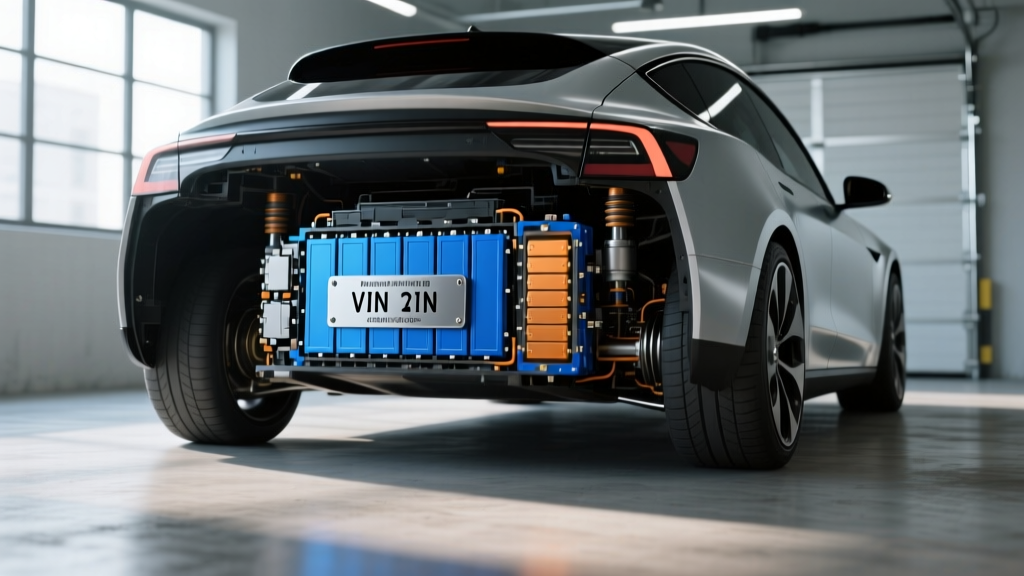
But that search also opens a much bigger conversation for anyone considering an electric vehicle in 2026. Modern EVs use a high-voltage lithium-ion traction battery — a 60–120+ kWh pack that powers the electric motor(s) and represents the single most expensive component in the vehicle. Understanding how these batteries differ from the humble 12V unit in a 2010 Outback, how long they last, what they cost to replace, and how to care for them is essential before signing an EV purchase agreement.
This guide covers the chemistry, degradation data, warranty structures, replacement economics, and care practices for modern EV traction batteries — with the context a data-driven buyer needs.
The 2010 Subaru Outback Battery: A 12V Baseline
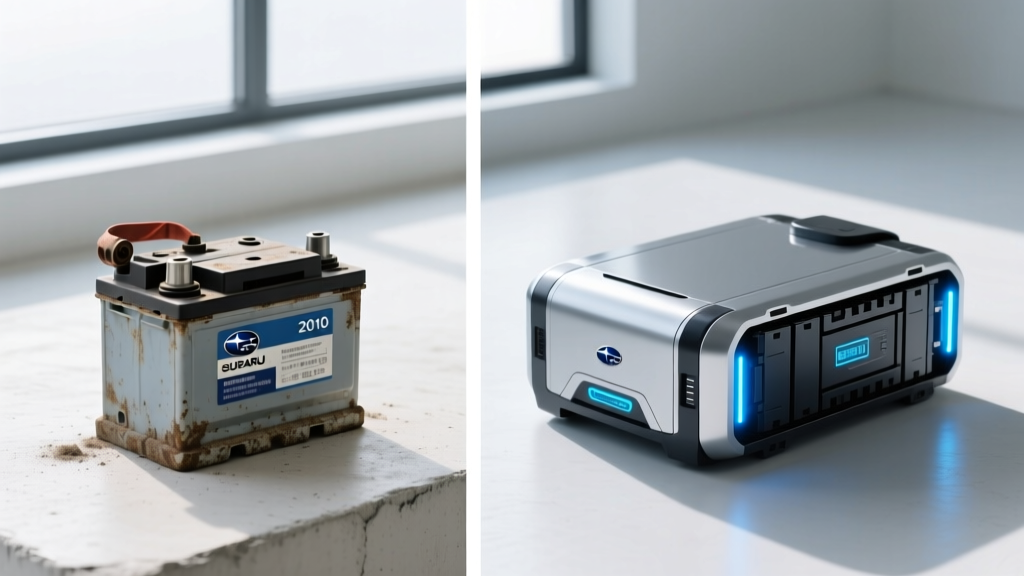
The 2010 Subaru Outback uses a conventional 12V lead-acid battery (typically Group 35, ~550–650 CCA) to start its 2.5L flat-four or 3.6L flat-six engine. It stores roughly 0.6–0.8 kWh of energy, weighs about 35–45 lbs, and is expected to last 3–5 years before replacement. A quality AGM replacement runs $180–$250 in 2026.
This battery has one job: deliver a high-current burst to the starter motor and power accessories when the alternator isn't spinning. It's a consumable item, and its failure is an inconvenience, not a financial crisis.
Contrast that with an EV traction battery:
| Attribute | 2010 Subaru Outback (12V) | Typical 2026 EV Traction Battery |
|---|---|---|
| Voltage | 12V | 400V–800V nominal |
| Capacity | ~0.6–0.8 kWh | 60–120+ kWh |
| Weight | 35–45 lbs | 800–1,500+ lbs |
| Chemistry | Lead-acid (flooded/AGM) | LFP or NMC lithium-ion |
| Replacement Cost | $150–$250 | $8,000–$22,000+ |
| Expected Lifespan | 3–5 years | 15–20+ years (to 70% capacity) |
Even though modern EVs still carry a small 12V auxiliary battery (often lithium iron phosphate in 2026 models) to run electronics, the traction battery is the engineering and economic centerpiece.
EV Battery Chemistry in 2026: LFP vs. NMC/NCA
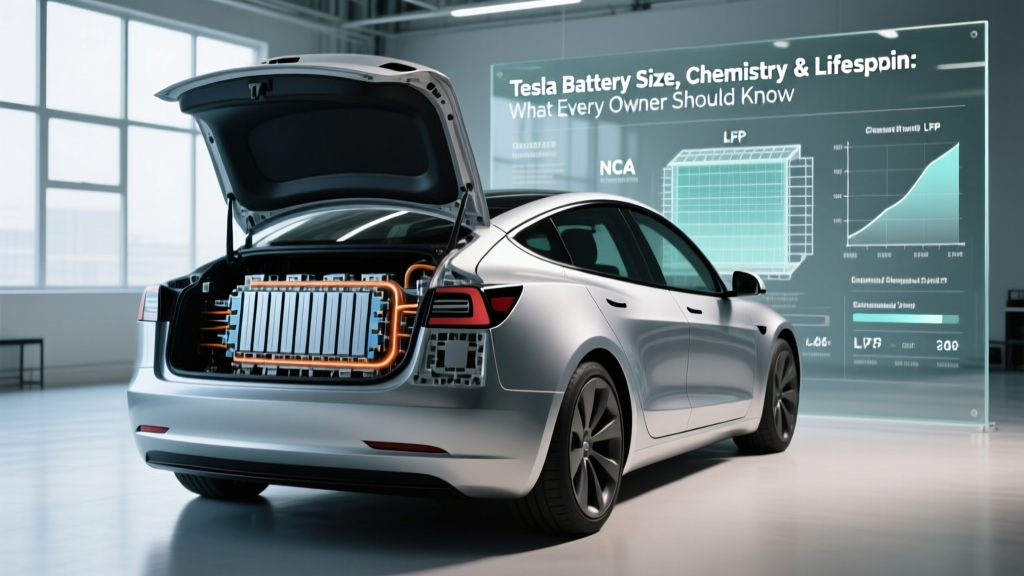
Two lithium-ion chemistries dominate the 2026 EV market. Understanding the trade-offs between them is the single most important battery decision a buyer makes, because it affects range, charging behavior, longevity, and cold-weather performance.
| Factor | LFP (Lithium Iron Phosphate) | NMC/NCA (Nickel Manganese Cobalt / Nickel Cobalt Aluminum) |
|---|---|---|
| Energy Density | Lower (~160–180 Wh/kg cell-level) | Higher (~220–300 Wh/kg cell-level) |
| Typical Use | Standard-range / base trims (Tesla Model 3 RWD, Ford Mustang Mach-E Select, many Chinese-market EVs) | Long-range / performance trims (Tesla Model 3 LR, Hyundai Ioniq 5 LR, Rivian R1T) |
| Cycle Life | 3,000–5,000+ full cycles to 80% SoH | 1,000–2,000 full cycles to 80% SoH |
| Cold-Weather Performance | Weaker — more range loss below freezing, slower cold charging | Better low-temp performance and charge acceptance |
| Charging to 100% | Recommended periodically for BMS calibration | Daily charging to 80% preferred; 100% for trips only |
| Cobalt Content | None (lower supply-chain concern) | Contains cobalt (ethical/sourcing considerations) |
| Cost | Lower per kWh | Higher per kWh |
| Thermal Stability | Excellent — lower runaway risk | Good, but requires more robust thermal management |
Which is better? It depends on your use case. If you charge at home nightly, drive moderate daily distances, and want maximum cycle life, LFP is the pragmatic choice. If you need maximum range per charge, frequently road-trip in cold climates, or want the longest single-charge legs, NMC/NCA delivers higher energy density and better cold-weather behavior. Neither chemistry is universally superior — the right answer is driven by your driving pattern and climate.
How Long Do EV Batteries Actually Last?
The fear that EV batteries need frequent replacement is not supported by fleet data. Most modern EV traction batteries are engineered to outlast the vehicle's economic life. Here's what the data shows:
Real-World Degradation Data Points (2026):
- Tesla fleet data (2025 Impact Report): Model 3/Y batteries retain approximately 85% capacity at 200,000 miles — roughly 15% loss over the typical life of the vehicle.
- Geotab fleet study (2024, 10,000+ EVs): Average annual degradation of ~1.8% per year, meaning a typical EV battery retains ~82% capacity after 10 years.
- Recurrent Auto data (2025): Chevrolet Bolt EV owners showed ~6–8% loss at 100,000 miles, with degradation curves flattening significantly after the first 2 years.
- Hyundai/Kia EV6 owner reports: 84 kWh NMC packs showing ~5–7% loss at 60,000 miles in moderate climates.
Most batteries degrade quickly in the first 1–2 years (typically 3–5%), then the curve flattens dramatically. A well-maintained 2026 EV battery should retain 75–85% of original capacity at 150,000–200,000 miles, which translates to 15–20+ years of usable service for most owners.
To put this in perspective: the 2010 Subaru Outback's engine is far more likely to need a head-gasket replacement or timing-chain service by 200,000 miles than a 2026 EV battery is to need replacement in the same mileage window.
Battery Warranty Terms: What's Covered and for How Long
Federal law mandates that EV batteries carry a minimum warranty of 8 years / 100,000 miles (in California Air Resources Board states, it's 10 years / 150,000 miles). Most automakers meet or exceed these minimums. Here's how major warranties compare in 2026:
| Manufacturer | Warranty Term | Capacity Threshold | Notes |
|---|---|---|---|
| Tesla (Model 3/Y RWD — LFP) | 8 yr / 100,000 mi | 70% retention | Standard-range LFP packs |
| Tesla (Model 3/Y LR — NMC) | 8 yr / 120,000 mi | 70% retention | Long-range / AWD variants |
| Hyundai / Kia | 10 yr / 100,000 mi | 70% retention | Ioniq 5, EV6, Ioniq 6 |
| Ford (Mustang Mach-E) | 8 yr / 100,000 mi | 70% retention | All trims |
| Rivian (R1T / R1S) | 8 yr / 175,000 mi | 70% retention | Higher mileage threshold |
| Chevrolet (Blazer EV, Equinox EV) | 8 yr / 100,000 mi | 60% retention | Lower threshold — note carefully |
| BMW (i4, iX) | 8 yr / 100,000 mi | 70% retention | Includes battery management system |
What the warranty covers: If your battery's State of Health (SoH) drops below the stated threshold within the warranty period, the manufacturer will repair or replace the battery (or individual modules, depending on the pack design) at no cost to restore capacity above the threshold.
What it does NOT cover: Normal gradual degradation above the threshold, damage from accidents, modifications, or improper charging equipment. Always read the specific warranty booklet — the capacity threshold varies (60% vs. 70%) and that difference matters at the margin.
For full warranty details and current federal requirements, refer to fueleconomy.gov's EV technology page.
EV Battery Replacement Cost: The Real Numbers
This is where most fear-mongering concentrates, so let's be precise. Battery replacement is rarely needed within a vehicle's normal ownership life, but it's important to know the economics.
| Vehicle / Pack Size | Battery Capacity | Estimated Replacement Cost (Parts + Labor) | Typical Need Timeline |
|---|---|---|---|
| Tesla Model 3 RWD (LFP) | ~60 kWh | $10,000–$14,000 | Rarely before 250,000+ mi |
| Tesla Model Y Long Range | ~75 kWh | $13,000–$18,000 | Rarely before 200,000+ mi |
| Hyundai Ioniq 5 | 77.4 kWh | $12,000–$16,000 | Rarely before 200,000+ mi |
| Ford F-150 Lightning (Ext. Range) | ~131 kWh | $20,000–$28,000 | Rarely before 200,000+ mi |
| Chevrolet Bolt EV (older gen) | 65 kWh | $14,000–$16,000 | Post-recall replacements |
| Rivian R1T (Large Pack) | ~135 kWh | $20,000–$25,000 | Rarely before 175,000+ mi |
Key context: Battery prices per kWh have dropped from ~$400/kWh in 2010 to roughly $110–$130/kWh at the cell level in 2026 (source: BloombergNEF). Replacement costs include labor, diagnostics, and dealer markup, which is why the total exceeds raw cell cost. Many replacements involve individual module swaps rather than full-pack replacements, significantly reducing cost.
For most owners, the battery will never need replacement. The vehicle's body, suspension, and interior will wear out before the battery falls below usable capacity. The 2010 Subaru Outback you might still be driving? Its engine rebuild at 200,000 miles would cost $4,000–$7,000 — a comparable powertrain-event cost for an ICE vehicle.
Factors That Affect EV Battery Lifespan
Not all miles are equal when it comes to battery wear. These factors have the largest measurable impact on long-term State of Health:
What Accelerates Degradation:
- Frequent DC fast charging above 150 kW: Occasional fast charging is fine, but daily reliance on 250–350 kW chargers increases thermal stress. Tesla's own data suggests heavy Supercharger use correlates with ~1–2% additional degradation over 100,000 miles vs. primarily Level 2 charging.
- Sustained 100% State of Charge: Storing an NMC battery at 100% for days accelerates calendar aging. LFP batteries tolerate 100% better and manufacturers recommend periodic full charges for BMS calibration.
- Extreme heat exposure: Sustained ambient temperatures above 95°F (35°C), especially with a high SoC, accelerates chemical degradation. Vehicles in Phoenix and Dubai show measurably higher degradation rates than those in Seattle or Portland.
- Deep discharge cycles: Regularly running the battery below 10% SoC stresses the cells. The BMS maintains a buffer (typically 2–5 kWh at the bottom), but habitually arriving at 0% isn't ideal.
What Maximizes Longevity:
- Daily charging to 80% (NMC) or 100% (LFP): Follow the manufacturer's charge-limit recommendation for your chemistry.
- Level 2 home charging as your primary source: Slower charging generates less heat. A 7.2–11.5 kW Level 2 charger is ideal for daily use.
- Preconditioning before fast charging: Most EVs automatically precondition the battery when you navigate to a DC fast charger. This warms or cools the pack to optimal temperature, reducing stress and improving charge speed.
- Avoiding prolonged storage at extreme SoC: If storing the vehicle for weeks, aim for ~50% SoC in a temperature-controlled environment.
- Using the vehicle regularly: Lithium-ion cells prefer moderate, regular cycling to prolonged static storage.
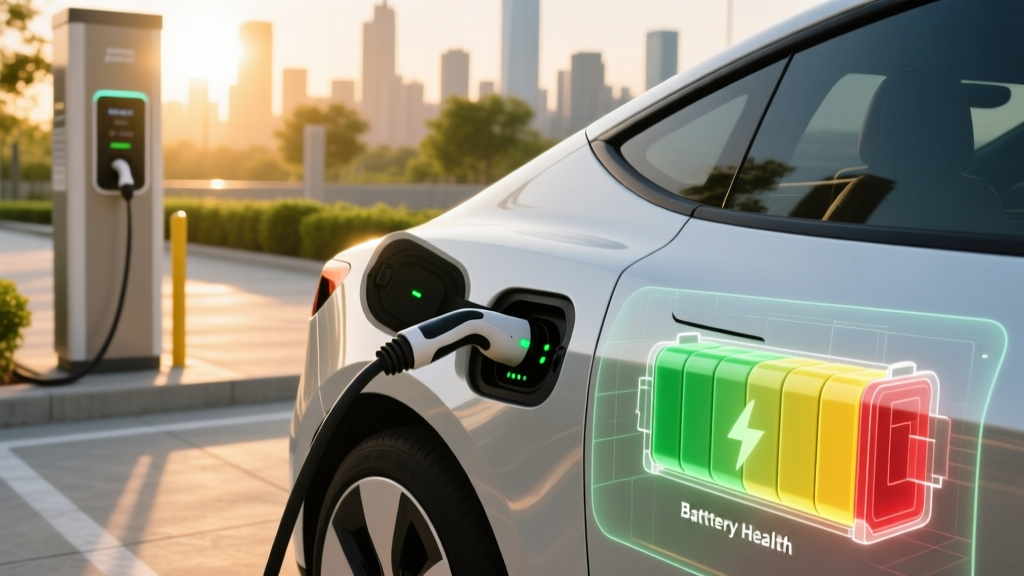
Monitoring Battery Health: How to Check SoH
State of Health (SoH) represents your battery's current maximum capacity as a percentage of its original capacity when new. A battery at 92% SoH that started at 80 kWh now holds approximately 73.6 kWh.
How to check SoH in 2026:
- In-vehicle displays: Tesla, Hyundai/Kia, BMW, and Mercedes now include battery health indicators in the vehicle settings menu. These show a percentage or bar-graph representation.
- Manufacturer apps: The Tesla app, Hyundai Bluelink, Kia Connect, and FordPass all provide battery health metrics or will flag warranty-eligible degradation.
- OBD-II diagnostic tools: Third-party tools like OBD Eleven, LeafSpy (for Nissan Leaf), and Scan My Tesla can read detailed cell-level data including individual module voltage variance, which is a more granular health indicator.
- Dealer diagnostics: Any authorized service center can run a full battery health report, typically during routine service visits. Request this if you're approaching a warranty mileage threshold.
- Third-party services: Companies like Recurrent Auto offer free battery health reports by connecting to your vehicle's telematics data, providing degradation curves compared to similar vehicles in your climate zone.
For used-EV buyers, a battery health report should be as non-negotiable as a compression test on a used ICE vehicle. Ask for the SoH percentage and request the dealer pull a diagnostic report before purchase.
Emerging Battery Tech: What's Next (and When)
Several next-generation battery technologies are in development. None are available in production vehicles as of early 2026, but they're worth tracking for future purchases:
Solid-State Batteries: These replace the liquid electrolyte with a solid material, promising higher energy density (~400–500 Wh/kg cell-level), faster charging, and improved safety. Toyota has announced a solid-state battery targeting 2027–2028 production in limited models, with a claimed 750 km (466 mi) range. Samsung SDI and QuantumScape are also advancing prototypes. Realistic widespread availability: 2028–2030+.
Silicon Anode Batteries: Companies like Sila Nanotechnologies and Group14 are replacing graphite anodes with silicon-dominant materials, boosting energy density by 20–40%. Early implementations are appearing in premium vehicles (the Mercedes G-Class EV uses a silicon-anode pack from Group14). Expanding availability: 2026–2028.
Sodium-Ion Batteries: CATL and BYD are producing sodium-ion cells that eliminate lithium entirely, offering lower cost and excellent cold-weather performance at the expense of energy density. These are appearing in budget Chinese-market EVs and may reach global markets by 2027–2028 in entry-level models. Timeline: 2027+ for US-market relevance.
For a buyer shopping today, current LFP and NMC chemistries are mature, well-understood, and backed by real-world fleet data. There's no compelling reason to wait for next-gen tech unless your purchase timeline is 3–5 years out.
EV Battery FAQ
How long do EV batteries last in years and miles?
Based on fleet data from Tesla, Geotab, and Recurrent Auto, most modern EV batteries retain 75–85% of original capacity at 150,000–200,000 miles, equating to 15–20+ years of service for average drivers (12,000–15,000 miles/year). Full replacement within a vehicle's normal life is uncommon.
How much does it cost to replace an EV battery?
Full-pack replacement ranges from ~$10,000 for a 60 kWh pack (Tesla Model 3 RWD) to $25,000+ for a 130+ kWh pack (Ford F-150 Lightning Extended Range, Rivian R1T). However, many repairs involve individual module replacement at significantly lower cost. Most batteries never require replacement during typical ownership.
What does the EV battery warranty actually cover?
Federal minimum is 8 years/100,000 miles (10 years/150,000 miles in CARB states). If your battery's capacity drops below the manufacturer's threshold (typically 70% of original) within the warranty period, the manufacturer repairs or replaces it at no cost. Normal gradual degradation above the threshold is not covered. Always check the specific warranty booklet for your model — Chevrolet uses a 60% threshold on some models, which is less generous.
How do I check and maximize my EV battery health?
Check SoH through your vehicle's settings menu, manufacturer app, or OBD-II diagnostic tool. To maximize longevity: charge daily to 80% (NMC) or 100% (LFP), rely primarily on Level 2 home charging, precondition before DC fast charging, avoid prolonged storage at extreme SoC levels, and minimize exposure to sustained extreme heat.
LFP vs. NMC — which battery chemistry should I choose?
Choose LFP if you want maximum cycle life (3,000–5,000+ cycles), lower cost, no cobalt concerns, and you primarily charge at home for daily commuting. Choose NMC/NCA if you need maximum range per charge, frequently drive in cold climates, or take regular road trips where energy density matters. Neither is universally better — the right choice depends on your driving pattern and climate.
Does the 2010 Subaru Outback have an EV battery?
No. The 2010 Subaru Outback is a conventional gasoline vehicle with a standard 12V lead-acid starter battery (Group 35). It has no high-voltage traction battery. If you're replacing the battery in a 2010 Outback, you need a standard 12V automotive battery — not an EV traction pack. Subaru did not introduce a fully electric vehicle (the Solterra) until the 2023 model year.
Is it true that cold weather damages EV batteries?
Cold weather temporarily reduces range (typically 20–30% loss at 20°F / -7°C) due to increased internal resistance and cabin heating demand, but it does not cause permanent damage. The battery's thermal management system protects the cells. However, charging a cold battery at high power without preconditioning can cause lithium plating — always let your EV precondition before DC fast charging in cold weather.
For current federal EV tax credit rules that may apply to your battery-related purchase decisions, consult the IRS clean vehicle credit page. Battery sourcing and critical mineral requirements under §30D directly affect which vehicles qualify for the up-to-$7,500 credit, and these rules are subject to change.