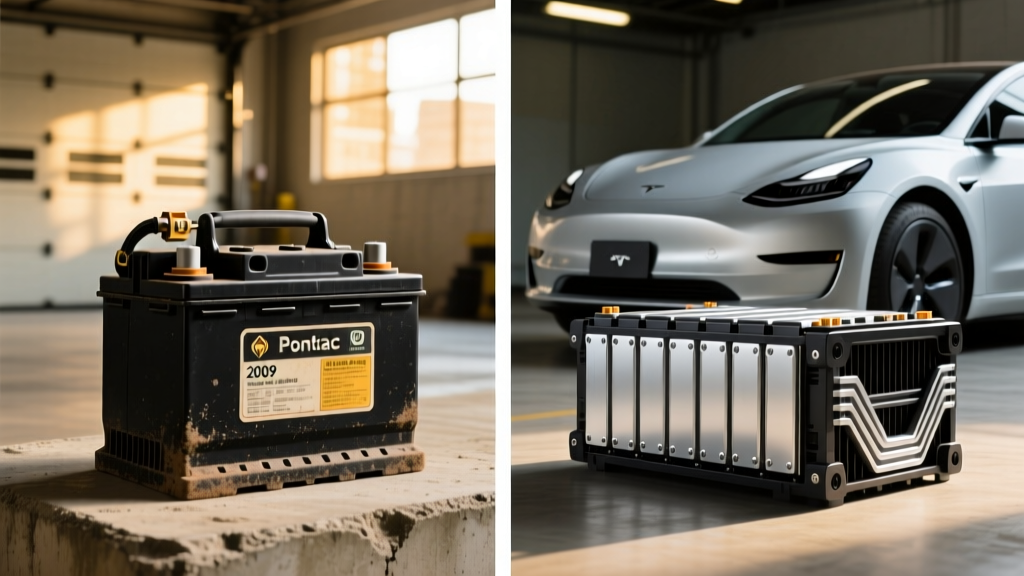
If you've ever searched for a 2009 Pontiac G6 battery, you were likely dealing with a familiar automotive headache: a dead 12-volt lead-acid unit under the hood that left you stranded in a parking lot. That Group 48 flooded-cell battery — roughly 70 amp-hours and 650 cold-cranking amps — typically lasted 3 to 5 years before sulfate buildup and plate corrosion ended its life. Replacement cost: $130 to $220 at an auto parts store.
Fast-forward to today's electric vehicles, and the word "battery" means something radically different. A modern EV traction battery stores 60 to 100+ kilowatt-hours (kWh) of energy, weighs 800 to 1,200 pounds, and is engineered to outlast the vehicle itself. Understanding this shift — from disposable 12V starters to sophisticated lithium-ion packs — is essential for anyone considering an EV purchase in 2026.
This guide breaks down current EV battery chemistry, real-world degradation data, warranty coverage, replacement economics, and care practices. We'll also clarify why your old G6's battery concerns don't translate to the EV world.
The 2009 Pontiac G6 Battery: A Baseline for Comparison
The 2009 Pontiac G6 used a conventional 12V lead-acid battery to crank a 2.4L four-cylinder or 3.5L/3.9L V6 engine. This battery had one job: deliver a burst of 600-700 amps for a few seconds to turn the starter motor. Once the engine fired, the alternator took over all electrical supply and recharged the battery.
Key specs of that original equipment battery:
- Chemistry: Flooded lead-acid (some upgraded to AGM)
- Capacity: ~70 Ah at 12V (roughly 0.84 kWh)
- Lifespan: 3-5 years typical; 1-2 years in extreme heat
- Replacement cost: $130-$220
- Failure mode: Sulfation, plate shedding, electrolyte loss
By contrast, a 2026 EV traction battery stores 100 times more energy, operates at 400-800 volts, and is warrantied for 8-10 years. The maintenance mindset is completely different. Yes, modern EVs still carry a small 12V auxiliary battery for accessory electronics, but confusing that with the high-voltage traction pack is a common error we'll address below.
EV Battery Chemistry in 2026: LFP vs NMC vs NCA
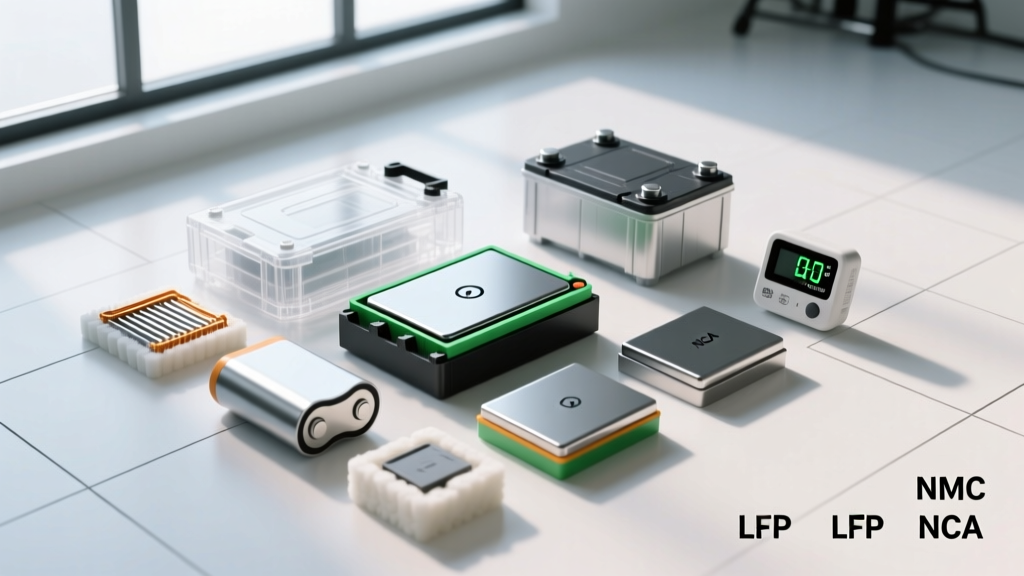
Today's EV battery packs use one of three dominant lithium-ion chemistries. The choice affects range, longevity, cost, and cold-weather behavior.
| Attribute | LFP (Lithium Iron Phosphate) | NMC (Nickel Manganese Cobalt) | NCA (Nickel Cobalt Aluminum) |
|---|---|---|---|
| Energy Density | ~160 Wh/kg (lower) | ~250 Wh/kg (higher) | ~270 Wh/kg (highest) |
| Cycle Life | 3,000-6,000+ cycles | 1,500-3,000 cycles | 1,000-2,000 cycles |
| Cold Performance | Moderate (10-15% range loss at 20°F) | Better (8-12% range loss at 20°F) | Better (8-12% range loss at 20°F) |
| Cost (per kWh) | $90-$110 (lower) | $120-$150 | $130-$160 |
| Thermal Stability | Excellent (less thermal runaway risk) | Good (requires active management) | Good (requires active management) |
| SoC Recommendation | Can charge to 100% daily | Best kept 20-80% for daily use | Best kept 20-80% for daily use |
| Example Vehicles (2026) | Tesla Model 3 RWD, Ford Mustang Mach-E Select, BYD models | Hyundai Ioniq 5, VW ID.4, BMW iX | Tesla Model S/X, Rivian R1T (some packs) |
Which Chemistry Is Better?
There is no universal winner — it depends on your use case.
Choose LFP if: You want maximum cycle life, plan to keep the vehicle 10+ years, charge at home nightly, live in a moderate climate, and prioritize lower cost over maximum range. LFP's tolerance for daily 100% charging simplifies ownership considerably.
Choose NMC/NCA if: You need the longest possible range per charge, frequently drive in cold climates, or want the lightest battery pack for performance. The trade-off is slightly faster degradation and the need to manage state of charge (avoiding prolonged 100% or below-10% states).
Real-World EV Battery Degradation: What the Data Shows
Unlike the 2009 Pontiac G6 battery, which failed suddenly and completely, EV traction batteries degrade gradually. You won't wake up to a dead pack — you'll notice range slowly shrinking over years.
Typical Degradation Curve (based on aggregated fleet data from Recurrent Auto, Geotab, and manufacturer reports):
- Year 1: 2-3% capacity loss (initial "break-in" drop)
- Year 2-4: ~1% per year (slow, linear decline)
- Year 5-8: ~0.5-1% per year (plateau phase)
- Year 10: Most packs retain 80-90% of original capacity
- Year 15: Projected 70-85% retention for well-maintained packs
Real-world examples from owner communities and fleet data:
- Tesla Model 3 (NMC, 2018-2020): Median ~12% degradation at 100,000 miles per Recurrent Auto fleet data.
- Chevrolet Bolt EV (NMC, 2017-2022): Most owners report 5-8% loss at 80,000 miles; some recall-affected packs were replaced under warranty.
- Nissan Leaf (LMO/NMC, 2011-2025): Early passive-cooled packs degraded 15-25% by year 5 in hot climates; later models with active thermal management improved significantly.
- Tesla Model S (NCA, 2013-2020): Fleet data shows ~10-15% degradation at 150,000 miles, with most packs still functional.
The key insight: modern liquid-cooled battery packs with active thermal management degrade far less than early EVs. The fear of a $20,000 replacement at 80,000 miles is largely outdated for 2026-era vehicles.
EV Battery Warranty Coverage Explained
Federal law mandates a minimum 8-year/100,000-mile warranty on EV battery packs (10 years/150,000 miles in California and states adopting CARB standards). Most manufacturers exceed this floor.
| Vehicle | Warranty Period | Capacity Threshold | Notes |
|---|---|---|---|
| Tesla Model 3 RWD (LFP) | 8 yr / 100,000 mi | 70% retention | Long Range/AWD: 8 yr / 120,000 mi |
| Hyundai Ioniq 5 | 10 yr / 100,000 mi | 70% retention | Among the longest coverage |
| Ford Mustang Mach-E | 8 yr / 100,000 mi | 70% retention | Transferable to second owner |
| Chevrolet Equinox EV | 8 yr / 100,000 mi | 70% retention | Battery module replacement supported |
| BMW iX | 8 yr / 100,000 mi | 70% retention | Includes thermal management system |
| Rivian R1T/R1S | 8 yr / 175,000 mi | 70% retention | Higher mileage cap for truck use |
What triggers a warranty claim? If your pack's State of Health (SoH) drops below the threshold — typically 70% of original capacity — within the warranty window, the manufacturer will repair or replace it. In practice, most claims involve individual module replacement rather than full pack swaps, reducing cost and downtime.
What's NOT covered: Damage from accidents, improper modifications, using non-approved chargers that cause electrical faults, or complete neglect (e.g., leaving a vehicle at 0% SoC for months in extreme heat). Normal gradual degradation above the threshold is expected wear, not a defect.
EV Battery Replacement Cost: Reality vs Fear
This is where the 2009 Pontiac G6 battery comparison ends entirely. You can't swap an EV traction pack at AutoZone for $180. But the narrative that every EV owner faces a catastrophic $25,000 bill is misleading.
| Vehicle / Pack Size | Battery Chemistry | Full Pack Cost (Parts) | Labor | Total Estimate | When Typically Needed |
|---|---|---|---|---|---|
| Tesla Model 3 RWD (~60 kWh) | LFP | $8,000-$11,000 | $1,500-$2,500 | $9,500-$13,500 | Rarely within 15 years |
| Hyundai Ioniq 5 (~77 kWh) | NMC | $11,000-$15,000 | $2,000-$3,000 | $13,000-$18,000 | Rarely within 12 years |
| Ford F-150 Lightning Ext. (~131 kWh) | NMC | $18,000-$25,000 | $2,500-$4,000 | $20,500-$29,000 | 15+ years if ever |
| Chevrolet Bolt EV (~65 kWh) | NMC | $9,000-$13,000 | $1,500-$2,500 | $10,500-$15,500 | Some early packs replaced under recall |
| Module-level repair (single module) | Varies | $1,500-$4,000 | $800-$1,500 | $2,300-$5,500 | When 1-2 modules degrade unevenly |
Critical context: The vast majority of EV batteries outlive their vehicles. According to data from Geotab's fleet analysis, fewer than 3% of EV battery packs require full replacement outside of warranty-covered defects. Most packs still hold 75-85% capacity at 200,000 miles. The vehicle's body, suspension, or electronics will likely fail before the battery does.
Additionally, the used-EV battery market is growing. Refurbished packs from salvage vehicles and second-life applications (home energy storage) are driving replacement costs downward year over year.
Factors That Accelerate — or Slow — Battery Degradation
Your habits matter, but perhaps less than you think. Modern battery management systems (BMS) are sophisticated, actively protecting cells from the worst abuse. Still, understanding the stressors helps you optimize longevity.
What Hurts Battery Life
- Frequent DC fast charging above 150 kW: High-current charging generates heat. Occasional road-trip fast charging is fine; daily reliance on 350 kW chargers accelerates degradation by 1-3% over 5 years compared to Level 2 home charging.
- Sustained high state of charge (NMC/NCA): Leaving an NMC pack at 100% for days or weeks stresses the cathode. LFP packs are immune to this concern.
- Deep discharge to 0%: Dropping below 5% regularly causes copper dissolution in the anode. Most BMS systems maintain a hidden bottom buffer, but you shouldn't test it habitually.
- Extreme heat exposure: Prolonged parking in 110°F+ environments without thermal management active. Liquid-cooled packs handle this better than passively cooled ones.
- High-mileage Supercharging patterns: Fleet data shows vehicles DC fast-charging 90%+ of the time degrade 2-5% more over 100,000 miles than those primarily using Level 2.
What Preserves Battery Life
- Home Level 2 charging (7-11 kW): Slow, cool charging is the single best thing for longevity. A 240V Level 2 home charger adds 25-44 miles of range per hour — plenty for overnight replenishment.
- Set charge limits (NMC/NCA): Configure your vehicle's charge limit to 80% for daily driving. Reserve 100% for road trips. Most EV apps make this a one-time setting.
- LFP owners — charge to 100% weekly: LFP chemistry benefits from periodic full charges for cell balancing and accurate SoC estimation. Tesla recommends 100% at least once per week for LFP Model 3 RWD.
- Precondition before fast charging: Use your vehicle's navigation to route to a DC charger — this activates battery preconditioning, warming the pack to optimal temperature for faster, healthier charging.
- Park in shade/garage when possible: Reducing ambient heat soak lessens thermal management workload and passive degradation.
- Don't obsess over perfection: The BMS protects you. Driving the car normally and enjoying it is more important than hitting every optimization target.
Monitoring Your Battery's State of Health (SoH)
State of Health represents your battery's current maximum capacity as a percentage of its original capacity when new. A brand-new pack reads 100% SoH; at 80% SoH, your 300-mile EPA range is now effectively ~240 miles.
How to Check SoH
- In-vehicle displays: Tesla, BMW, and Mercedes-Benz offer battery health readouts in the service menu or app. Hyundai/Kia provide SoH through the dealer diagnostic tool — ask during service visits.
- OBD-II dongles + apps: Tools like OBDeleven (VW/Audi), LeafSpy (Nissan Leaf), or Scan My Tesla read cell-level data including SoH, cell voltage variance, and pack temperature.
- Dealer diagnostics: Any authorized service center can pull a full battery health report. Request this when buying a used EV — it's the most important pre-purchase check.
- Third-party services: Recurrent Auto offers free battery health reports for connected vehicles, tracking degradation over time against fleet averages.
When to be concerned: A sudden SoH drop of 5%+ in a single month, or individual cell voltage variance exceeding 200 mV, may indicate a module fault warranting dealer inspection. Gradual 1-2% annual loss is normal.
The 12V Battery: Where Your G6 Experience Still Applies
Here's where the old-world knowledge transfers directly. Every EV — Tesla, Rivian, Hyundai, Ford — still carries a 12V auxiliary battery (increasingly lithium-ion, but often still lead-acid) that powers the electronics, door locks, infotainment, and the contactor that connects the main traction battery.
If that 12V battery dies, your EV is just as immobilized as a 2009 Pontiac G6 with a dead starter battery. You can't open the doors, start the drive system, or charge. Tesla moved to a lithium-ion 12V in the Model 3 refresh, which lasts longer and weighs less, but many 2026 EVs still use lead-acid 12V units with 3-5 year lifespans.
Practical tip: If your EV suddenly shows a "12V battery low" warning, address it immediately. Keep a lithium jump-starter pack in the vehicle. And if you're storing an EV for weeks, leave it plugged in — the vehicle's DC-DC converter will maintain the 12V battery from the traction pack.
Emerging Battery Technology: What's Next (and When)
Battery technology continues advancing, but separating marketing hype from production reality is critical. Here's the honest 2026 landscape:
Solid-State Batteries
Solid-state cells replace the liquid electrolyte with a solid ceramic, polymer, or sulfide conductor. Promised benefits include 40-50% higher energy density, faster charging (potentially 10-80% in under 10 minutes), and improved safety (no flammable electrolyte). Toyota, Samsung SDI, and QuantumScape have all demonstrated prototype cells.
Realistic timeline: Limited production vehicles with semi-solid-state batteries (a hybrid approach) are expected from Toyota and Nissan around 2027-2028. True all-solid-state packs at scale remain 2029+ due to manufacturing yield challenges. Expect early adoption in premium models at significant cost premiums.
Silicon-Dominant Anodes
Replacing graphite anodes with silicon can theoretically boost energy density by 20-40%. Companies like Sila Nanotechnologies and Group14 are supplying silicon-composite anode materials to battery manufacturers now.
Realistic timeline: Partial silicon anodes (5-10% silicon content) are already in production cells from Panasonic and LG Energy Solution. Higher silicon content anodes are in limited 2026 production and will scale through 2028. This is an incremental improvement, not a revolution.
Sodium-Ion Batteries
Sodium-ion chemistry uses abundant, cheap materials (no lithium, cobalt, or nickel). Energy density is lower (~120-140 Wh/kg), making it suitable for budget city EVs and stationary storage but not long-range vehicles.
Realistic timeline: CATL and BYD are producing sodium-ion cells in China for affordable micro-EVs. US-market availability in passenger vehicles is 2028+ at the earliest.
The honest take: None of these technologies will obsolete your current EV. Today's lithium-ion packs are mature, reliable, and continuously improving through manufacturing refinement. Buy based on current technology, not future promises.
Frequently Asked Questions
How long do EV batteries actually last?
Based on fleet data through 2026, most modern liquid-cooled EV battery packs retain 80-90% of original capacity at 10 years and 150,000 miles. Many will outlast 200,000 miles with 75%+ retention before the vehicle is retired for other reasons. Catastrophic failure is rare — fewer than 3% of packs need full replacement outside of recalls.
How much does an EV battery cost to replace in 2026?
Full pack replacement ranges from roughly $9,500 (smaller LFP packs like a Tesla Model 3 RWD) to $29,000 (large NMC packs like the F-150 Lightning Extended Range), including labor. However, module-level repairs — replacing just the degraded section — cost $2,300-$5,500 and are increasingly common. Most owners never face this expense because the battery outlives the car.
What does the EV battery warranty actually cover?
Federal minimum is 8 years/100,000 miles; many manufacturers offer 10 years/100,000 miles. The warranty guarantees the pack will retain at least 70% of original capacity. If SoH drops below that threshold within the warranty period, the manufacturer repairs or replaces the pack (or individual modules) at no cost. Damage from accidents, modifications, or extreme neglect is excluded.
LFP vs NMC — which battery chemistry should I choose?
LFP is better for longevity, cost, and simplicity (charge to 100% daily, no SoC anxiety). NMC is better for maximum range and cold-weather performance. If you drive under 250 miles daily, charge at home, and plan to keep the car 10+ years, LFP is the pragmatic choice. If you need 300+ miles of range and live where winters are harsh, NMC's energy density advantage matters.
Does fast charging damage my EV battery?
Occasional DC fast charging (road trips, a few times per month) causes negligible extra degradation. Daily reliance on 150+ kW fast charging can add 1-3% additional degradation over 5 years compared to Level 2 home charging. The real risk is heat: always use battery preconditioning (navigate to the charger) and avoid fast charging in extreme heat when possible. For daily use, a home Level 2 charger at 7-11 kW is ideal.
How do I check my EV's battery health before buying used?
Request a dealer battery health diagnostic showing State of Health percentage and cell voltage variance. For Teslas, third-party apps like Tessie or Scan My Tesla read this data via OBD-II. For Nissan Leafs, LeafSpy is the standard tool. Compare the SoH reading against the vehicle's age and mileage — a 5-year-old EV with 92% SoH is in excellent shape; one at 78% may face warranty issues soon.
Will a new battery technology make my current EV obsolete?
No. Solid-state, silicon-anode, and sodium-ion batteries are incremental improvements, not paradigm shifts. Today's lithium-ion packs are already excellent, and charging infrastructure compatibility won't change. The EV you buy today will remain practical and supported for its entire useful life. Don't delay a purchase waiting for next-generation chemistry that may be 3-5 years from mass-market availability.