The 2009 Ford Escape Hybrid occupies a unique place in electrified-vehicle history. As one of the first mainstream hybrid SUVs sold in the United States, it introduced thousands of drivers to battery-assisted propulsion using a nickel-metal hydride (NiMH) traction pack. Now, well over a decade later, many original and second owners are confronting a familiar question: what happens when the high-voltage battery in a 2009 Ford Escape Hybrid reaches the end of its usable life?
This guide breaks down the original NiMH battery's real-world longevity, current replacement costs, and the care factors that determine how long these packs last. We'll also place the Escape Hybrid's battery in the broader context of modern EV battery chemistry — comparing the LFP and NMC cells powering today's BEVs and PHEVs — so you can make an informed decision whether to repair, replace, or upgrade to a newer electrified vehicle.
The 2009 Ford Escape Hybrid Battery: Original Specs and Chemistry
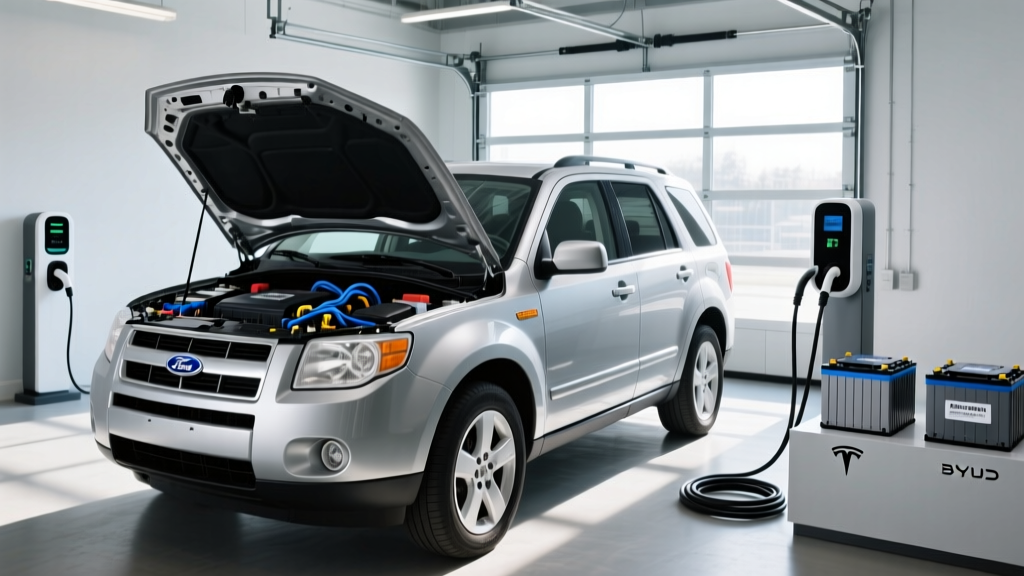
The 2009 Ford Escape Hybrid uses a nickel-metal hydride (NiMH) high-voltage traction battery manufactured by Sanyo. This is not the small 12V auxiliary battery under the hood that powers lights and accessories — it's the main hybrid-system battery located beneath the cargo floor.
| Specification | 2009 Ford Escape Hybrid |
|---|---|
| Battery Chemistry | Nickel-Metal Hydride (NiMH) |
| Nominal Voltage | 330V |
| Battery Capacity | ~1.8 kWh (gross) |
| Cell Configuration | 25 modules, 5 cells per module (125 cells) |
| Electric Motor Output | 94 hp (70 kW) |
| Combined System Output | 177 hp (2.5L Atkinson-cycle I4 + electric) |
| EPA Fuel Economy (FWD) | 34 city / 31 highway / 32 combined MPG |
| Original Battery Warranty | 8 years / 100,000 miles |
NiMH chemistry was the standard for early hybrids — the Toyota Prius, Honda Insight, and Escape Hybrid all used it. Compared to modern lithium-ion cells, NiMH is heavier, less energy-dense, and more prone to the "memory effect" (voltage depression from repeated partial cycling). However, NiMH packs proved remarkably durable in practice, with many surviving well beyond their warranty periods.
How Long Does the 2009 Escape Hybrid Battery Last?
Real-world data from owner forums, repair databases, and hybrid-specialty shops paints a consistent picture: the original NiMH battery in a 2009 Ford Escape Hybrid typically delivers 10 to 15 years or 120,000 to 180,000 miles of service before degradation causes noticeable performance loss.
NiMH Degradation Pattern (Escape Hybrid & Comparable Early Hybrids):
- Years 1–5 (0–75,000 mi): Minimal capacity loss, approximately 5–10%. Most owners notice no change in fuel economy or electric-assist behavior.
- Years 5–10 (75,000–140,000 mi): Gradual decline to roughly 75–85% of original capacity. Fuel economy may drop 1–3 MPG as the gasoline engine compensates.
- Years 10–15 (140,000–180,000 mi): Capacity falls toward 60–75%. The vehicle may throw a hybrid-system warning light, reduce regenerative braking effectiveness, or limit electric-only operation at low speeds.
- Beyond 15 years / 180,000+ mi: High risk of individual cell failure within modules, triggering the check-engine light with codes such as P0A7F (hybrid battery pack deterioration) or P0A80 (replace hybrid battery).
It's worth noting that many 2009 Escape Hybrids are still on the road with their original batteries. Climate plays a significant role: vehicles in moderate coastal climates (Pacific Northwest, Southeast) tend to see longer battery life than those enduring extreme heat (Arizona, Texas) or extreme cold (Upper Midwest), both of which accelerate chemical degradation in NiMH cells.
2009 Escape Hybrid Battery Replacement Cost
If your Escape Hybrid's traction battery has failed or degraded below usable thresholds, you have three main replacement paths. Prices below reflect 2026 market rates from hybrid repair shops and parts suppliers:
| Replacement Option | Cost Range | Warranty | Notes |
|---|---|---|---|
| New OEM Battery (Ford/Motorcraft) | $3,000–$3,800 (part only) | Typically 1–2 years | Limited availability; may require dealer order. Labor adds $500–$800. |
| Remanufactured Battery | $1,800–$2,800 (installed) | 1–3 years typical | Most popular option. Reputable suppliers (e.g., Green Bean Battery, Exclusive Hybrid) test and replace weak modules. |
| Used/Salvage Battery | $600–$1,200 (part only) | 30–90 days typical | Highest risk. Capacity and remaining life are unknown. Labor adds $500–$800. |
Total installed cost for the most common path — a remanufactured battery from a hybrid specialist — typically lands between $2,200 and $3,500 depending on your region and shop labor rates.
Before committing to a full replacement, ask your technician about module-level reconditioning. Since the NiMH pack contains 25 individual modules, it's sometimes possible to identify and replace only the 2–4 weakest modules and rebalance the pack, bringing total cost down to $800–$1,500. This is a temporary fix (1–3 additional years) but can be cost-effective on a vehicle with high mileage.
Factors That Affect Hybrid Battery Life
NiMH battery longevity in the Escape Hybrid depends on several variables you can partially control:
- Temperature exposure: NiMH cells degrade fastest above 110°F (43°C) and below 0°F (-18°C). Garage parking in extreme climates meaningfully extends pack life.
- Driving pattern: Regular use keeps cells balanced. Vehicles that sit unused for weeks at a time experience more voltage depression and cell imbalance.
- State of charge extremes: The Escape Hybrid's battery management system (BMS) already buffers the pack — it never charges to a true 100% or discharges to 0%. This built-in protection is one reason NiMH hybrid packs outlast early BEV packs that lacked robust buffers.
- Cooling system maintenance: The Escape Hybrid battery has an air-cooling vent near the cargo area. If this vent is blocked by cargo or clogged with dust/pet hair, the pack runs hotter and degrades faster. Clean it periodically.
- Regenerative braking load: Aggressive driving with frequent hard regenerative-braking cycles generates more heat in the pack than gentle, anticipatory driving.
What Does the Battery Warranty Cover?
When new, the 2009 Ford Escape Hybrid's battery was covered under Ford's Hybrid/Electric Vehicle Component Warranty: 8 years or 100,000 miles (whichever came first). In California Air Resources Board (CARB) states, the warranty extended to 10 years or 150,000 miles.
| Warranty Aspect | Original Coverage | Current Status (2026) |
|---|---|---|
| Duration | 8 yr / 100,000 mi (10 yr / 150,000 mi in CARB states) | Expired for all 2009 models |
| Capacity Threshold | Failure or significant deterioration preventing normal hybrid operation | N/A — owner-responsible |
| What's Covered | Battery pack, battery control module, associated wiring | Replacement is now out-of-pocket |
| What's Not Covered | Damage from accidents, modifications, flooding, or neglect | Same exclusions apply to aftermarket warranties |
For comparison, modern EV battery warranties under current federal emissions-related requirements mandate at least 8 years / 100,000 miles, and most automakers (Hyundai, Kia, Tesla, Chevrolet) offer 8–10 years / 100,000–150,000 miles with a capacity-retention threshold of 70% of original capacity. If you're shopping for a new EV or PHEV in 2026, this 70% threshold over 8 years is the industry baseline — a far more specific guarantee than what early hybrids offered.
How to Check and Maximize Battery Health
The 2009 Escape Hybrid doesn't have a built-in State of Health (SoH) percentage display like modern EVs. Here's how to assess your pack's condition:
OBD-II Scanner Method
Use an OBD-II scan tool with hybrid-specific capabilities (such as a ScanGauge, Torque Pro with Ford hybrid PIDs, or a professional-grade scanner at a hybrid shop). Key parameters to monitor:
- Individual module voltages: All 25 modules should read within 0.2V of each other under load. A module reading 0.5V+ below the rest signals a weak cell.
- Battery temperature: Consistently running above 104°F (40°C) under normal driving suggests cooling issues.
- State of charge (SoC) range: If the displayed SoC rarely rises above 60% or drops below 40% during normal driving, the usable capacity has shrunk significantly.
Practical Driving Indicators
- Fuel economy has dropped more than 3–4 MPG below original figures (e.g., from 32 to below 28 combined)
- The gasoline engine runs more frequently at low speeds or stops
- Regenerative braking feels weaker or the battery-charge gauge moves less during deceleration
- Dashboard hybrid-system warnings or check-engine light with P0A-code faults
For modern EVs and PHEVs, checking battery health is simpler. Most 2026 models display SoH directly in the infotainment system or companion app, and third-party services like Recurrent can analyze your charging data to estimate degradation. Some manufacturers (Tesla, Hyundai) include SoH readouts in their service menus accessible through the touchscreen.
Modern Battery Chemistry: LFP vs NMC/NCA
If you're considering whether to invest in your 2009 Escape Hybrid or upgrade to a newer electrified vehicle, understanding modern battery chemistry is essential. Today's EVs and PHEVs use lithium-ion cells in two dominant chemistries:
| Attribute | LFP (Lithium Iron Phosphate) | NMC/NCA (Nickel Manganese Cobalt / Nickel Cobalt Aluminum) |
|---|---|---|
| Energy Density | Lower (~140–170 Wh/kg cell-level) | Higher (~200–300 Wh/kg cell-level) |
| Cycle Life | Excellent — 3,000–6,000+ cycles to 80% SoH | Good — 1,000–2,500 cycles to 80% SoH |
| Cold-Weather Performance | Weaker — slower charging, more range loss below 32°F | Better — less range loss, faster cold charging |
| Cost per kWh | Lower — no cobalt or nickel | Higher — commodity-sensitive pricing |
| Safety/Thermal Stability | Superior — higher thermal runaway threshold | Good — requires more active thermal management |
| Typical Applications (2026) | Tesla Model 3/Y RWD, Ford Mustang Mach-E Select, BYD models, Rivian standard range | Tesla Long Range/Performance, Hyundai Ioniq 5/6, Chevrolet Silverado EV, most luxury EVs |
| Degradation Profile | Slower, more linear; tolerates 100% SoC storage better | Faster initial drop, then stabilizes; prefers 20–80% daily SoC window |
Which is better? It depends on your use case. LFP wins on longevity, cost, and safety — ideal for daily commuters who charge at home and want a battery that will outlast the vehicle. NMC wins on range per pound and cold-weather usability — better for road-trippers, cold-climate drivers, and anyone who needs maximum range from a smaller pack. Many automakers now offer both chemistries across their lineups, with LFP in base trims and NMC in long-range variants.
Compared to the NiMH pack in your 2009 Escape Hybrid, both modern chemistries offer dramatically higher energy density (roughly 5–10× per kilogram), far less memory effect, and more sophisticated thermal management. A 2026 PHEV like the Toyota RAV4 Prime uses an 18.1 kWh lithium-ion pack to deliver 42 miles of electric-only range — something the Escape Hybrid's 1.8 kWh NiMH pack could never achieve.
Emerging Battery Technologies: What's Next
The battery landscape continues to evolve. Here are the technologies most likely to reach production vehicles in the coming years:
- Solid-state batteries: Replace the liquid electrolyte with a solid material, promising higher energy density (~400–500 Wh/kg), faster charging, and improved safety. Toyota, Samsung SDI, and QuantumScape are leading development. Toyota has announced a 2027–2028 production target, but initial deployment will likely be limited to low-volume or premium models. Mass-market availability is realistically 2030 or later.
- Silicon-dominant anodes: Replacing graphite anodes with silicon can increase cell energy density by 20–40%. Companies like Sila Nanotechnologies and Group14 are already supplying silicon-composite anodes to manufacturers. Expect broader adoption in 2026–2028 model-year vehicles.
- Sodium-ion batteries: Use abundant sodium instead of lithium, cutting costs significantly. CATL and BYD are producing sodium-ion cells for smaller, lower-range vehicles in China. US-market adoption remains uncertain and likely several years away.
These technologies are forward-looking and not yet available in current-production US-market vehicles. If you're making a purchase decision today, LFP and NMC lithium-ion remain your proven, warrantied options.
Repair, Replace, or Upgrade? A Decision Framework
Repair your 2009 Escape Hybrid battery if:
- The vehicle is otherwise in good mechanical condition with under 160,000 miles
- A remanufactured battery at $2,200–$3,500 installed fits your budget
- You drive under 12,000 miles/year and the repair extends the vehicle's life by 4–6 years
- You value keeping a paid-off vehicle over taking on new car payments
Upgrade to a modern EV or PHEV if:
- Your Escape Hybrid has other significant issues (transmission, suspension, rust) that compound the battery investment
- You want modern safety features (AEB, lane-keeping, blind-spot monitoring) absent from the 2009 model
- You qualify for the federal EV tax credit (§30D) — up to $7,500 for new EVs meeting battery-sourcing, MSRP, and income requirements (see IRS guidelines)
- You want substantially lower operating costs: a 2026 PHEV delivers 30–45 miles of electric-only driving, and a BEV eliminates gasoline entirely with EPA ranges of 250–400+ miles
Frequently Asked Questions
How long do EV batteries last in years and miles?
Modern lithium-ion EV batteries (LFP and NMC) are engineered to last 15–20 years or 150,000–200,000+ miles before degrading to 70–80% of original capacity. Data from fueleconomy.gov and fleet operators like Tesla and Recurrent show median annual degradation of roughly 1.5–2.5% for liquid-cooled packs. NiMH hybrid batteries like the Escape Hybrid's typically last 10–15 years / 120,000–180,000 miles. The vast majority of EV batteries outlast the vehicle they're installed in.
How much does an EV battery cost to replace?
For modern EVs, full battery replacement costs range from approximately $5,000 to $20,000+ depending on pack size: compact EVs (40–60 kWh) fall in the $5,000–$10,000 range, while large packs (80–120 kWh) in trucks and luxury vehicles can reach $15,000–$22,000. For the 2009 Escape Hybrid's smaller NiMH pack, expect $2,200–$3,500 installed for a remanufactured unit. However, full replacements are rare — most packs outlive the car, and module-level repairs are often possible.
What does the battery warranty cover?
Current US federal law requires EV and hybrid battery warranties of at least 8 years / 100,000 miles. Most automakers guarantee the pack will retain at least 70% of its original capacity over that period. If capacity drops below this threshold under normal use, the manufacturer must repair or replace the battery at no cost. This covers defects and abnormal degradation but excludes physical damage, improper modifications, and sometimes extreme-temperature abuse.
How do I check and maximize my battery's health?
For modern EVs: use the in-car SoH display, the manufacturer's app, or third-party analytics like Recurrent. For the 2009 Escape Hybrid: use an OBD-II scanner with hybrid PIDs to check module voltage balance and temperature. To maximize longevity in any electrified vehicle: avoid frequent DC fast charging when Level 2 suffices, keep the battery between 20–80% SoC for daily use (NMC) or charge freely to 100% (LFP), precondition the battery in cold weather, and never leave the vehicle sitting at 0% or 100% SoC for extended periods in extreme heat.
LFP vs NMC — which battery chemistry is better and why?
Neither is universally better. LFP (lithium iron phosphate) offers longer cycle life (3,000–6,000+ cycles), lower cost, better thermal safety, and tolerance for 100% SoC storage — but sacrifices energy density and cold-weather performance. NMC/NCA delivers higher energy density (more range in a lighter, smaller pack) and better cold-weather behavior — at higher cost and with a shorter cycle life. Choose LFP if you prioritize longevity and cost; choose NMC if you need maximum range or drive in cold climates. Both dramatically outperform the NiMH chemistry in your 2009 Escape Hybrid.
Can I put a modern lithium-ion battery in my 2009 Escape Hybrid?
No. The Escape Hybrid's battery management system, power electronics, and software are designed exclusively for its NiMH pack. Retrofitting lithium-ion cells would require replacing the BMS, recalibrating the powertrain controller, and potentially modifying the physical enclosure — a project that would far exceed the vehicle's value and has no certified aftermarket solution. If you want lithium-ion battery benefits, upgrading to a newer hybrid or EV is the practical path.
Whether you decide to keep your 2009 Escape Hybrid running with a remanufactured battery or transition to a modern EV with LFP or NMC chemistry, understanding the real data behind battery longevity, cost, and care puts you in a stronger position to make the right financial choice. The hybrid that introduced you to electrified driving has served its purpose — and the technology it pioneered has only gotten better.