If you've ever swapped a 12V lead-acid battery in a 2008 Buick Lucerne, you probably spent about $180 at an auto parts store and ten minutes in the driveway. That experience — simple, cheap, and routine — shapes how many drivers think about "the battery" in any car. But the high-voltage traction battery in a modern electric vehicle is a fundamentally different machine: a liquid-cooled, chemically complex energy store that costs more than the entire Lucerne did on its last trade-in, yet routinely outlasts 200,000 miles.
This guide breaks down exactly how EV traction batteries work in 2026, what chemistries dominate, how they degrade, what warranties actually cover, and what you'll pay if one ever needs replacement. We'll also address the inevitable comparison to that familiar 12V under the hood of your old sedan.
Two Completely Different Batteries: The 2008 Buick Lucerne Battery vs. an EV Traction Pack
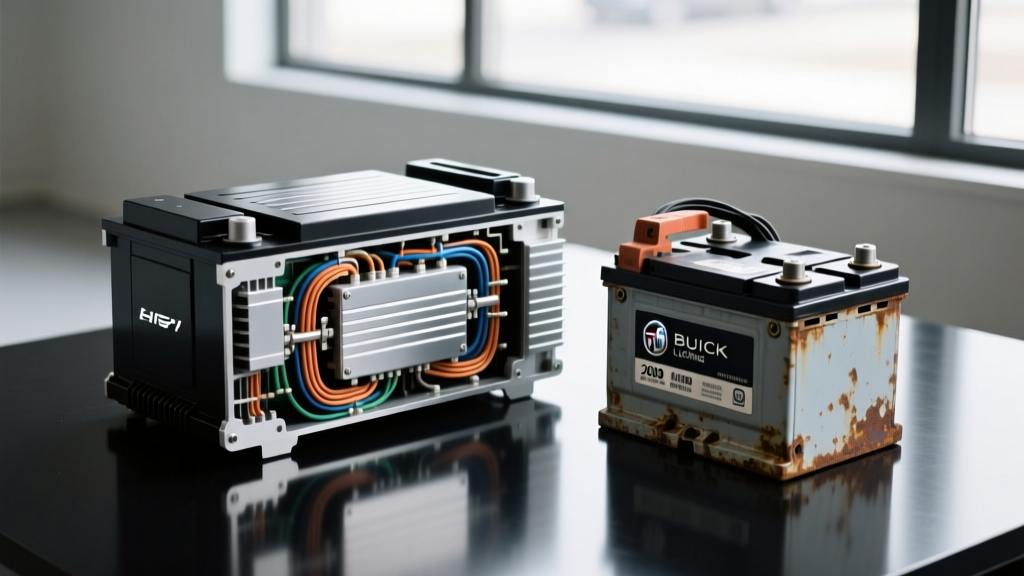
The 2008 Buick Lucerne uses a Group 78 or Group 75 lead-acid 12V battery rated at roughly 700–800 cold cranking amps (CCA). Its job: spin a starter motor and run the radio when the engine is off. Typical lifespan is 3–5 years, and replacement runs $150–$250. It weighs about 40 pounds and holds less than 1 kilowatt-hour (kWh) of usable energy.
An EV traction battery, by contrast, is the vehicle's primary energy source. Consider the numbers:
| Specification | 2008 Buick Lucerne 12V Battery | Typical 2026 EV Traction Battery |
|---|---|---|
| Chemistry | Lead-acid (flooded or AGM) | NMC, NCA, or LFP lithium-ion |
| Voltage | 12V nominal | 400V–800V nominal |
| Energy capacity | ~0.8 kWh | 58–131 kWh usable |
| Weight | ~40 lbs | 750–1,800 lbs |
| Typical lifespan | 3–5 years | 15–20+ years / 200,000+ miles |
| Replacement cost | $150–$250 | $5,000–$20,000+ |
| Thermal management | None (passive) | Active liquid cooling/heating |
Yes, EVs also carry a small 12V auxiliary battery (often lithium iron phosphate in newer models) to run lights, computers, and accessories. But when EV owners and engineers talk about the battery, they mean the multi-hundred-kilowatt-hour traction pack. That's what this guide covers.
LFP vs. NMC vs. NCA: The Chemistry Decision That Defines Your EV
In 2026, virtually every EV sold in the U.S. uses one of three lithium-ion cathode chemistries. The choice affects range, longevity, cold-weather performance, and price.
| Attribute | LFP (Lithium Iron Phosphate) | NMC (Nickel Manganese Cobalt) | NCA (Nickel Cobalt Aluminum) |
|---|---|---|---|
| Energy density | Lower (~160 Wh/kg cell-level) | Higher (~250–280 Wh/kg) | Highest (~260–300 Wh/kg) |
| Cycle life | 3,000–5,000+ cycles | 1,000–2,000 cycles | 1,000–1,500 cycles |
| Cold-weather performance | Moderate — slower charging below 32°F | Better low-temp charge acceptance | Good low-temp performance |
| Cost per kWh | Lower (~$80–$100/kWh pack-level) | Higher (~$120–$150/kWh) | Higher (~$120–$150/kWh) |
| Thermal stability | Excellent — lowest runaway risk | Good with active management | Good with active management |
| Recommended daily SoC | 100% is fine daily | 80% daily; 100% for trips only | 80% daily; 100% for trips only |
| Notable 2026 applications | Tesla Model 3/Y RWD, Ford Mustang Mach-E Select (LFP option), BYD models | Hyundai Ioniq 5/6, VW ID.4, Chevy Equinox EV | Tesla Model S/X, Rivian R1T/R1S (large pack trims) |
Which is better? It depends on how you drive. LFP wins for daily commuters who want maximum cycle life and don't need 350+ miles of range. You can charge it to 100% every night without accelerated degradation — a significant ownership convenience. NMC and NCA win for drivers prioritizing maximum range in a lighter package, especially those in colder climates where LFP's slower cold-charge acceptance matters. Neither chemistry is universally superior; both are mature and reliable in 2026.
How Long Do EV Batteries Actually Last? Degradation Data by the Numbers
The short answer: far longer than most buyers expect. Data from fleet operators, manufacturer warranty claims, and independent testing shows that modern EV batteries are outlasting their original projections.
Observed degradation patterns (2020–2026 fleet and owner data):
- Year 1 / 15,000 miles: 1–3% capacity loss (initial formation settling)
- Year 3 / 45,000 miles: 4–7% total loss
- Year 5 / 75,000 miles: 6–10% total loss
- Year 8 / 120,000 miles: 8–14% total loss
- Year 10 / 150,000 miles: 10–17% total loss (highly variable by usage)
- Year 15 / 200,000+ miles: 15–25% total loss for well-maintained packs
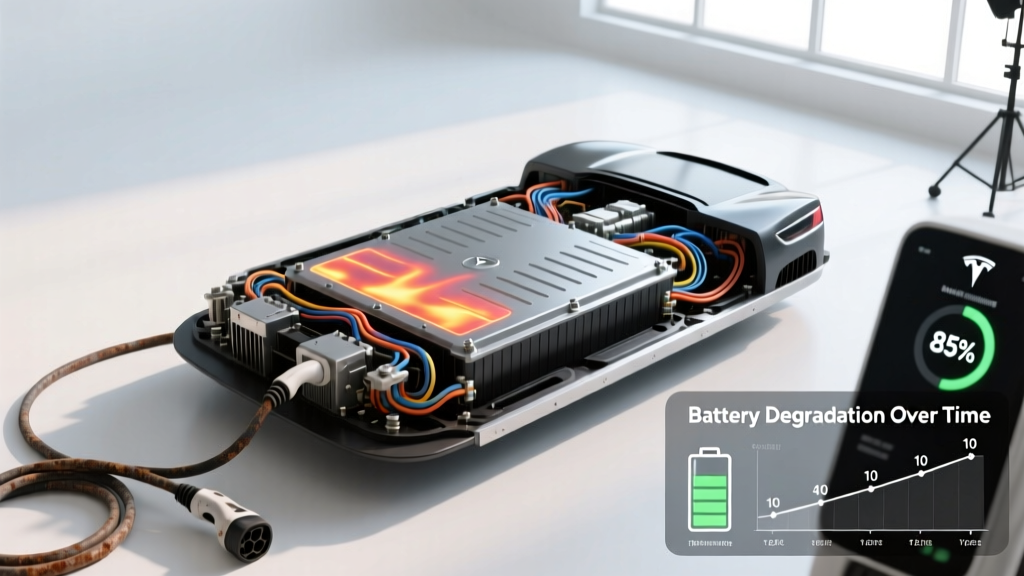
Tesla's 2025 Impact Report noted that Model 3/Y vehicles retained approximately 85% of original battery capacity at 150,000 miles. According to the U.S. Department of Energy via fueleconomy.gov, most EV batteries are designed to retain at least 70–80% of original capacity over 150,000–200,000 miles under normal use.
For context, a Chevrolet Equinox EV with an 85 kWh usable NMC pack losing 12% over 150,000 miles would still deliver roughly 245 miles of its original 279-mile EPA range — entirely livable for most drivers. The battery doesn't "die" at a cliff; it slowly fades, much like a smartphone.
What the Battery Warranty Actually Covers (and What It Doesn't)
Federal law mandates a minimum 8-year / 100,000-mile warranty on EV battery packs for emissions-related compliance, and nearly every major manufacturer meets or exceeds this baseline. In California Air Resources Board (CARB) states, some warranties extend to 10 years / 150,000 miles.
| Manufacturer (2026 Models) | Battery Warranty | Capacity Retention Threshold |
|---|---|---|
| Tesla (Model 3/Y RWD – LFP) | 8 years / 120,000 miles | 70% minimum |
| Tesla (Model 3/Y Long Range – NMC) | 8 years / 120,000 miles | 70% minimum |
| Hyundai / Kia (Ioniq 5, EV6) | 10 years / 100,000 miles | 70% minimum |
| General Motors (Equinox EV, Blazer EV) | 8 years / 100,000 miles | 60% minimum (some trims 70%) |
| Ford (Mustang Mach-E, F-150 Lightning) | 8 years / 100,000 miles | 70% minimum |
| Volkswagen (ID.4) | 8 years / 100,000 miles | 70% minimum |
| Rivian (R1T / R1S) | 8 years / 175,000 miles | 70% minimum |
Key details buyers miss:
- The threshold matters. A 70% retention guarantee means the manufacturer replaces or repairs the pack only if it drops below 70% of original capacity within the warranty period. A pack at 72% — while degraded — is considered "within spec."
- Warranties cover defects AND excessive degradation. If your pack drops to 65% at 80,000 miles, that's a warranty claim, not just a "defect."
- Module-level repair is common. Manufacturers often replace individual modules (a fraction of the full pack) rather than the entire battery, reducing cost and waste.
- The warranty does not cover: damage from accidents, flooding, improper modifications, or use outside manufacturer guidelines (e.g., persistent 100% SoC storage on NMC packs against recommendations).
EV Battery Replacement Cost: What You'd Actually Pay — and When
Full traction battery replacement is rare before 200,000 miles, but it's important to know the numbers. Costs vary enormously by pack size and chemistry.
| Vehicle Category | Example Models | Pack Size (usable kWh) | Estimated Replacement Cost (2026) |
|---|---|---|---|
| Compact / Standard Range | Tesla Model 3 RWD, Chevy Bolt EV | 50–65 kWh | $5,000–$9,000 |
| Mid-size / Long Range | Hyundai Ioniq 5, VW ID.4, Tesla Model Y LR | 72–82 kWh | $9,000–$14,000 |
| Large / Extended Range | Ford F-150 Lightning Ext., Rivian R1T Max | 100–149 kWh | $14,000–$22,000 |
| Luxury / Performance | Mercedes EQS, Tesla Model S | 95–118 kWh | $15,000–$25,000+ |
A few realities that temper the sticker shock:
- Most owners never pay this. If degradation stays above the warranty threshold (which the vast majority do), the manufacturer covers it. Independent data from Recurrent Auto shows fewer than 2% of EV batteries have required out-of-warranty replacement as of 2025.
- Prices are declining. Pack-level costs have fallen roughly 80% since 2013. By 2030, analysts project further reductions driven by LFP adoption and manufacturing scale.
- Module-level repair is cheaper. Replacing a single degraded module might cost $1,500–$4,000 rather than swapping the entire pack.
- The comparison baseline: A 2008 Buick Lucerne with its 3.8L V6 would have consumed roughly $12,000–$18,000 in gasoline over 200,000 miles at 2026 fuel prices. The EV battery, even if replaced once, often costs less than the fuel it displaced.
Five Factors That Accelerate (or Preserve) Battery Health
Not all miles age a battery equally. These five factors have the largest measurable impact on long-term State of Health (SoH):
- State of Charge (SoC) habits. For NMC/NCA packs, daily charging to 80% and avoiding prolonged storage above 90% or below 10% significantly extends cycle life. LFP packs tolerate 100% daily charging and benefit from periodic full charges for cell balancing. Storing any EV at 50% SoC for extended periods (e.g., vacations) is ideal.
- DC fast-charging frequency. Occasional fast charging (1–2 times per week) has minimal impact. Daily reliance on 150+ kW DC fast charging can add 1–3% extra degradation over 100,000 miles compared to predominantly Level 2 home charging. Modern thermal management has reduced this penalty substantially, but the physics of lithium plating at high C-rates still applies.
- Extreme temperatures. Sustained exposure to ambient temperatures above 95°F accelerates electrolyte decomposition. Cold weather below 20°F doesn't permanently damage the battery but temporarily reduces available capacity and slows charge acceptance. Garage parking in both summer and winter measurably helps.
- Depth of discharge cycles. Shallow cycles (e.g., charging from 30% to 80%) are gentler than deep cycles (5% to 95%). You don't need to obsess over this — the battery management system (BMS) includes top and bottom buffers — but avoiding running the pack to near-zero regularly is beneficial.
- Preconditioning before fast charging. Using your EV's built-in navigation to route to a DC fast charger triggers battery preconditioning — warming the pack to optimal temperature for charging. This reduces stress on the cells and improves charge speed. Arriving at a fast charger with a cold, un-preconditioned pack forces the charger to heat the battery before delivering peak power.
How to Check Your Battery's State of Health (SoH)
Most 2026 EVs provide SoH data directly through the infotainment system or companion app. Here's how to access it by brand:
- Tesla: No built-in SoH percentage in the app, but you can calculate it: compare your current full-charge range estimate (at 100% SoC) to the original EPA range. Third-party tools like TeslaFi or Tessie log detailed degradation curves.
- Hyundai / Kia: The EV-specific menu in the infotainment system displays battery condition as a percentage. The Bluelink / Kia Connect app also reports this.
- General Motors (Ultium platform): The myChevrolet / myCadillac app includes a battery health indicator. OnStar diagnostics can provide a detailed report.
- Ford: The FordPass app shows estimated range at full charge, which you can compare to original EPA figures. Dealers can pull a detailed SoH readout via OBD-II diagnostics.
- Volkswagen: The Car-Net / VW ID app displays battery health status. Dealership diagnostics provide cell-level voltage variance data.
For a more precise reading: Any EV-certified dealership can perform a battery health check using manufacturer diagnostic tools. This typically takes 30–60 minutes and provides cell-by-cell voltage data, internal resistance measurements, and a calculated SoH percentage. Some owners use OBD-II dongles paired with apps like ABRP (A Better Routeplanner) or Car Scanner to pull live battery data.
What's Next: Solid-State and Silicon-Anode Batteries (Forward-Looking)
Emerging battery technologies promise step-change improvements, but realistic timelines matter.
Solid-state batteries replace the liquid electrolyte with a solid ceramic or polymer separator, potentially offering 40–50% higher energy density, faster charging, and improved safety. Toyota, Nissan, and Samsung SDI have announced solid-state production targets for 2028–2030, but these are initially expected in limited, premium applications. Widespread, affordable solid-state EVs are not expected before 2032 at the earliest, according to U.S. Department of Energy research summaries.
Silicon-anode batteries (used by companies like Sila Nanotechnologies and Group14) replace graphite anodes with silicon-dominant materials, boosting energy density by 20–40%. These are already entering production in 2025–2026 in limited applications and are expected to become mainstream by 2028–2029. Mercedes-Benz's upcoming G-Class EV is one announced early adopter.
Sodium-ion batteries offer a lower-cost, cobalt-free alternative with slightly lower energy density. CATL and BYD are producing these for budget EVs in China, and U.S. market introduction in entry-level models is plausible by 2028.
None of these technologies are available in 2026 production vehicles at scale. If you're buying an EV today, current LFP and NMC chemistries are mature, well-understood, and backed by extensive warranty coverage.
Frequently Asked Questions
How long do EV batteries last in years and miles?
Based on fleet data through 2026, most modern EV traction batteries retain 75–85% of original capacity at 150,000 miles and 10–12 years of age. Many packs are projected to remain functional (above 70% capacity) past 200,000 miles. The battery does not suddenly fail — it gradually loses capacity, similar to a laptop battery. With proper care, the battery will likely outlast other major vehicle components.
How much does an EV battery cost to replace?
Full pack replacement in 2026 ranges from approximately $5,000 for a compact EV (50–65 kWh pack) to $22,000+ for a large truck or luxury sedan (100+ kWh pack). However, fewer than 2% of EV owners have paid for out-of-warranty replacement. Module-level repairs cost $1,500–$4,000. Most packs last the life of the vehicle under warranty coverage.
What does the EV battery warranty cover?
Standard warranties cover both manufacturing defects and excessive capacity degradation — typically guaranteeing at least 70% capacity retention over 8 years / 100,000 miles (or 10 years / 100,000 miles for Hyundai/Kia). If your battery drops below the threshold, the manufacturer repairs or replaces it at no cost. Warranties do not cover accident damage, flood damage, or unauthorized modifications. For EV tax credit information that may offset purchase costs, see the IRS §30D guidelines.
How do I check and maximize my EV battery health?
Check SoH through your vehicle's infotainment system, companion app, or a dealership diagnostic check. To maximize longevity: charge NMC/NCA packs to 80% daily (100% for LFP), avoid storing the vehicle at very high or very low SoC, use Level 2 home charging as your primary method, precondition the battery before DC fast charging, and park in a garage during extreme heat when possible.
LFP vs. NMC — which battery chemistry is better?
Neither is universally superior. Choose LFP if you want the longest cycle life (3,000–5,000+ cycles), the convenience of daily 100% charging, lower cost, and best thermal safety — and you don't need 350+ miles of range. Choose NMC/NCA if you prioritize maximum range per charge, better cold-weather fast-charging performance, and lighter pack weight. Both chemistries are proven, reliable, and backed by comparable warranties in 2026.
Is replacing an EV battery like replacing the battery in a 2008 Buick Lucerne?
No. The 2008 Buick Lucerne's 12V lead-acid battery is a $150–$250 consumable you swap every 3–5 years. An EV traction battery is a structurally integrated, liquid-cooled lithium-ion pack costing $5,000–$22,000 that typically lasts 15–20 years. The EV also carries its own small 12V auxiliary battery (similar in concept to the Lucerne's), which still costs $150–$400 to replace. The two systems serve entirely different purposes.