If you've ever swapped a 12-volt lead-acid battery in a 2006 Ram 1500, you know the drill: a $150-$200 Group 34 or H7 AGM unit, a 10mm wrench, and ten minutes in the driveway. But as that same truck owner — or any long-haul driver — considers switching to an electric vehicle, the battery conversation changes entirely. An EV's high-voltage traction battery is a fundamentally different beast: a 60-130 kWh lithium-ion pack that can cost $10,000-$25,000 to replace and is engineered to last the life of the vehicle.
This guide bridges that gap. We'll compare the simple 12V battery in your 2006 Ram 1500 to modern EV traction batteries, then dive deep into the chemistry, degradation data, warranty terms, replacement economics, and care practices that every current or prospective EV owner needs to understand in 2026.
What Kind of Battery Does a 2006 Ram 1500 Use?
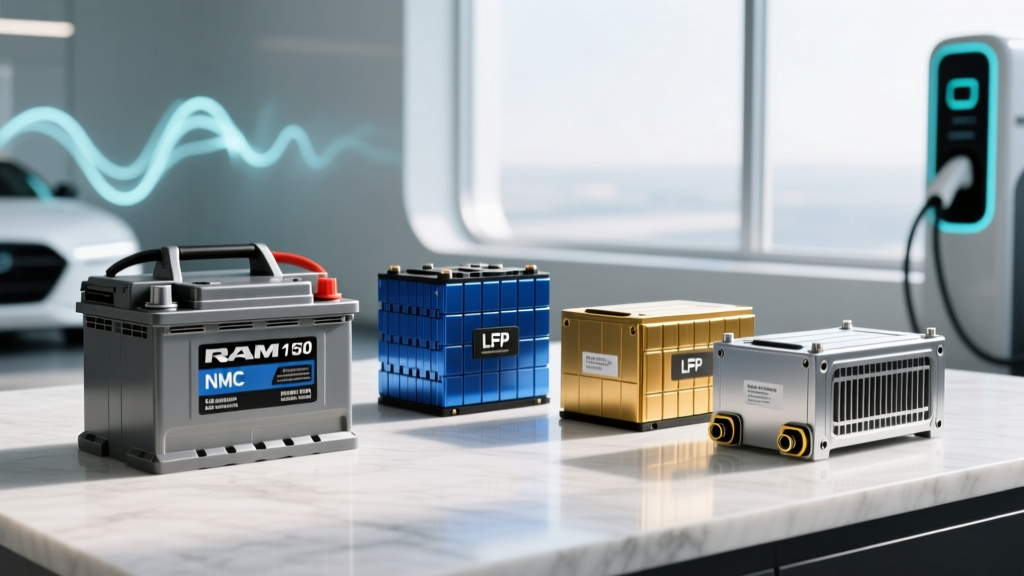
The 2006 Dodge Ram 1500 uses a conventional 12-volt lead-acid battery — typically a Group 34, Group 65, or H7 (Group 94R) size depending on the engine (the 4.7L V8, 5.7L HEMI V8, and 8.3L V10 each have slightly different cranking-amp requirements). You're looking at roughly 700-850 cold cranking amps (CCA) and a replacement cost between $120 and $220 at any auto parts store. Lifespan? Expect 3-5 years in moderate climates, shorter in extreme heat.
This battery serves one purpose: start the internal combustion engine and power accessories when the alternator isn't spinning. It's a commodity item, widely available, and trivially replaceable.
An electric vehicle's traction battery is an entirely different category of component — and understanding that difference is critical before you make an EV purchase decision.
EV Traction Batteries Explained: kWh, Chemistry, and Why It Matters
An EV's traction battery is the high-voltage lithium-ion pack that stores energy and powers the electric motor(s). Capacity is measured in kWh (kilowatt-hours) — the total energy the battery can hold. For reference, a Tesla Model Y Long Range carries roughly 75 kWh of usable capacity, a Ford F-150 Lightning Extended Range holds about 131 kWh, and a Chevrolet Equinox EV has approximately 85 kWh usable. More kWh generally means more range, but vehicle weight and efficiency (measured in kWh per 100 miles) also play major roles.
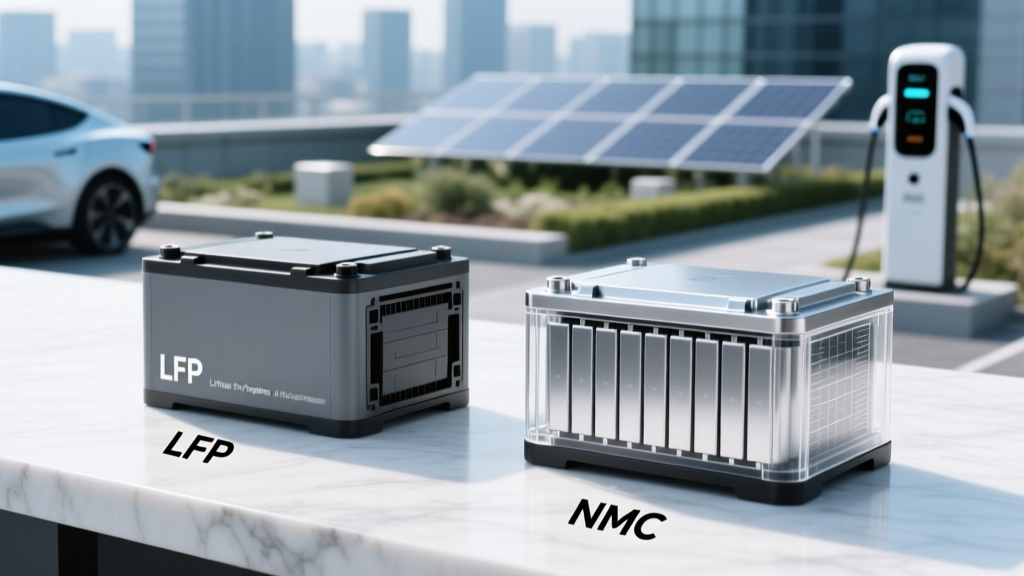
The two dominant lithium-ion chemistries in 2026 EVs are NMC/NCA (nickel manganese cobalt / nickel cobalt aluminum) and LFP (lithium iron phosphate). The choice between them affects range, longevity, cold-weather performance, and price.
| Attribute | LFP (Lithium Iron Phosphate) | NMC / NCA (Nickel-based) |
|---|---|---|
| Energy Density | Lower (~160 Wh/kg cell-level) | Higher (~250-300 Wh/kg cell-level) |
| Cycle Life | 3,000-5,000+ cycles | 1,000-2,000 cycles |
| Cold-Weather Performance | Reduced — slower charging below 32°F, ~15-25% range loss | Better — more tolerant, ~10-20% range loss |
| Cost per kWh | Lower (~$80-100/kWh pack-level in 2026) | Higher (~$110-140/kWh pack-level) |
| Cobalt Content | None | Varies (NCA minimal, NMC some) |
| State of Charge Tolerance | Can charge to 100% daily without degradation penalty | Best kept 20-80% for daily use |
| Common Applications | Tesla Model 3/Y RWD, Ford Mustang Mach-E Select, BYD models | Tesla Long Range, Hyundai Ioniq 5/6, Rivian, most long-range EVs |
Which is better? It depends on your use case. If you want maximum range and don't mind charging to 80% daily, NMC/NCA delivers higher energy density. If you prioritize longevity, lower cost, and the convenience of charging to 100% every day (ideal for commuters with predictable routes), LFP is the stronger choice — provided you don't live in a consistently sub-freezing climate where LFP's cold-weather limitations become more pronounced.
How Long Do EV Batteries Actually Last?
This is the single most common concern among EV shoppers — and the data is reassuring. Based on fleet data, manufacturer reports, and independent testing from sources like Recurrent Auto, modern EV batteries are lasting significantly longer than early-generation packs.
Typical lifespan: Most EV batteries manufactured from 2020 onward are engineered for 15-20 years or 150,000-200,000+ miles before reaching the end of their useful automotive life (typically defined as 70-80% of original capacity).
Here's what real-world degradation looks like across different timeframes:
| Timeframe | Typical Capacity Loss | Context / Data Source |
|---|---|---|
| Year 1 | 1-3% | Initial formation loss; most pronounced in first few thousand miles |
| Years 2-4 | ~1% per year | Linear degradation phase; Tesla fleet data shows ~90-92% SoH at 100k miles (per Tesla 2023 Impact Report) |
| Years 5-8 | ~0.5-1% per year | Degradation curve flattens; most packs at 85-90% SoH |
| Years 10+ | Gradual, ~0.5%/yr | Limited long-term data on newest chemistries; early Nissan Leaf (passive cooling) degraded faster than liquid-cooled packs |
| High-mileage outlier | ~12-15% loss at 200k mi | Tesla Model S/X fleet data; liquid-cooled packs hold up well |
Critical nuance: Early EVs with passive air-cooled batteries (notably the 2011-2017 Nissan Leaf) degraded significantly faster — sometimes losing 20-30% capacity in 5 years, especially in hot climates. Modern liquid-cooled thermal management systems (standard on virtually all 2026 EVs) have dramatically improved longevity. This is not your 2013 Leaf's battery.
What Does the EV Battery Warranty Cover?
Federal law mandates that EV batteries carry a minimum warranty of 8 years / 100,000 miles (10 years / 150,000 miles in California and states that follow CARB standards). Most manufacturers exceed this floor. Here's how major warranties compare in 2026:
| Manufacturer | Warranty Term | Capacity Retention Threshold | Notes |
|---|---|---|---|
| Tesla (Model 3/Y RWD — LFP) | 8 yr / 100,000 mi | 70% | Standard range models |
| Tesla (Model 3/Y Long Range, S, X) | 8 yr / 120,000-150,000 mi | 70% | Varies by model |
| Hyundai / Kia (E-GMP platform) | 10 yr / 100,000 mi | 70% | Among the longest coverage |
| Ford (Mustang Mach-E, F-150 Lightning) | 8 yr / 100,000 mi | 70% | Applies to high-voltage battery |
| GM (Ultium platform — Equinox EV, Blazer EV, Silverado EV) | 8 yr / 100,000 mi | 70% | Standard across Ultium vehicles |
| Rivian (R1T, R1S) | 8 yr / 175,000 mi | 70% | Higher mileage cap reflects truck use |
| BMW (i4, iX, i7) | 8 yr / 100,000 mi | 70% | Includes battery management system |
What triggers a warranty claim? If your battery's State of Health (SoH) drops below the stated threshold (usually 70% of original capacity) within the warranty period, the manufacturer will repair or replace it — typically replacing failed modules rather than the entire pack. Normal gradual degradation above the threshold is not covered.
What voids the warranty? Physical damage (collision, flooding), unauthorized modifications to the high-voltage system, or use of non-approved charging equipment that causes damage. Simply DC fast-charging frequently does not void your warranty, despite common myths.
How Much Does It Cost to Replace an EV Battery?
This is where the comparison to your 2006 Ram 1500's $160 battery becomes stark. EV traction battery replacement is a major service event — but context matters enormously.
| Vehicle / Pack Size | Battery Capacity | Estimated Replacement Cost (Parts + Labor) | When Is It Typically Needed? |
|---|---|---|---|
| Tesla Model 3 RWD (LFP) | ~60 kWh | $12,000 - $16,000 | Rarely within 15 years; module repair more common ($2,000-$5,000) |
| Tesla Model Y Long Range | ~75 kWh | $14,000 - $20,000 | Out-of-warranty replacement uncommon before 200k+ mi |
| Ford F-150 Lightning Ext. Range | ~131 kWh | $22,000 - $32,000 | Large pack; individual module replacement $3,000-$7,000 |
| Hyundai Ioniq 5 | ~77.4 kWh | $14,000 - $18,000 | 10-yr warranty reduces owner risk significantly |
| Chevrolet Bolt EV (2nd gen) | ~65 kWh | $10,000 - $14,000 | Smaller pack = lower absolute cost |
| Rivian R1T (Large Pack) | ~128 kWh | $20,000 - $28,000 | Module-level repair preferred by Rivian service |
Key context most coverage misses:
- Most EV batteries never need full replacement. According to Recurrent, fewer than 5% of EVs have required battery replacement, and many of those were due to manufacturing defects caught under warranty — not age-related degradation.
- Module-level repair is increasingly standard. Rather than replacing the entire pack, technicians can identify and swap individual failed modules for $2,000-$7,000 — a fraction of the full-pack cost.
- Pack costs are declining. Battery pack prices have fallen from over $1,000/kWh in 2010 to roughly $100-$140/kWh in 2026, per BloombergNEF tracking. By the time a 2026 EV actually needs an out-of-warranty replacement in 2038-2040, costs will likely be substantially lower.
- The battery usually outlasts the rest of the car. Suspension, electronics, and body components often reach end-of-life before the battery drops below 70% SoH.
Factors That Affect EV Battery Life — and What You Can Control
Not all miles are created equal when it comes to battery wear. Here's what accelerates degradation and what you can do about it:
Do: Maximize Battery Longevity
- Charge to 80% daily (NMC/NCA): Keeping the pack between 20-80% State of Charge reduces stress on the cathode. LFP owners can charge to 100% daily without penalty.
- Use Level 2 home charging as your primary method: Slow, steady charging at 7-11.5 kW generates far less heat than DC fast charging.
- Precondition the battery before DC fast charging: Most EVs do this automatically when you navigate to a charger. A warm battery (around 77-95°F / 25-35°C) accepts charge faster and with less stress.
- Park in shade or a garage in extreme heat: Sustained high temperatures (above 100°F ambient) accelerate calendar degradation. Active thermal management helps, but reducing exposure is better.
- Drive it regularly: Batteries prefer regular use over sitting at high SoC for weeks. If storing for extended periods, leave the car plugged in with a charge limit set to 50-60%.
Don't: Common Battery Mistakes
- Don't DC fast-charge exclusively: Occasional DC fast charging is fine, but using it as your only charging method (e.g., daily 150-250 kW sessions) adds cumulative heat stress. Studies suggest exclusively DC fast-charged packs may degrade 2-5% more over 100,000 miles compared to primarily Level 2 charged packs.
- Don't leave the car at 100% SoC for days (NMC/NCA): High voltage at full charge accelerates electrolyte decomposition. Charge to 100% only when you'll drive soon after.
- Don't let the battery sit at 0% for extended periods: Deep discharge can damage cells. If you're approaching empty, charge soon.
- Don't ignore extreme cold without preconditioning: Charging a frozen battery (below 32°F / 0°C) without preconditioning can cause lithium plating on the anode — permanent damage. Always let the car warm the battery first.
How to Check Your EV Battery's State of Health (SoH)
State of Health (SoH) is the percentage of original capacity your battery still holds. A brand-new pack is 100% SoH; a pack that held 75 kWh when new but now holds 67.5 kWh is at 90% SoH.
How to check it:
- In-car displays: Some manufacturers (Tesla, BMW, Hyundai) provide battery health indicators in the infotainment system or service menu. Tesla's "Battery Health" feature (rolled out in 2024) shows estimated range compared to when new.
- OBD-II diagnostic tools: Third-party apps like Leaf Spy (Nissan), Scan My Tesla, or Car Scanner can read detailed battery telemetry — individual cell voltages, pack temperature, charge cycles, and calculated SoH — through the OBD-II port.
- Dealer service department: Any authorized service center can run a full battery diagnostic and provide an SoH report. Request this during routine service visits.
- Third-party services: Companies like Recurrent provide battery health reports for used EVs, useful when shopping pre-owned.
When to be concerned: If your SoH drops more than 3% in a single year after the initial break-in period, or if you notice a sudden range decrease that doesn't correlate with cold weather, schedule a diagnostic. Sudden capacity drops can indicate a failing module — which is often covered under warranty.
What's Next: Solid-State, Silicon Anodes, and Beyond
Several next-generation battery technologies are in development, but realistic timelines matter:
Silicon anode batteries: Companies like Sila Nanotechnologies and Group14 are replacing graphite anodes with silicon-dominant materials, boosting energy density by 20-40%. These are entering limited production in 2026-2027 (Mercedes-Benz G-Class EV will feature silicon anode cells from Group14). Expect broader adoption by 2028-2029.
Solid-state batteries: These replace the liquid electrolyte with a solid material, promising higher energy density, faster charging, and improved safety. Toyota, Samsung SDI, and QuantumScape have all announced pilot production, with Toyota targeting limited commercialization around 2027-2028. However, manufacturing scale-up remains the primary bottleneck. Widespread availability in mainstream, affordably priced EVs is not expected before 2030-2032.
Sodium-ion batteries: CATL and BYD are producing sodium-ion cells for lower-cost, shorter-range EVs. These offer lower energy density than lithium-ion but eliminate lithium and cobalt entirely, reducing cost and supply-chain risk. Expect these in budget-oriented city EVs by 2027-2028, primarily in Asian and European markets initially.
The practical takeaway: If you're buying an EV in 2026, current lithium-ion technology (both LFP and NMC) is mature, well-tested, and backed by robust warranties. Waiting for solid-state means waiting 4-6+ years for mainstream availability.
From Your Ram 1500 to an EV: The Battery Mindset Shift
The 2006 Ram 1500's 12V battery and an EV's traction battery represent two entirely different paradigms of vehicle ownership. The Ram's battery is a wear item you budget for every few years — cheap, simple, and disposable. An EV's traction battery is a capital component designed to outlast the vehicle itself, backed by an 8-10 year federal warranty mandate, and continuously monitored by sophisticated battery management systems.
The fear of a $20,000 battery replacement is understandable but, for the vast majority of owners, theoretical. The data consistently shows that modern liquid-cooled lithium-ion packs retain 85-90% of their capacity at 100,000 miles and remain functional well past 150,000-200,000 miles. With pack costs declining and module-level repair becoming standard, the long-term risk is far lower than internet forums suggest.
If you're cross-shopping your next vehicle and weighing a late-model used truck against a new EV, the battery should be the least of your worries — not the most.
How long do EV batteries last in years and miles?
Modern EV batteries (2020 and newer, liquid-cooled) are designed for 15-20 years or 150,000-200,000+ miles before dropping below 70-80% of original capacity. Real-world fleet data from Tesla shows approximately 90% capacity retention at 100,000 miles. Early-generation air-cooled batteries (2011-2017 Nissan Leaf) degraded faster, but this is not representative of current technology.
How much does an EV battery cost to replace?
Full pack replacement ranges from approximately $10,000-$16,000 for a 60 kWh pack (Chevrolet Bolt, Tesla Model 3 RWD) to $22,000-$32,000 for a 130+ kWh pack (F-150 Lightning Extended Range, Rivian R1T). However, most batteries never require full replacement, and module-level repair typically costs $2,000-$7,000. Pack costs continue to decline annually.
What does the EV battery warranty cover?
Federal law requires a minimum 8-year / 100,000-mile battery warranty (10/150,000 in CARB states). Coverage applies if the battery's capacity drops below a stated threshold — typically 70% of original capacity. The warranty covers defects, premature degradation, and module failures. It does not cover physical damage from collisions or unauthorized modifications.
How do I check and maximize my EV battery health?
Check SoH through in-car diagnostics, OBD-II apps (Leaf Spy, Scan My Tesla), or dealer service visits. To maximize longevity: charge to 80% daily on NMC/NCA packs (100% is fine for LFP), rely on Level 2 home charging, precondition before DC fast charging, avoid prolonged storage at 100% or 0% SoC, and protect the vehicle from sustained extreme heat when possible.
LFP vs NMC — which battery chemistry is better?
Neither is universally superior. LFP offers longer cycle life (3,000-5,000+ vs. 1,000-2,000 cycles), lower cost, no cobalt, and the ability to charge to 100% daily — but has lower energy density and worse cold-weather performance. NMC/NCA provides higher energy density (more range in a smaller, lighter pack) and better cold-weather operation, but should be kept between 20-80% for daily use. Choose LFP for commuting and longevity; choose NMC/NCA for maximum range and cold-climate driving.
Does DC fast charging damage my EV battery?
Occasional DC fast charging causes no meaningful harm. Exclusively relying on DC fast charging (daily use at 150+ kW) may add 2-5% additional degradation over 100,000 miles compared to primarily Level 2 charging, due to cumulative heat stress. Modern battery management systems actively limit charge rates when the pack is too cold or too warm, providing built-in protection. Use DC fast charging for road trips; use Level 2 at home for daily needs.