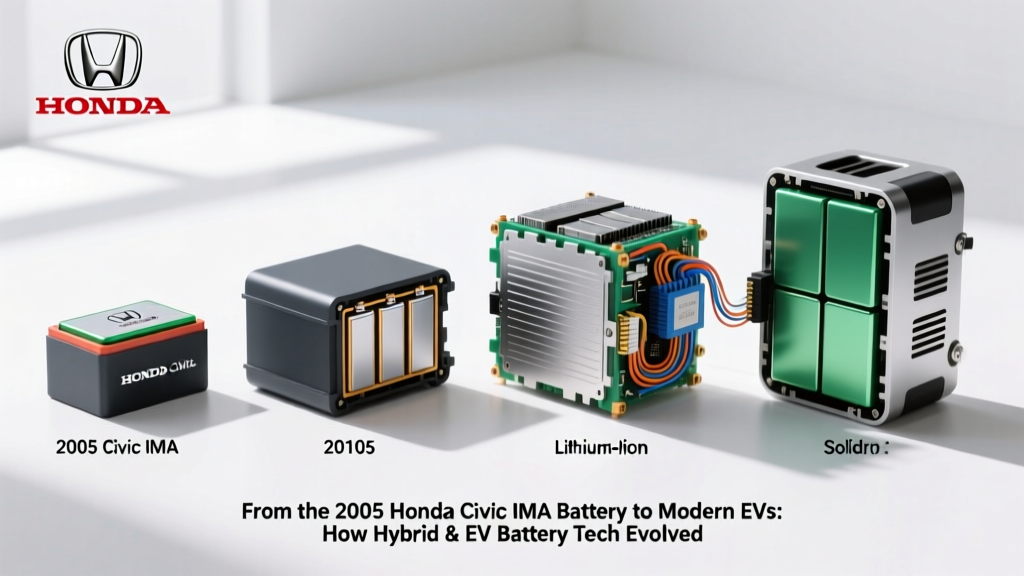
If you owned or researched a 2005 Honda Civic IMA (Integrated Motor Assist), you likely remember one persistent concern: the nickel-metal hydride (NiMH) hybrid battery. That compact IMA pack — rated at roughly 0.35 kWh and mounted behind the rear seat — was one of the earliest mass-market hybrid batteries sold in the United States. Two decades later, the questions that plagued Civic IMA owners — how long will it last, what does replacement cost, and how do I keep it healthy? — remain the exact same questions modern EV buyers ask about lithium-ion traction batteries.
The difference? The answers have changed dramatically. This guide traces the arc from that early NiMH pack to the NMC and LFP batteries powering 2026's electric vehicles, with hard data on degradation, warranty coverage, replacement economics, and the care habits that maximize battery life.
The 2005 Honda Civic IMA Battery: What We Learned From Early Hybrid Packs
The 2005 Honda Civic Hybrid used Honda's IMA system, pairing a 1.3L gasoline engine with a thin electric motor sandwiched between the engine and transmission. The high-voltage NiMH battery pack stored just 0.35 kWh of energy — enough to assist acceleration and enable brief engine-off coasting, but not to drive the car on electricity alone. For context, a modern Tesla Model 3 Long Range carries roughly 75 kWh of usable energy — over 200 times the IMA pack's capacity.
That early NiMH pack taught the industry several lessons that still apply:
- Heat accelerates degradation. Civic IMA batteries in hot climates (Arizona, Texas) often failed between 60,000–90,000 miles, while those in cooler regions regularly exceeded 120,000 miles.
- Shallow cycling extends life. The IMA system deliberately kept the battery between roughly 20% and 80% state of charge (SoC), never fully charging or fully depleting it — a buffer strategy every modern EV still uses.
- Replacement cost stings on an older vehicle. A dealer replacement IMA battery ran $2,000–$3,500 in the mid-2000s (roughly $3,000–$5,000 adjusted for inflation), which often exceeded the car's residual value by year eight or ten.
These patterns — thermal sensitivity, buffer management, and the economic pain of out-of-warranty replacement — directly shaped how engineers designed the lithium-ion packs in today's EVs.
Modern EV Battery Chemistry: LFP vs. NMC Explained
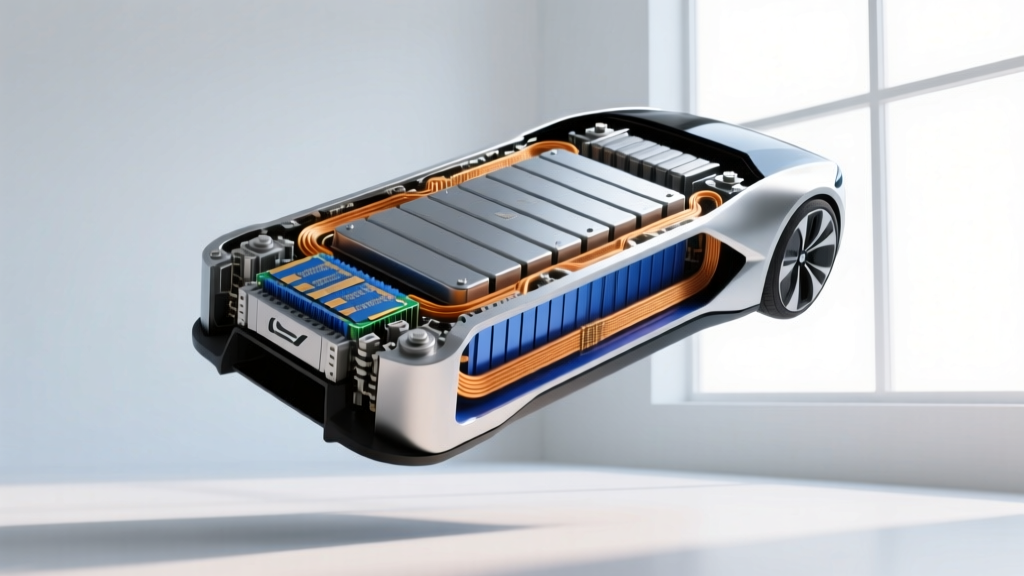
Virtually every 2026 EV uses one of two lithium-ion chemistries: NMC (nickel manganese cobalt) or LFP (lithium iron phosphate). The chemistry choice affects range, longevity, cold-weather behavior, and price. Here's how they compare:
| Attribute | NMC / NCA | LFP |
|---|---|---|
| Energy Density | Higher (~250–300 Wh/kg cell-level) | Lower (~160–200 Wh/kg cell-level) |
| Typical EV Range | 300–400+ mi EPA | 230–330 mi EPA (same vehicle class) |
| Cycle Life | ~1,000–2,000 full cycles | ~3,000–5,000+ full cycles |
| Cold Performance | Better low-temp power delivery | Greater range loss below 32°F; slower cold charging |
| 100% SoC Charging | Degrades faster if held at 100% routinely | Can be charged to 100% regularly without significant harm |
| Cost (2026) | ~$110–$140/kWh pack-level | ~$80–$100/kWh pack-level |
| Cobalt Content | Contains cobalt (supply-chain/ethics concern) | Cobalt-free |
| Common 2026 Examples | Tesla Model 3 LR, Hyundai Ioniq 5, Ford F-150 Lightning Extended | Tesla Model 3 RWD, BYD Seal, base Ford Mustang Mach-E Select |
Which is better? There is no universal winner. NMC delivers more range per kilogram, making it the choice for long-range and performance trims. LFP offers far superior cycle life and lower cost, making it ideal for standard-range models and fleet/high-mileage use. If you drive 30+ miles daily and can charge at home nightly, an LFP pack's longevity advantage compounds significantly over a decade.
How Long Do EV Batteries Actually Last? Degradation Data
The fear that EV batteries need replacement every few years is a holdover from early hybrids like the Civic IMA. Modern lithium-ion packs tell a very different story.
Typical Degradation Curve (NMC and LFP Packs, 2020–2026 Data):
- Year 1 / 15,000 mi: 2–5% capacity loss (initial formation loss)
- Year 3 / 45,000 mi: 5–8% total loss
- Year 5 / 75,000 mi: 7–12% total loss
- Year 8 / 120,000 mi: 10–18% total loss (NMC); 5–10% (LFP)
- Year 10 / 150,000 mi: 12–22% total loss (NMC); 8–14% (LFP)
These figures come from aggregated fleet data reported by sources including Geotab's long-term EV battery study, which tracked over 6,000 electric vehicles. The key insight: degradation is not linear. Most capacity loss occurs in the first year or two, then the curve flattens considerably. A 2023 Tesla Model 3 with an NMC pack, for example, typically retains 88–92% of its original capacity at 60,000 miles — meaning a car with a 358-mile EPA rating still delivers roughly 315–330 miles of range at that age.
For comparison, the 2005 Civic IMA's NiMH pack often lost 20–30% of its already-small capacity within 80,000 miles, and because the pack was so small, that loss was immediately noticeable as reduced fuel economy and assist performance.
What Does the Battery Warranty Cover?
Federal regulations mandate that EV and hybrid battery warranties cover at least 8 years / 100,000 miles (10 years / 150,000 miles in CARB states like California, New York, and Massachusetts). Most manufacturers meet or exceed this floor. Here's what coverage looks like across popular 2026 models:
| Vehicle (2026 MY) | Battery Warranty | Capacity Threshold |
|---|---|---|
| Tesla Model 3 Long Range (NMC) | 8 yr / 120,000 mi | 70% retention |
| Tesla Model 3 RWD (LFP) | 8 yr / 100,000 mi | 70% retention |
| Hyundai Ioniq 5 (NMC) | 10 yr / 100,000 mi | 70% retention |
| Ford F-150 Lightning (NMC) | 8 yr / 100,000 mi | 70% retention |
| Chevrolet Equinox EV (NMC) | 8 yr / 100,000 mi | 60% retention |
| Toyota bZ4X (NMC) | 8 yr / 100,000 mi | 70% retention |
The critical detail is the capacity retention threshold. If your battery drops below the stated percentage within the warranty period, the manufacturer must repair or replace it at no cost. In practice, very few modern EV batteries breach the 70% threshold within 100,000 miles — which is why out-of-warranty replacement remains uncommon for vehicles under 150,000 miles.
This is a stark contrast to the 2005 Civic IMA era, when Honda's hybrid battery warranty was 8 years / 80,000 miles (extended to 10 years / 120,000 miles in CARB states after a class-action settlement), and many packs failed just outside that window.
EV Battery Replacement Cost: What to Budget
When an EV battery does eventually need replacement — typically beyond 150,000–200,000 miles for modern packs — the cost depends heavily on battery size and chemistry. Prices have declined substantially; where a 2012 Nissan Leaf replacement ran $6,500+ for a 24 kWh pack, today's larger packs benefit from lower per-kWh pricing even as total capacity increases.
| Vehicle / Pack Size | Chemistry | Estimated Replacement Cost (2026) |
|---|---|---|
| Tesla Model 3 RWD (~60 kWh) | LFP | $7,000–$10,000 |
| Tesla Model 3 LR (~75 kWh) | NMC | $10,000–$14,000 |
| Hyundai Ioniq 5 (~77 kWh) | NMC | $11,000–$16,000 |
| Ford F-150 Lightning Ext. (~131 kWh) | NMC | $18,000–$25,000 |
| Chevrolet Bolt EV (~65 kWh) | NMC | $8,000–$12,000 |
| 2005 Honda Civic IMA (~0.35 kWh) | NiMH | $2,000–$4,000 (aftermarket/refurb) |
Important context: These costs include the battery module and labor but can vary by region, dealership vs. independent shop, and whether OEM or refurbished modules are used. Most EVs will never need a full pack replacement during typical first-owner use. According to data from Consumer Reports, the vast majority of EV batteries outlast 150,000 miles with over 80% capacity remaining. When replacement is needed, it's often individual modules rather than the entire pack, reducing cost further.
Factors That Accelerate (or Slow) Battery Degradation
The same principles that killed 2005 Civic IMA batteries early — heat, high state of charge, and aggressive cycling — apply to modern lithium-ion packs, though today's thermal management systems mitigate them far more effectively.
Battery Care Checklist for Maximum Longevity:
- Avoid sustained 100% SoC (NMC packs): Charge to 80–90% for daily use; reserve 100% for road trips. LFP packs are the exception — manufacturers recommend periodic 100% charges for cell balancing.
- Minimize DC fast charging when possible: Occasional fast charging is fine, but daily 150+ kW sessions increase thermal stress. Use Level 2 home charging as your primary method.
- Precondition before fast charging: Most 2026 EVs automatically precondition the battery when you navigate to a charger. This warms or cools the pack to optimal temperature, improving charge speed and reducing stress. If your car doesn't auto-precondition, enable it manually.
- Park in shade or a garage in extreme heat: Prolonged exposure to 100°F+ ambient temperatures accelerates calendar degradation, even when parked.
- Don't leave the car at very low SoC for weeks: Storing an EV below 10% SoC for extended periods can cause copper dissolution in cells. If storing, leave it at ~50% SoC.
- Use regenerative braking moderately in extreme cold: Aggressive regen on a cold battery forces high charge rates into cells that aren't warm enough to accept them. Most 2026 EVs automatically limit regen when cold, but driving gently for the first few miles in sub-freezing weather is still wise.
How to Check Your EV's Battery Health (State of Health)
State of Health (SoH) is the percentage of original capacity your battery retains. A new EV has 100% SoH; a five-year-old EV might sit at 90–93%. Here's how to monitor it:
- In-car displays: Many 2026 EVs (Tesla, Hyundai/Kia, BMW) include a battery health indicator in the settings or service menu. Tesla's service mode, for example, shows estimated SoH percentage.
- OBD-II diagnostic tools: Devices like the OBDLink MX+ paired with apps such as EVNotify or LeafSpy (for Nissan) can read detailed battery telemetry, including cell voltage variance, pack resistance, and SoH estimates.
- Dealer or service center check: A service visit can pull a full battery report. This is especially useful before purchasing a used EV — ask for a printout of the battery health diagnostic.
- Real-world range tracking: The simplest method. If your EV originally delivered 320 miles at 100% SoC and now shows 290 miles under identical conditions, that's roughly a 9–10% degradation indicator. Track this seasonally to separate temperature effects from actual capacity loss.
For used-EV buyers, SoH is the single most important metric — more critical than odometer reading alone. A 60,000-mile EV with 95% SoH is a healthier purchase than a 40,000-mile example at 87% SoH, which suggests abusive charging habits or thermal exposure.
Looking Ahead: Solid-State and Silicon-Anode Batteries
Two emerging technologies promise to reshape EV batteries, but realistic timelines matter:
Solid-state batteries replace the liquid electrolyte with a solid material (ceramic, sulfide, or polymer), offering higher energy density (~400–500 Wh/kg cell-level), faster charging, and improved safety (no flammable electrolyte). Toyota has announced limited solid-state production for 2027–2028, initially in small volumes for premium models. Samsung SDI and QuantumScape are targeting similar timelines. Expect solid-state to reach mainstream, affordable EVs no earlier than 2030–2032.
Silicon-anode batteries (sometimes called silicon-dominant anodes) increase the silicon content in the anode, boosting energy density by 20–40% over current graphite anodes. Companies like Sila Nanotechnologies and Group14 are supplying early production cells. These are closer to market — appearing in limited applications in 2025–2026 luxury vehicles — but cost and manufacturing scale remain challenges for mass adoption.
Neither technology is available in a production EV you can buy today. Current NMC and LFP lithium-ion packs remain the standard, and they're good enough that most will outlast the vehicles they're installed in.
Frequently Asked Questions
How long do EV batteries last in years and miles?
Modern lithium-ion EV batteries (2020–2026 models) typically retain 80–90% of their original capacity at 150,000 miles or 10 years. LFP packs generally outlast NMC packs in cycle life. Full replacement before 200,000 miles is uncommon. By comparison, the 2005 Honda Civic IMA's NiMH battery often needed attention between 80,000–120,000 miles.
How much does an EV battery cost to replace?
Replacement costs in 2026 range from roughly $7,000 for a smaller LFP pack (e.g., Tesla Model 3 RWD, ~60 kWh) to $25,000 for a very large NMC pack (e.g., F-150 Lightning Extended Range, ~131 kWh). Most owners never face this expense, as batteries are designed to last the vehicle's usable life and are covered by 8–10 year warranties.
What does the EV battery warranty actually cover?
Federal law requires at minimum 8 years / 100,000 miles of battery coverage (10/150,000 in CARB states). The warranty guarantees the battery will retain a specified percentage of original capacity — typically 70%. If it drops below that threshold within the warranty period, the manufacturer repairs or replaces it at no cost. This covers defects and excessive degradation, but not damage from accidents, flooding, or unauthorized modifications.
How do I maximize my EV battery's health?
For NMC packs: charge to 80–90% daily, avoid leaving the car at 100% SoC overnight, use Level 2 home charging over DC fast charging when convenient, precondition before fast charging, and avoid prolonged exposure to extreme heat. For LFP packs: you can charge to 100% regularly, and manufacturers actually recommend periodic full charges for cell balancing. In both cases, avoid storing the vehicle at very low SoC for extended periods.
Is LFP or NMC better for my situation?
Choose LFP if you prioritize longevity, lower cost, and plan to keep the vehicle 8+ years or drive high annual mileage. LFP is ideal if you have reliable home charging and don't need maximum range. Choose NMC if you need the longest possible EPA range, frequently drive in cold climates, or want the fastest DC charging speeds. NMC's higher energy density means more range in a lighter package, which matters for road-trip-heavy drivers.
Can I still get a battery for a 2005 Honda Civic Hybrid?
Yes, though options have shifted. Honda dealers may still stock OEM NiMH IMA packs, but most owners turn to aftermarket refurbished packs ($1,500–$2,500) or reconditioned modules. Given the car's age and value, a full OEM replacement rarely makes financial sense. This is precisely the scenario that pushed the industry toward longer-lasting lithium-ion chemistry with robust warranty coverage.