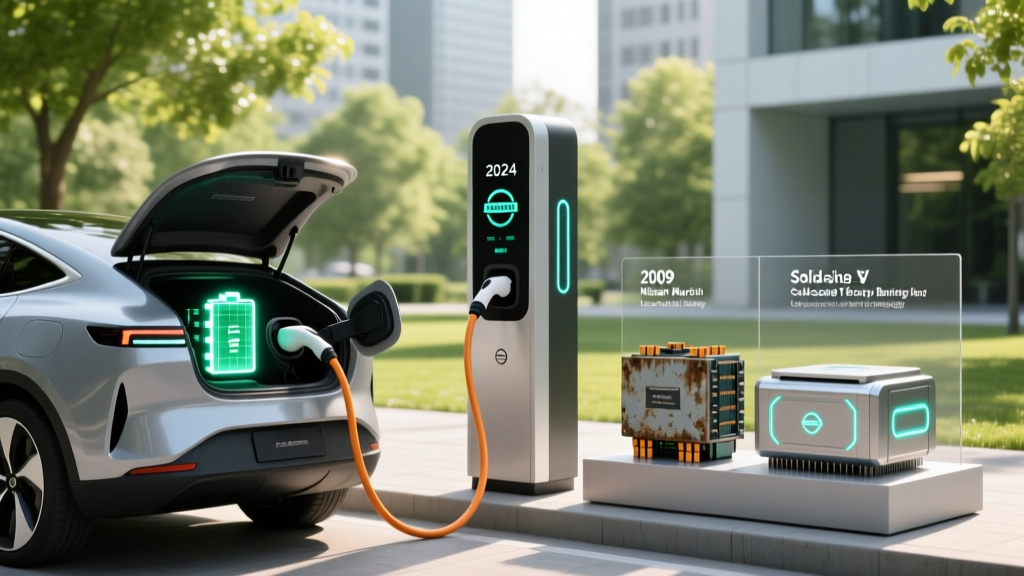
If you've searched for a 09 Nissan Murano battery, you're likely dealing with a familiar scenario: the 12V lead-acid battery in a 2009 Nissan Murano is dying and needs replacement — typically a Group 35 or 24F unit costing $150–$250 at any auto parts store. That's a straightforward, conventional maintenance item.
But if you're reading this on an EV publication, you may also be asking a bigger question: How do modern electric vehicle traction batteries compare in longevity, cost, and reliability to the simple 12V batteries we've replaced for decades? And more practically: Should battery replacement fear keep me from buying an EV?
This guide answers those questions with hard data — chemistry trade-offs, degradation curves, warranty terms, and real replacement costs — so you can evaluate EV battery ownership with the same clear-eyed calculus you'd apply to any major vehicle component.
The 09 Nissan Murano Battery: A Baseline for Comparison
The 2009 Nissan Murano uses a conventional 12V lead-acid battery (typically 550–650 CCA) to start its 3.5L V6 engine and power accessories. Here's what ownership looks like:
- Replacement cost: $150–$250 (battery only)
- Typical lifespan: 3–5 years
- Labor: 10 minutes, DIY-friendly
- Warranty: 2–3 years free replacement
Over a 15-year vehicle life, you might buy three or four of these batteries — totaling $600–$1,000 in maintenance. Nobody fears this cost because it's predictable, small, and routine.
Modern EV traction batteries are a fundamentally different component: they're the single most expensive part of the vehicle, store 60–130 kWh of energy, and are designed to last the life of the car. Let's examine what that actually means in practice.
EV Battery Chemistry: LFP vs. NMC/NCA Explained
Not all EV batteries are the same. Two dominant chemistries power nearly every EV on the road today, and the choice between them affects range, longevity, cold-weather performance, and cost.
| Attribute | LFP (Lithium Iron Phosphate) | NMC/NCA (Nickel Manganese Cobalt / Nickel Cobalt Aluminum) |
|---|---|---|
| Energy Density | Lower (~160 Wh/kg cell-level) | Higher (~250–300 Wh/kg cell-level) |
| Typical Range Impact | Shorter range for same pack weight | Longer range for same pack weight |
| Cycle Life | 3,000–5,000+ cycles | 1,000–2,000 cycles |
| Cold Performance | Moderate range loss in freezing temps (15–30%) | Better cold performance with active thermal management |
| Cost per kWh | Lower ($80–$100/kWh at pack level) | Higher ($110–$140/kWh at pack level) |
| Recommended Daily SoC | Can charge to 100% daily | Best kept at 80% for daily use |
| Common In | Tesla Model 3/Y RWD, Ford Mustang Mach-E Select, BYD models | Long-range/performance trims, Hyundai Ioniq 5/6, Rivian, Lucid |
The practical takeaway: If you prioritize longevity and daily charging convenience (charging to 100% without worry), LFP is the stronger choice. If you need maximum range for road trips or live in a very cold climate where energy density matters, NMC/NCA delivers. Neither is universally "better" — it depends on your driving pattern.
According to industry data tracked by BloombergNEF, LFP market share in global EV batteries surpassed 40% by 2025, driven by its cost advantage and superior cycle life.
How Long Do EV Batteries Actually Last?
This is the question that dominates EV purchase decisions. The answer, backed by fleet data and manufacturer warranty structures: most EV batteries outlast the vehicles they're installed in.
Here's what real-world degradation data shows:
Typical EV Battery Degradation Curve
Based on aggregated fleet data from Recurrent Auto, Geotab, and manufacturer reports:
- Year 1 / 15,000 miles: ~2–3% capacity loss (initial formation loss)
- Year 3 / 45,000 miles: ~5–7% total loss
- Year 5 / 75,000 miles: ~7–10% total loss
- Year 8 / 120,000 miles: ~10–15% total loss
- Year 10 / 150,000 miles: ~12–18% total loss (varies significantly by chemistry and thermal management)
To make this concrete: a 2026 Tesla Model Y Long Range with an EPA-rated 320 miles of range and an NMC battery might realistically deliver ~275–285 miles of range at year 8. That's still eminently usable — not a "dead" battery by any measure.
Critically, degradation is non-linear. Most capacity loss occurs in the first 1–2 years, then the curve flattens significantly. A battery that has lost 8% by year 4 is not on track to lose 16% by year 8 — it will likely lose only 3–5% more over the next four years.
LFP batteries tend to show slower long-term degradation, though they may exhibit slightly steeper initial loss. Tesla's LFP-equipped Model 3 RWD vehicles have shown degradation rates of approximately 5–8% over 100,000 miles in fleet data.
What Does the EV Battery Warranty Cover?
Federal law mandates that EV battery warranties cover a minimum of 8 years / 100,000 miles (10 years / 150,000 miles in CARB states including California, New York, Massachusetts, and others). Every major manufacturer meets or exceeds this baseline.
| Manufacturer | Warranty Period | Capacity Retention Threshold |
|---|---|---|
| Tesla (Model 3/Y LFP) | 8 yr / 120,000 mi | 70% of original capacity |
| Tesla (Model 3/Y LR/Perf NMC) | 8 yr / 120,000 mi | 70% of original capacity |
| Hyundai / Kia (E-GMP platform) | 10 yr / 100,000 mi | 70% of original capacity |
| Ford (Mach-E, F-150 Lightning) | 8 yr / 100,000 mi | 70% of original capacity |
| GM (Ultium-based: Equinox EV, Blazer EV, Silverado EV) | 8 yr / 100,000 mi | 70% of original capacity |
| Rivian (R1T/R1S) | 8 yr / 175,000 mi | 70% of original capacity |
| BMW (iX, i4, i7) | 8 yr / 100,000 mi | 70% of original capacity |
What triggers a warranty claim: If your battery's usable capacity drops below the stated threshold (typically 70%) within the warranty period, the manufacturer will repair or replace modules to restore capacity above that level. This does not mean you get a brand-new battery — it means they bring you back above the threshold.
What's excluded: Damage from accidents, improper modifications, flooding, or using the battery as a stationary power source beyond V2L/V2H specifications. Normal degradation above the threshold is not a warranty event.
The warranty structure itself is informative: manufacturers would not offer 8-year/100,000-mile coverage if they expected widespread battery failures within that window. The actuarial math behind these warranties confirms that catastrophic battery failure is rare.
EV Battery Replacement Cost: When and How Much
If your battery degrades beyond the warranty threshold after the warranty expires — or if it suffers physical damage — replacement is expensive. Here's the current landscape:
| Vehicle / Pack Size | Battery Capacity | Replacement Cost Range (Parts + Labor) |
|---|---|---|
| Tesla Model 3 RWD (LFP) | ~60 kWh | $12,000–$16,000 |
| Tesla Model Y Long Range (NMC) | ~82 kWh | $16,000–$22,000 |
| Hyundai Ioniq 5 (NMC) | 77.4 kWh | $15,000–$20,000 |
| Ford F-150 Lightning Extended Range | ~131 kWh | $25,000–$35,000 |
| Chevrolet Equinox EV | ~85 kWh | $14,000–$19,000 |
| Rivian R1T (Large Pack) | ~128 kWh | $22,000–$30,000 |
Important context: These costs are comparable to replacing a transmission or engine in a conventional vehicle — a major repair that does happen but is not the norm. Data from Consumer Reports and Recurrent Auto indicates that fewer than 5% of EVs have required a full battery pack replacement within the first 10 years of ownership.
A more common (and less expensive) scenario is module-level repair. Modern battery packs are composed of individual modules. If one module fails or degrades disproportionately, a technician can replace just that module for $2,000–$5,000 rather than replacing the entire pack. Tesla, Rivian, and GM's Ultium platform are designed with modular serviceability in mind.
Looking ahead, pack-level costs continue to decline. BloombergNEF reports average lithium-ion pack prices fell below $120/kWh at the cell level in 2025, with further reductions expected as LFP adoption grows and manufacturing scales.
Factors That Accelerate (or Preserve) Battery Life
Not all miles age a battery equally. These factors have the most significant impact on long-term State of Health (SoH):
Battery Longevity Best Practices
- Avoid frequent DC fast charging above 150 kW: Occasional road-trip fast charging is fine, but daily use of high-power DC charging accelerates degradation. Level 2 home charging (7–11 kW) is gentler on cells.
- Manage State of Charge (SoC) for NMC/NCA: Set your daily charge limit to 80%. Reserve 100% charges for road trips. LFP batteries can and should be charged to 100% regularly — Tesla recommends this for calibration.
- Avoid prolonged storage at extreme SoC: Don't leave an NMC vehicle at 100% or below 10% for weeks. If storing, aim for 50% SoC.
- Precondition before fast charging: Use your vehicle's navigation to route to a DC fast charger — this triggers battery preconditioning, warming the pack to optimal temperature for faster charging and less stress.
- Minimize exposure to extreme heat: Park in shade or a garage when possible. Sustained ambient temperatures above 95°F with a high SoC accelerates calendar degradation. Active thermal management systems (liquid cooling) mitigate this significantly — vehicles without it (some older or budget models) are more vulnerable.
- Don't obsess over regenerative braking settings: Regen current is well within safe charge C-rates. It does not meaningfully accelerate degradation.
The single highest-impact habit: home Level 2 charging with an 80% daily limit (for NMC) is the gold standard for battery longevity. Fleet data consistently shows that vehicles primarily charged at home on Level 2 degrade slower than those reliant on public DC fast charging.
How to Check Your EV Battery Health (State of Health)
State of Health (SoH) is the percentage of original capacity your battery can still hold. A new battery is 100% SoH; a battery that can only hold 85 kWh of its original 100 kWh is at 85% SoH.
Methods for checking SoH:
- In-vehicle display: Some vehicles (Tesla via the service menu, Hyundai/Kia via the infotainment system, BMW) display estimated battery health or degradation percentage directly. Tesla's approach: navigate to Service > Battery Health in the app or vehicle screen.
- OBD-II diagnostic tools: Devices like the OBDLink SX combined with apps such as EV Bat Mon or LeafSpy (for Nissan Leaf) can read the Battery Management System (BMS) directly and report SoH, cell voltage variance, and temperature data.
- Manufacturer service centers: Any authorized dealer can pull a detailed battery health report during routine service. Request this if you're evaluating a used EV purchase.
- Third-party services: Companies like Recurrent Auto offer free battery health reports that track your degradation over time and compare it to similar vehicles in their fleet. This is particularly useful for establishing a baseline when buying used.
When buying a used EV, always verify SoH before purchase. A 2020 Model 3 Long Range at 88% SoH with 55,000 miles is a healthy battery. One at 78% SoH with the same mileage may indicate heavy DC fast charging or exposure to extreme conditions — and could signal future warranty eligibility.
Emerging Battery Technology: What's Next (and When)
Several next-generation battery technologies are in development. It's important to separate what's real from what's still years away:
Solid-state batteries replace the liquid electrolyte with a solid material, promising higher energy density, faster charging, and improved safety. Toyota has announced a solid-state battery targeting 2027–2028 production, initially in limited volumes for premium models. Samsung SDI and QuantumScape are also advancing prototypes. However, manufacturing scalability remains unproven at automotive volumes. Realistic timeline: limited production 2028–2030, mainstream adoption 2032+.
Silicon anode batteries replace graphite anodes with silicon, increasing energy density by 20–40%. Sila Nanotechnologies and Group14 are supplying early production cells. These are closer to market — expect them in premium EVs by 2027–2028. They improve range without fundamentally changing the charging experience.
Sodium-ion batteries use abundant sodium instead of lithium, reducing cost and supply-chain risk. CATL has begun production in China for lower-range urban EVs. Energy density is significantly lower than LFP, making them unsuitable for long-range vehicles but viable for budget city cars. US market availability: 2028+ at earliest.
None of these technologies should factor into a 2026 purchase decision. Current lithium-ion batteries (both LFP and NMC) are mature, well-understood, and supported by a growing service infrastructure. Waiting for solid-state is waiting for a technology that won't be widely available or affordable for years.
EV Battery FAQ
How long do EV batteries last in years and miles?
Most modern EV batteries retain 80–88% of original capacity at 150,000 miles or 10 years. With proper care (Level 2 charging, 80% daily SoC for NMC), many will exceed 200,000 miles before dropping below the 70% warranty threshold. LFP batteries may last longer due to superior cycle life.
How much does an EV battery cost to replace?
Full pack replacement ranges from $12,000 for smaller packs (60 kWh) to $35,000 for large packs (130+ kWh). However, module-level repairs cost $2,000–$5,000, and fewer than 5% of EVs require full replacement within 10 years. Most batteries outlast the vehicle.
What does the EV battery warranty cover?
Federal minimum: 8 years / 100,000 miles. Coverage triggers if capacity drops below ~70% of original. In CARB states, coverage extends to 10 years / 150,000 miles. Warranties cover defects and excessive degradation, not physical damage from accidents or misuse.
How do I check and maximize my EV battery health?
Check SoH via your vehicle's service menu, an OBD-II diagnostic tool, or a third-party service like Recurrent Auto. Maximize longevity by charging primarily on Level 2 at home, limiting NMC batteries to 80% daily SoC, preconditioning before DC fast charging, and avoiding prolonged high-SoC storage in extreme heat.
LFP vs NMC — which battery chemistry is better?
LFP offers longer cycle life (3,000–5,000 cycles), lower cost, and the convenience of daily 100% charging — ideal for commuters and daily drivers. NMC provides higher energy density for longer range and better cold-weather performance — better for road-trip-heavy drivers and cold climates. Neither is universally superior; the right choice depends on your driving pattern.
Does fast charging damage my EV battery?
Occasional DC fast charging does not meaningfully accelerate degradation. Daily use of high-power (150+ kW) fast charging can increase degradation by 2–4% over the battery's life compared to Level 2 charging. Modern battery management systems and preconditioning mitigate most of the thermal stress. For daily use, Level 2 home charging is optimal.
Will my EV battery need replacing before I sell the car?
Statistically, no. The average American keeps a vehicle 8.4 years and drives ~14,000 miles per year (approximately 118,000 miles total). Most EV batteries at that age and mileage retain 85–90% of capacity — well above warranty thresholds and still providing practical daily range.
Whether you're replacing a $180 lead-acid battery in a 2009 Nissan Murano or evaluating a $45,000 EV with an 82 kWh NMC pack, the calculus is the same: understand the component's lifespan, its failure cost, and how your habits affect it. The data consistently shows that modern EV batteries are durable, well-warrantied, and — for the vast majority of owners — a non-event in the ownership experience.