If you've searched for a 08 Chevy Malibu battery, you're likely dealing with a familiar scenario: the 12V lead-acid battery in a 2008 Chevrolet Malibu has died after 3–5 years, and you're facing a $150–$250 replacement. That's the rhythm of conventional car ownership — swap the battery every few winters and move on.
But if you're researching EVs and you've landed here because "battery" means something very different in the electric-vehicle world, this guide is for you. The high-voltage traction battery in a modern EV is a fundamentally different component: it's a 60–100+ kWh lithium-ion pack designed to last the life of the vehicle. Let's break down exactly how EV batteries compare to the humble 12V unit in your old Malibu, what degradation actually looks like with real data, and what you'll pay if replacement ever becomes necessary.
The 08 Chevy Malibu Battery vs. an EV Traction Battery: Two Completely Different Beasts
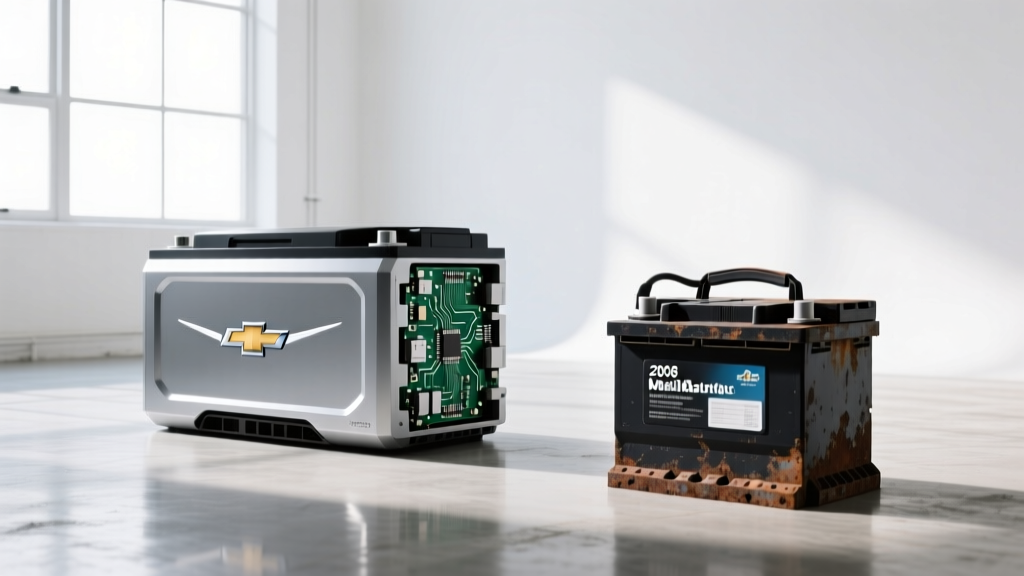
The 2008 Chevrolet Malibu uses a standard Group 86 or 121R lead-acid 12V battery rated at roughly 0.7–0.8 kWh of energy storage. It cranks a 2.4L four-cylinder or 3.6L V6 engine and powers accessories. It weighs about 35–45 lbs and costs around $150–$250 at an auto parts store.
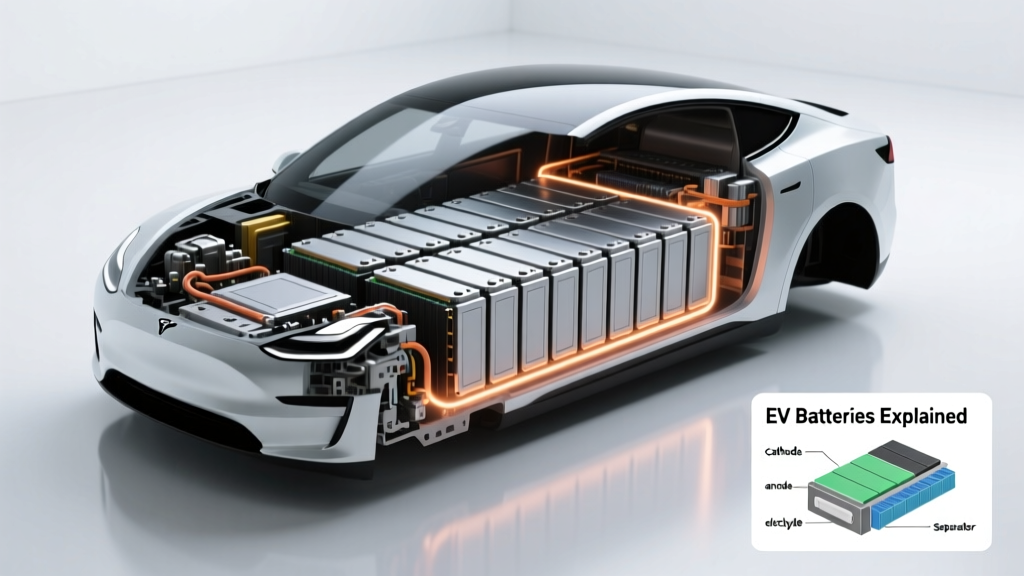
A modern EV traction battery — say the 82 kWh pack in a 2026 Tesla Model Y — stores roughly 100 times more energy, weighs 900–1,100 lbs, and costs $10,000–$16,000 to replace. It's not a consumable you swap every few years; it's the most expensive single component in the vehicle, engineered for 15–20 years of service.
| Attribute | 08 Chevy Malibu 12V Battery | 2026 EV Traction Battery (Typical) |
|---|---|---|
| Chemistry | Lead-acid (flooded or AGM) | Lithium-ion (NMC or LFP) |
| Capacity | ~0.7 kWh | 60–100+ kWh usable |
| Voltage | 12V | 400V–800V nominal |
| Weight | 35–45 lbs | 700–1,200 lbs |
| Typical Lifespan | 3–5 years | 15–20+ years |
| Replacement Cost | $150–$250 | $10,000–$20,000+ |
| Warranty | 2–4 years | 8 years / 100,000 miles (federal minimum) |
Note: EVs also have a separate 12V auxiliary battery (or DC-DC converter) for accessories and computers. That's the equivalent of the Malibu's battery — and yes, it still needs replacing every 4–6 years. This guide focuses on the high-voltage traction battery.
How Long Do EV Batteries Actually Last? The Degradation Data
The short answer: far longer than most buyers fear. Real-world fleet data consistently shows modern lithium-ion EV batteries losing roughly 5–10% of their original capacity over the first 100,000 miles, with degradation slowing significantly after the initial break-in period.
Real-World Degradation Data Points (Fleet & Long-Term Test Sources):
- Tesla Model 3/Y (NMC, 2018–2024): Average ~12% degradation at 100,000 miles, per Tesla's 2024 Impact Report and third-party fleet data from Recurrent Auto.
- Chevrolet Bolt EV/EUV (NMC, 2017–2023): ~6–8% loss at 80,000 miles; some early 2017 models saw higher loss tied to thermal management limitations.
- Nissan Leaf (NMC, passive air cooling): 15–25% loss at 80,000–100,000 miles — a cautionary example of why active liquid cooling matters.
- Tesla Model S/X (2013–2020): ~10–15% at 150,000 miles; some high-mileage taxis report 20%+ at 250,000+ miles but still operational.
- Hyundai/Kia E-GMP platform (Ioniq 5, EV6): Early data (30,000–50,000 miles) shows <5% degradation, aided by advanced thermal management.
- LFP-equipped vehicles (Tesla Model 3 RWD, BYD): Anecdotal and fleet data suggests <5% loss at 100,000 miles, consistent with LFP's superior cycle life.
Sources: Recurrent Auto, Tesla Impact Report, fleet operator data.
The degradation curve is not linear. Most packs experience a steeper drop in the first 10,000–20,000 miles (the "break-in" phase where the solid electrolyte interface stabilizes), then flatten to a very gradual decline of roughly 1–2% per year under normal use. At this rate, most EV batteries will retain 75–85% of their original capacity at 150,000 miles — well within the usable life of the vehicle.
LFP vs NMC/NCA: Which Battery Chemistry Is Better?
Not all lithium-ion batteries are the same. The two dominant chemistries in 2026 EVs are NMC (nickel-manganese-cobalt, sometimes NCA — nickel-cobalt-aluminum) and LFP (lithium iron phosphate). Each has distinct trade-offs that affect range, longevity, cost, and cold-weather performance.
| Attribute | NMC / NCA | LFP |
|---|---|---|
| Energy Density | Higher (~250–300 Wh/kg cell-level) | Lower (~160–200 Wh/kg) |
| Range per kg of Battery | More miles for same weight | Fewer miles; heavier pack for same range |
| Cycle Life | ~1,000–2,000 full cycles | ~3,000–5,000+ full cycles |
| Calendar Life | Good (15+ years typical) | Excellent (20+ years projected) |
| Cold Performance | Better in sub-freezing temps | More range loss in cold; slower cold charging |
| Charging to 100% | Not recommended daily (accelerates degradation) | Can and should charge to 100% regularly (BMS calibration) |
| Cost | Higher (cobalt/nickel commodity exposure) | Lower (iron and phosphate are cheap and abundant) |
| Thermal Stability | Good with active cooling | Excellent; inherently more stable |
| Common In (2026) | Tesla Model Y LR, Hyundai Ioniq 5 LR, Ford F-150 Lightning ER | Tesla Model 3 RWD, Tesla Model Y RWD, BYD models, Ford Mustang Mach-E SR |
The practical takeaway: If you prioritize maximum range and live in a cold climate, NMC/NCA is typically the better fit. If you want maximum longevity, lower cost, and don't mind slightly less range, LFP is increasingly compelling — especially for daily commuters who charge at home. Tesla's decision to shift all standard-range Model 3 and Model Y vehicles to LFP reflects this calculus.
What Does the EV Battery Warranty Actually Cover?
U.S. federal law mandates a minimum battery warranty of 8 years / 100,000 miles for all EVs sold in the United States (10 years / 150,000 miles in California and states that follow CARB standards). But the details matter — specifically the capacity retention threshold.
| Manufacturer | Warranty Term | Capacity Threshold | Notes |
|---|---|---|---|
| Tesla | 8 yr / 120,000 mi (Model 3/Y); 8 yr / 150,000 mi (S/X) | 70% | Longest mileage coverage in class for S/X |
| Hyundai / Kia | 10 yr / 100,000 mi | 70% | Best-in-class duration; applies to Ioniq 5, EV6, EV9 |
| Ford | 8 yr / 100,000 mi | 70% | Covers Mustang Mach-E, F-150 Lightning |
| GM (Chevrolet) | 8 yr / 100,000 mi | 60% (Bolt); 70% (Ultium models) | Bolt's lower threshold drew criticism; Equinox EV / Blazer EV use 70% |
| BMW | 8 yr / 100,000 mi | 70% | i4, iX, i7 covered |
| Rivian | 8 yr / 175,000 mi (R1T); 8 yr / 120,000 mi (R1S) | 70% | R1T pickup gets highest mileage warranty |
What triggers a warranty claim: If your battery's usable capacity drops below the stated threshold (typically 70% of original) within the warranty period, the manufacturer must repair or replace it at no cost. In practice, this means a pack originally rated at 300 miles of EPA range would need to fall below ~210 miles of range — a level of degradation that current data suggests is unlikely within the warranty window for liquid-cooled packs.
The warranty covers defects and abnormal degradation but not damage from accidents, flooding, or aftermarket modifications. Always read the fine print in your owner's manual for exclusions.
How Much Does an EV Battery Replacement Cost?
This is the question that generates the most anxiety — and the most misinformation. Let's look at actual figures.
| Vehicle | Pack Size | Estimated Replacement Cost | Context |
|---|---|---|---|
| Tesla Model 3 (LFP) | ~60 kWh | $12,000–$14,000 | Out-of-warranty; third-party shops may offer less |
| Tesla Model Y LR (NMC) | ~82 kWh | $14,000–$18,000 | Most common pack in the US fleet |
| Chevrolet Bolt EV | 65 kWh | $14,000–$16,000 | Many were replaced under recall/warranty |
| Ford F-150 Lightning ER | ~131 kWh | $20,000–$30,000+ | Largest consumer pack; cost proportional to kWh |
| Hyundai Ioniq 5 | 77.4 kWh | $13,000–$17,000 | E-GMP platform; module-level repair may be possible |
| Porsche Taycan | 93.4 kWh | $25,000–$33,000 | Premium pricing; Porsche offers module replacement |
The critical context most articles omit: the vast majority of EV batteries never need replacement. Data from Recurrent Auto and manufacturer warranty claims show that fewer than 2–3% of EV batteries are replaced under warranty, and out-of-warranty failures in the first 15 years remain rare. For comparison, you'll almost certainly spend more on brake jobs, tires, and suspension work over the same period than you would on a battery replacement — and the battery is far less likely to fail.
When replacement is needed, costs are dropping. Battery pack prices fell from ~$400/kWh in 2010 to roughly $120–$140/kWh in 2025–2026 (per BloombergNEF data). Module-level repair — replacing individual bad modules rather than the entire pack — is increasingly available through specialized EV shops and can cost $2,000–$6,000 instead of a full pack swap.
Factors That Affect EV Battery Life (and What You Can Control)
Not all miles are created equal when it comes to battery wear. Here are the primary factors, ranked by impact:
Battery Care Best Practices — What the Data Actually Supports:
- ✅ Avoid sustained 100% state of charge (NMC/NCA only): For NMC/NCA packs, daily charging to 80% is ideal. Charging to 100% is fine for road trips — just don't let the car sit at 100% for days. LFP packs are different: charge to 100% at least weekly for BMS calibration.
- ✅ Minimize DC fast charging when possible: Frequent 150+ kW DC fast charging generates heat that accelerates degradation. Use Level 2 home charging as your daily routine; reserve DCFC for road trips. Data from Recurrent shows that vehicles that DCFC >3x/week degrade ~2–3% more over 100K miles than those that primarily use Level 2.
- ✅ Use preconditioning: Most EVs let you precondition (warm) the battery before fast charging or departure. This brings the pack to optimal temperature, reducing stress and improving charge speed. Always precondition in cold weather.
- ✅ Avoid extreme heat exposure when possible: Parking in shade or a garage during 100°F+ summer days reduces calendar degradation. Liquid-cooled packs handle this better than passively cooled ones (looking at you, older Nissan Leafs).
- ✅ Don't baby it too much: Storing an NMC pack at exactly 50% for months is marginally better than 80%, but the difference is small. Drive your EV normally — the BMS and thermal management are doing a lot of work behind the scenes to protect the cells.
- ❌ Don't let the pack sit at 0% or near-0% for extended periods: Deep discharge can cause copper dissolution in the anode, leading to permanent damage. If storing, leave it at ~50%.
How to Check Your EV Battery's State of Health (SoH)
State of Health (SoH) is the percentage of your battery's original capacity that remains usable. Here's how to monitor it:
In-vehicle displays: Many EVs show estimated range and efficiency, but few display SoH directly. Tesla's service mode (accessible via the software menu on recent models) shows battery health metrics. Hyundai/Kia's infotainment system includes an EV battery diagnostics page. The Chevrolet Bolt displays a "battery capacity" bar graph in the energy settings.
OBD-II dongles and apps: Tools like LeafSpy (Nissan Leaf), Scan My Tesla, and OBDeleven (VW/Audi) can read detailed battery telemetry including SoH, individual cell voltages, and temperature data via the OBD-II port.
Third-party services: Companies like Recurrent offer free battery health reports by connecting to your vehicle's telematics data. Some dealerships can pull a detailed battery health report during service visits.
The DIY range test: Charge to 100% (on an LFP) or note the displayed range at your typical charge level, then compare to the EPA-rated range adjusted for your SoC. If your fully charged Model 3 LR shows 280 miles when the EPA rating is 341, that's roughly 82% SoH. Factor in temperature — cold weather temporarily reduces displayed range without affecting actual SoH.
What's Coming Next: Solid-State and Silicon-Anode Batteries
Next-generation battery technologies are frequently hyped, so here's a grounded assessment of what's realistic as of 2026:
Solid-state batteries replace the liquid electrolyte with a solid material, promising higher energy density (~400+ Wh/kg), faster charging, and improved safety. Toyota has announced limited production for 2027–2028, and Samsung SDI is targeting 2027. However, manufacturing scalability and cost remain unsolved challenges. Expect solid-state to appear first in premium/low-volume vehicles, not mass-market EVs, and not before 2028–2030 at the earliest for broader availability.
Silicon-anode batteries (used in limited form in the Porsche Taycan and some Mercedes EQ models via Sila Nanotechnologies) offer 10–20% energy density improvement over conventional graphite anodes. This technology is already in production in select vehicles and will expand through 2026–2028. It's an incremental improvement, not a revolution.
Sodium-ion batteries are emerging as a low-cost alternative for entry-level EVs, particularly from Chinese manufacturers like BYD and CATL. They offer lower energy density but dramatically lower material costs. Expect these in budget-oriented EVs by 2027–2028, primarily in markets outside the US initially.
The practical advice: don't delay an EV purchase waiting for next-gen batteries. Current lithium-ion technology is mature, reliable, and backed by extensive warranty coverage. The improvements coming are incremental, not transformative enough to justify waiting years.
Frequently Asked Questions
How long do EV batteries last in years and miles?
Based on fleet data from Recurrent Auto and manufacturer reports, most modern liquid-cooled EV batteries retain 75–85% of their original capacity at 150,000 miles and 10–15 years of age. Many will outlast the vehicle itself. The Nissan Leaf's passively cooled pack is a notable exception, showing higher degradation rates.
How much does an EV battery cost to replace in 2026?
Full pack replacement ranges from roughly $12,000 for a 60 kWh LFP pack (Tesla Model 3 RWD) to $30,000+ for a 130+ kWh pack (Ford F-150 Lightning Extended Range, Porsche Taycan). Module-level repairs can cost $2,000–$6,000. Costs continue to decline as cell prices fall. However, the vast majority of EV batteries never need replacement during typical ownership.
What does the federal battery warranty mandate require?
U.S. federal law requires a minimum 8-year / 100,000-mile warranty on EV traction batteries (10 years / 150,000 miles in CARB states). The warranty guarantees a minimum capacity retention — typically 70% of original capacity. If your battery degrades below that threshold within the warranty period, the manufacturer must repair or replace it at no charge.
Is LFP or NMC better for daily driving?
For daily commuting with home charging, LFP is arguably better: it tolerates 100% daily charging, lasts more cycles, costs less, and is more thermally stable. NMC is preferable if you need maximum range, frequently drive in very cold climates, or take regular long road trips where energy density matters. Neither is universally "better" — it depends on your use case.
Does fast charging damage my EV battery?
Frequent DC fast charging (especially at 150+ kW) accelerates degradation modestly — roughly 2–3% additional capacity loss over 100,000 miles compared to primarily Level 2 charging, per Recurrent data. Occasional fast charging on road trips is perfectly fine. The key is to use Level 2 as your daily charging method and precondition the battery before fast charging sessions.
What happened to the 08 Chevy Malibu — can it be converted to electric?
The 2008 Chevrolet Malibu was a conventional gasoline sedan. While aftermarket EV conversions exist, they typically cost $15,000–$30,000+ and result in limited range (50–100 miles) with no warranty, no regenerative braking optimization, and no access to the federal EV tax credit. For virtually all buyers, purchasing a modern production EV is more practical, safer, and more cost-effective.