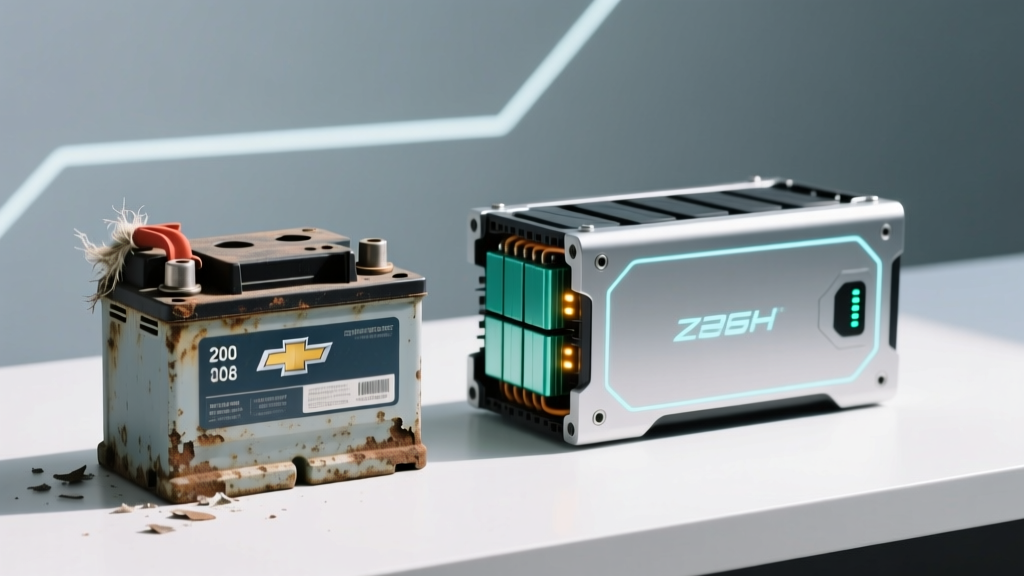
If you're searching for an 08 Chevy Cobalt battery, you're almost certainly dealing with a conventional 12-volt lead-acid replacement — a Group 47 or H5 battery that powers your starter, lights, and accessories. That's a straightforward $150–$250 fix at any auto parts store. But if that search brought you here, you might also be curious about how modern electric vehicle batteries compare: the high-voltage lithium-ion traction packs that actually propel EVs down the road.
This guide bridges both worlds. We'll clarify the 12V battery your Cobalt needs, then provide a deep dive into EV traction battery chemistry, degradation, warranty coverage, replacement costs, and care — the data-driven breakdown every EV shopper or owner should have.
The 08 Chevy Cobalt Battery: What You Actually Need
The 2008 Chevrolet Cobalt uses a standard 12V lead-acid battery, typically a Group 47 (H5) size. This battery has nothing to do with electric propulsion — it's the same type found in millions of gas-powered cars. Here are the specs that matter:
- Group Size: 47 / H5
- Cold Cranking Amps (CCA): 570–650 CCA recommended
- Typical Cost: $140–$250 (AGM variants on the higher end)
- Expected Lifespan: 3–5 years depending on climate and use
- Warranty: Usually 2–3 years free replacement, prorated up to 5 years
This is a commodity part. Any auto parts retailer stocks it, and installation takes about 10 minutes. Now let's contrast this with the high-voltage traction batteries in modern EVs — a fundamentally different technology with different economics.
EV Traction Batteries vs. 12V Batteries: The Critical Distinction
Every EV on the road — from a Nissan Leaf to a Tesla Model Y — actually carries two batteries:
- 12V auxiliary battery: Powers lights, infotainment, door locks, and control computers. Often a small lead-acid or lithium 12V unit. Similar to your Cobalt's battery.
- High-voltage traction battery: The large lithium-ion pack (typically 40–120 kWh) that stores energy for the electric motor(s) and determines your vehicle's range.
When people ask "how long does an EV battery last?" or "how much does an EV battery cost to replace?" — they're asking about the traction battery. That's what we'll focus on for the rest of this guide.
LFP vs. NMC/NCA: EV Battery Chemistry Explained
Modern EV traction batteries primarily use one of two lithium-ion chemistries. Understanding the trade-offs matters because it affects your range, longevity, and charging habits.
| Attribute | LFP (Lithium Iron Phosphate) | NMC / NCA (Nickel Manganese Cobalt / Nickel Cobalt Aluminum) |
|---|---|---|
| Energy Density | Lower (~160 Wh/kg cell-level) | Higher (~230–260 Wh/kg cell-level) |
| Cycle Life | 3,000–5,000+ full cycles | 1,000–2,000 full cycles |
| Cold-Weather Performance | Weaker; greater range loss below 32°F | Better low-temp discharge capability |
| Charging to 100% | Recommended regularly (helps BMS calibration) | Daily limit of 80% preferred for longevity |
| Cost | Lower — no cobalt or nickel | Higher — commodity-priced metals |
| Thermal Stability | Excellent — inherently safer | Good but requires more active thermal management |
| Common in 2025–2026 Models | Tesla Model 3/Y RWD, Ford Mustang Mach-E Select (standard range), BYD models | Hyundai Ioniq 5, Kia EV6, Chevy Equinox EV, most long-range/AWD trims |
Which is better? Neither is universally superior. LFP wins on longevity, cost, and safety — ideal for daily commuters who charge at home and don't need maximum range. NMC/NCA wins on energy density and cold-weather performance — better for drivers who need 300+ miles of range or live in northern climates. For most buyers in 2026, LFP's cycle-life advantage makes it the pragmatic choice for a vehicle you plan to keep 10+ years.
How Long Do EV Batteries Last? Degradation Data
EV battery degradation follows a predictable curve: steeper loss in the first year or two, then a long, slow plateau. Based on aggregated fleet data and studies from sources like Geotab's battery health research, here's what real-world degradation looks like:
- Year 1: ~2–4% capacity loss (initial formation)
- Year 3: ~5–8% total loss
- Year 5: ~8–12% total loss
- Year 8: ~10–15% total loss
- Year 10: ~12–18% total loss
- 150,000–200,000 miles: Most packs retain 80–90% of original capacity
Note: Liquid-cooled packs (Tesla, Hyundai E-GMP, GM Ultium) consistently outperform passively cooled packs (early Nissan Leaf) by 3–6 percentage points at the same age.
For context, an EV with 250 miles of EPA range that loses 12% over 8 years still delivers ~220 miles — more than adequate for most daily driving. The vast majority of EV batteries outlast the vehicle's body, suspension, and interior. Complete failure before 150,000 miles is rare and usually covered under warranty.
EV Battery Warranty Coverage: What's Protected
Federal regulations mandate a minimum EV battery warranty of 8 years / 100,000 miles (10 years / 150,000 miles in CARB states including California, New York, and others). Most manufacturers meet or exceed this baseline. Here's how major warranties compare for 2025–2026 models:
| Manufacturer | Warranty Period | Capacity Retention Threshold |
|---|---|---|
| Tesla (Model 3/Y RWD — LFP) | 8 yr / 100,000 mi | 70% minimum |
| Tesla (Model 3/Y Long Range — NMC) | 8 yr / 120,000 mi | 70% minimum |
| Hyundai / Kia (E-GMP platform) | 10 yr / 100,000 mi | 70% minimum |
| GM (Ultium — Equinox EV, Blazer EV) | 8 yr / 100,000 mi | 70% minimum |
| Ford (Mustang Mach-E, F-150 Lightning) | 8 yr / 100,000 mi | 70% minimum |
| Rivian (R1T, R1S) | 8 yr / 175,000 mi | 70% minimum |
The warranty threshold matters: if your battery's measured capacity drops below 70% of its original kWh within the warranty period, the manufacturer must repair or replace it at no cost. In practice, very few owners hit this threshold — modern thermal management has made severe degradation uncommon.
EV Battery Replacement Cost: What to Budget
If your battery fails outside of warranty — or you're buying a used EV with high mileage — replacement cost is a legitimate concern. Here's the current landscape for out-of-warranty replacements:
| Vehicle / Pack Size | Battery Capacity | Estimated Replacement Cost | Typical Need Timeline |
|---|---|---|---|
| Nissan Leaf (40 kWh) | 40 kWh | $6,500–$9,000 | 10–15 years / 150k+ mi |
| Tesla Model 3 RWD (LFP, ~57 kWh) | ~57 kWh | $8,000–$12,000 | 15+ years / 200k+ mi |
| Hyundai Ioniq 5 (77.4 kWh) | 77.4 kWh | $12,000–$16,000 | 15+ years / 200k+ mi |
| Ford F-150 Lightning (131 kWh ext.) | 131 kWh | $18,000–$25,000 | 15+ years / 200k+ mi |
| Chevy Bolt EV / EUV (65 kWh) | 65 kWh | $9,000–$14,000 | 12–15 years / 175k+ mi |
Important context: most EV owners never need a full battery replacement. The pack typically outlasts other major components. When replacement is needed, individual module repair (replacing only degraded cells) is increasingly available for $2,000–$5,000 instead of a full pack swap. As battery production scales, per-kWh costs continue to decline — down from ~$1,100/kWh in 2010 to roughly $115–$130/kWh at the cell level in 2025, per BloombergNEF battery pricing surveys.
Maximizing Battery Life: Care Habits That Work
Your daily habits measurably impact long-term battery health. Here's what the data supports:
- Limit DC fast charging to road trips. Frequent 150+ kW sessions accelerate degradation by ~1–3% over 5 years compared to Level 2-only charging. Occasional fast charging is fine; daily fast charging is not ideal.
- Keep daily State of Charge between 20–80% for NMC/NCA packs. LFP packs should be charged to 100% at least once weekly for accurate BMS calibration.
- Precondition in cold weather. Warming the battery before driving (most EVs do this automatically when navigating to a charger) reduces stress and preserves range.
- Avoid prolonged storage at 100% or below 10%. If leaving the car for 2+ weeks, set charge to ~50%.
- Park in shade or a garage when possible. Sustained battery temperatures above 95°F accelerate calendar aging.
- Use regenerative braking in moderate mode in cold weather to avoid high-current regen into a cold battery.
Monitoring Battery Health: How to Check State of Health (SoH)
State of Health (SoH) is the percentage of original capacity your battery currently holds. Here's how to check it:
- In-vehicle displays: Tesla, Hyundai, and BMW include battery health indicators in the service menu or app. Tesla's app shows estimated range vs. original, from which you can calculate SoH.
- OBD-II diagnostic tools: Devices like the OBDeleven or Leaf Spy Pro (Nissan Leaf) read the battery management system directly for precise SoH percentages.
- Dealer diagnostics: Any authorized service center can run a full battery health report, typically during warranty inspections.
- Third-party services: Companies like Recurrent Auto provide battery health reports based on telematics data — useful when evaluating a used EV purchase.
For a used EV buyer, always request or run a battery health check before purchase. A pack showing 90%+ SoH at 50,000 miles is in excellent shape; below 85% at that mileage warrants investigation.
Emerging Battery Technology: What's Next
Several next-generation technologies are in development, but none are commercially available in production vehicles as of 2026:
- Solid-state batteries: Promise 30–50% higher energy density and faster charging. Toyota, Samsung SDI, and QuantumScape are targeting limited production in 2027–2029 vehicles. Realistic widespread availability: 2030+.
- Silicon-dominant anodes: Companies like Sila Nanotechnologies and Group14 are replacing graphite anodes with silicon composites, boosting energy density ~20%. Early production applications appeared in limited runs in 2025; broader adoption expected 2027–2028.
- Sodium-ion batteries: Lower cost and no lithium required, but ~30% lower energy density. CATL and BYD are deploying these in Chinese-market budget EVs; US availability is uncertain before 2028.
These are promising developments, but for anyone buying an EV today, current lithium-ion technology (LFP or NMC) is mature, well-warranted, and proven to last the life of the vehicle.
Frequently Asked Questions
How long do EV batteries last in years and miles?
Most modern EV batteries with active thermal management last 15–20 years and 200,000+ miles while retaining 80–90% of original capacity. The battery will likely outlast other major vehicle components like suspension, interior electronics, and body panels.
How much does an EV battery cost to replace?
Full pack replacement ranges from roughly $6,500 for a 40 kWh Nissan Leaf pack to $25,000 for a 131 kWh Ford F-150 Lightning pack. However, most owners never need a replacement, and module-level repairs cost significantly less ($2,000–$5,000). Prices continue declining as manufacturing scales.
What does the EV battery warranty cover?
Federal minimum is 8 years / 100,000 miles (10 yr / 150,000 mi in CARB states). Coverage applies if the battery drops below 70% of its original capacity. The manufacturer must repair or replace the pack at no cost. This covers defects and abnormal degradation, not damage from accidents or misuse.
How do I check my EV's battery health?
Use your vehicle's built-in health display (if available), an OBD-II diagnostic tool like Leaf Spy Pro, a dealer diagnostic report, or a third-party service like Recurrent Auto. Always check SoH before purchasing a used EV.
LFP vs NMC — which battery chemistry should I choose?
Choose LFP if you prioritize longevity (3,000–5,000 cycles), lower cost, and can charge to 100% regularly. Choose NMC/NCA if you need maximum range per charge, live in a cold climate, or want faster DC charging speeds. Both chemistries are well-proven in 2026 production vehicles.
Is the 08 Chevy Cobalt battery the same as an EV battery?
No. The 2008 Chevy Cobalt uses a standard 12V lead-acid battery (Group 47/H5, ~$150–$250) for starting and accessories. EV traction batteries are high-voltage lithium-ion packs (40–131 kWh, $6,500–$25,000) that propel the vehicle. They are entirely different technologies with different costs, lifespans, and purposes. Note: EVs also carry a small 12V auxiliary battery similar to the Cobalt's, but it's separate from the main traction pack.